Common Big-headed Frog

Common Big-headed Frog

Oreobates quixensis

Silhouette: Dmitry Bogdanov (vectorized by T. Michael Keesey) · PhyloPic

LCLeast ConcernNTVUENCR
Daily sighting probability ~40% · Likely
at Yasuní National Park

In 3 days ~80% in a week >90%

100 Verified sightings at Yasuní National Park From 2019 to 2026
126 In all 3 parks
November Best month
🌙 Nocturnal When it's spotted

About the Common Big-headed Frog

Oreobates quixensis, also known as the common big-headed frog, is a species of frog in the family Strabomantidae. It is found in the upper Amazon Basin in Bolivia, western Brazil, Colombia, Ecuador, and Peru. It is a very common terrestrial frog of primary and secondary tropical moist forest, also to be found in clearings, open areas and banana groves.

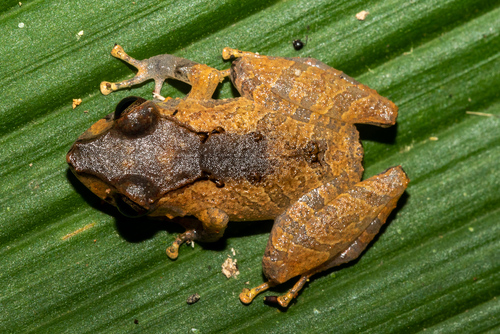
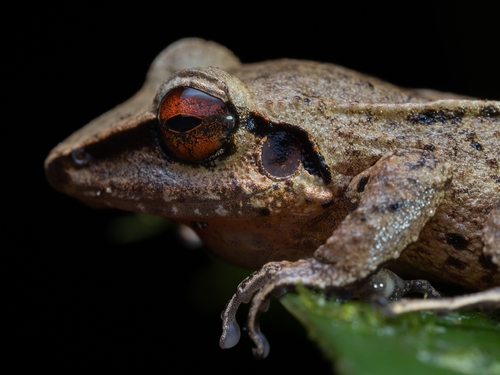
Oreobates quixensis are large among the species of the genus Oreobates with adults measuring 35–63 mm (1.4–2.5 in) in snout–vent length. The head is large and wider than long; the snout is short. The dorsum is pale brown to dark brown with purple tonalities and cream flecks; the skin is granular, with round keratinized granules and small, sparse, prominent, and enlarged warts. Breeding is by direct development. Gravid females contain 15–51 eggs.

Phylogenomic analysis in 2021 revealed that O. quixensis is closely related to Oreobates saxatilis. The study found the two species to be mutually polyphyletic, meaning individuals of one species are sometimes genetically closer to the other than to their own kind. This suggests either recent divergence, historical gene flow, or that current morphological definitions... Wikipedia →

Sounds

Advertisement call0:50

Ecuador · 2025

© Marc Anderson · XC1076523 · CC BY-NC-ND 4.0

Recording0:45

Brazil · 2021

© Marllus Rafael Almeida · iNaturalist · CC BY-NC 4.0

Global Distribution

Parks Where Found

# Park Country Daily sighting probability
1 Yasuní National Park 🇪🇨 Ecuador
~40%
2 Cuyabeno Wildlife Reserve 🇪🇨 Ecuador
~20%
3 Manu National Park 🇵🇪 Peru
~10%

Closest Relatives at Yasuní National Park

Before you go

What are the chances of seeing a Common Big-headed Frog in Yasuní National Park?

Likely

About 40% of wildlife watchers report a Common Big-headed Frog sighting in Yasuní National Park on a given day, based on 100 verified sightings from GBIF citizen-science data from 2019 to 2026. It is the 3rd most-seen of the 49 amphibians we can rate there. Over three days the chance rises to about 80%, and over a week to over 90%, if each day is a fresh chance.

When is the best time to see a Common Big-headed Frog in Yasuní National Park?

November

In that month about 60% of wildlife watchers report a Common Big-headed Frog in Yasuní National Park on a given day, against about 30% in March, July–August and December, the lowest months.

What time of day is best to see a Common Big-headed Frog?

Between 7 and 10 pm

Across all the parks we cover, that three-hour window holds the most Common Big-headed Frog sightings with a recorded time, and about 9 in 10 of them come between 6 pm and 6 am: it is mostly seen at night.

Is Yasuní National Park the best place to see a Common Big-headed Frog?

Yes

Of the 3 parks where we can rate Common Big-headed Frog sightings, Yasuní National Park has the highest daily chance: about 40%. Next come Cuyabeno Wildlife Reserve (Ecuador, about 20%) and Manu National Park (Peru, about 10%).

Which relatives of the Common Big-headed Frog live in Yasuní National Park?

Same family: Craugastoridae

The closest relatives of the Common Big-headed Frog that you can see in Yasuní National Park (family Craugastoridae, Fleshbelly and Terrestrial-breeding Frogs) are Jatun Sacha Rain Frog (about 20%), Chirping Robber Frog (about 20%) and Diadem Rain Frog (about 20%), with each one's daily chance of a sighting.

Where does the Common Big-headed Frog sighting chance come from?

GBIF citizen-science records

It is estimated from how often the Common Big-headed Frog is recorded against all the amphibians logged in Yasuní National Park (100 verified sightings from 2019 to 2026), calibrated against known sighting rates. Figures are rounded to the nearest 10% because citizen-science data supports honest approximations, not decimals, and months with records from fewer than five people show "—". How it works.

← Back to Yasuní National Park