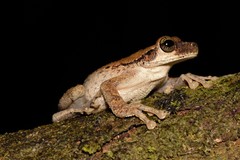
Giant Broad-headed Treefrog

Giant Broad-headed Treefrog

Osteocephalus taurinus

Silhouette: Dmitry Bogdanov (vectorized by T. Michael Keesey) · PhyloPic

LCLeast ConcernNTVUENCR
Daily sighting probability ~30% · Possible
at Yasuní National Park

In 3 days ~70% in a week ~90%

45 Verified sightings at Yasuní National Park From 2019 to 2026
175 In all 4 parks
June Best month
🌙 Nocturnal When it's spotted

About the Giant Broad-headed Treefrog

The Manaus slender-legged tree frog (Osteocephalus taurinus), also known as the giant broad-headed tree frog, is a species of frog in the family Hylidae found in Bolivia, Brazil, Colombia, Ecuador, French Guiana, Guyana, Peru, Suriname, and Venezuela. Its natural habitats are subtropical or tropical dry forest, subtropical or tropical moist lowland forest, moist savanna, rivers, intermittent freshwater marshes, and canals and ditches. It is threatened by habitat loss. It is also reported to produce bufotenin.

The adult male frog measures 71 to 92 mm long in snout-vent length and the adult female 90 to 101 mm. The male frogs have warty skin and the female frogs have smooth skin. The skin of the frog's dorsum is light bronw to dark brown in color. Some frogs have a light brown line down the middle of the back. The back legs have dark brown transverse stripes. The iris of the eye is gold in color with black reticulation. The belly is cream to whitish in color.

This frog is arboreal and nocturnal. When the male frogs sing for the female frogs, they sit on short plants or in the water. The female frog lays 2000 eggs per clutch, laid on the surface of the... Wikipedia →

Sounds

Advertisement call0:58

Ecuador · 2025

© Marc Anderson · XC1002261 · CC BY-NC-ND 4.0

Recording1:21

Suriname · 1968

© M.S. Hoogmoed · XC882825 · CC BY 4.0

Recording0:27

Brazil · 2020

© Marllus Rafael Almeida · iNaturalist · CC BY-NC 4.0

Global Distribution

Parks Where Found

# Park Country Daily sighting probability
1 Cuyabeno Wildlife Reserve 🇪🇨 Ecuador
~40%
2 Tambopata National Reserve 🇵🇪 Peru
~40%
3 Yasuní National Park 🇪🇨 Ecuador
~30%
4 Manu National Park 🇵🇪 Peru
~10%

Before you go

What are the chances of seeing a Giant Broad-headed Treefrog in Yasuní National Park?

Possible

About 30% of wildlife watchers report a Giant Broad-headed Treefrog sighting in Yasuní National Park on a given day, based on 45 verified sightings from GBIF citizen-science data from 2019 to 2026. It is the 7th most-seen of the 49 amphibians we can rate there. Over three days the chance rises to about 70%, and over a week to about 90%, if each day is a fresh chance.

When is the best time to see a Giant Broad-headed Treefrog in Yasuní National Park?

February, June–July and September

In those months about 40% of wildlife watchers report a Giant Broad-headed Treefrog in Yasuní National Park on a given day, against under 5% in May and December, the lowest months.

What time of day is best to see a Giant Broad-headed Treefrog?

Between 7 and 10 pm

Across all the parks we cover, that three-hour window holds the most Giant Broad-headed Treefrog sightings with a recorded time, and about 9 in 10 of them come between 6 pm and 6 am: it is mostly seen at night.

Is Yasuní National Park the best place to see a Giant Broad-headed Treefrog?

3rd of 4

Of the 4 parks where we can rate Giant Broad-headed Treefrog sightings, Yasuní National Park ranks 3rd at about 30%. The best odds are in Cuyabeno Wildlife Reserve (Ecuador, about 40%) and Tambopata National Reserve (Peru, about 40%).

Where does the Giant Broad-headed Treefrog sighting chance come from?

GBIF citizen-science records

It is estimated from how often the Giant Broad-headed Treefrog is recorded against all the amphibians logged in Yasuní National Park (45 verified sightings from 2019 to 2026), calibrated against known sighting rates. Figures are rounded to the nearest 10% because citizen-science data supports honest approximations, not decimals, and months with records from fewer than five people show "—". How it works.

← Back to Yasuní National Park