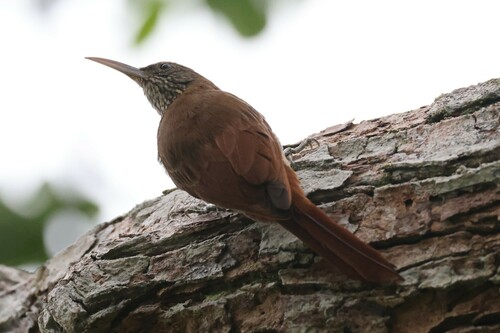
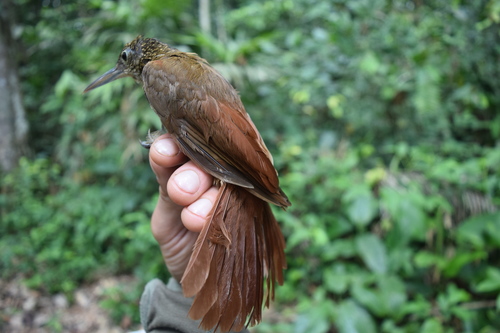
Lesser Hornero

Lesser Hornero

Furnarius minor

Silhouette: Abraão B. Leite · PhyloPic

LCLeast ConcernNTVUENCR
Daily sighting probability <5% · Rare
at Yasuní National Park

In 3 days <5%

12 Verified sightings at Yasuní National Park From 2019 to 2026
123 In all 2 parks
October Best month
☀️ Diurnal When it's spotted

About the Lesser Hornero

The lesser hornero (Furnarius minor) is a species of bird in the ovenbird family Furnariidae. It is closely related to the Pale-legged hornero, and their global distribution overlaps somewhat. This species is monotypic, meaning there is only one subspecies.

The lesser hornero is found in Brazil, Colombia, Ecuador, and Peru, along the banks of the Amazon River and some of its major tributaries. It is a river specialist, feeding and breeding mostly in river island scrub and early successional scrub along the edge of white-water rivers and on young river islands and, in Peru the understory of Cecropia forest. This type of successional habitat is dependent on seasonal flooding and is patchily distributed along the length of its range. It is found from 50 to 200 m (160–660 ft) above sea-level.

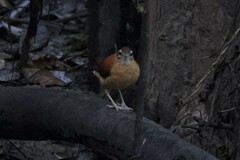
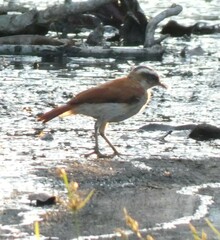
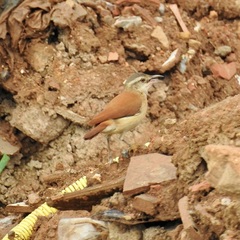
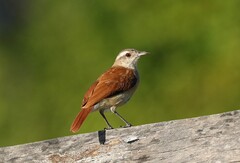
The lesser hornero is a very small ovenbird, 12 to 13 cm (4.7–5.1 in) in length and weighing 23 to 29 g (0.81–1.02 oz). The head is grey with a prominent white stripe above the eye, a white throat, a rufous rump and wings, tawny-buff breast and flanks becoming paler below. The bill is long and straight. Both sexes are alike, and the plumage of juvenile birds has not been described.

The lesser hornero feeds on arthropods and other invertebrates. It hunts individually or in pairs, searching the ground, river-shore mud or low branches for prey, often foraging in dense cover. Like other species in its genus, it constructs a mud "oven" nest in the branches of trees, and lines the nest with grasses and hair. The clutch size is four eggs. Little else is known about its nesting habits, other than it has been recorded building its nests in November and incubating in January. Wikipedia →

Sounds

Song0:07

Colombia · 2021

© Brayan Coral Jaramillo · XC713446 · CC BY-NC-SA 4.0

Call0:37

Ecuador · 1988

© Paul Coopmans · XC264528 · CC BY-NC-SA 4.0

Alarm call1:20

Ecuador · 1995

© Niels Krabbe · XC248780 · CC BY-SA 4.0

Global Distribution

Parks Where Found

# Park Country Daily sighting probability
1 Amacayacu National Natural Park 🇨🇴 Colombia
~20%
2 Yasuní National Park 🇪🇨 Ecuador
<5%

Before you go

What are the chances of seeing a Lesser Hornero in Yasuní National Park?

Rare

Under 5% of wildlife watchers report a Lesser Hornero sighting in Yasuní National Park on a given day, based on 12 verified sightings from GBIF citizen-science data from 2019 to 2026. It is the 489th most-seen of the 533 birds we can rate there. Over three days the chance rises to under 5%, if each day is a fresh chance.

When is the best time to see a Lesser Hornero in Yasuní National Park?

Any time of year

In every month with enough records, under 5% of wildlife watchers report a Lesser Hornero in Yasuní National Park on a given day, so our monthly data shows no clear season.

What time of day is best to see a Lesser Hornero?

Between 3 and 6 pm

Across all the parks we cover, that three-hour window holds the most Lesser Hornero sightings with a recorded time, and about 8 in 10 of them come between 6 am and 6 pm: it is a daytime animal.

Is Yasuní National Park the best place to see a Lesser Hornero?

2nd of 2

Of the 2 parks where we can rate Lesser Hornero sightings, Yasuní National Park ranks 2nd at under 5%. The best odds are in Amacayacu National Natural Park (Colombia, about 20%).

Where does the Lesser Hornero sighting chance come from?

GBIF citizen-science records

It is estimated from how often the Lesser Hornero is recorded against all the birds logged in Yasuní National Park (12 verified sightings from 2019 to 2026), calibrated against known sighting rates. Figures are rounded to the nearest 10% because citizen-science data supports honest approximations, not decimals, and months with records from fewer than five people show "—". How it works.

← Back to Yasuní National Park