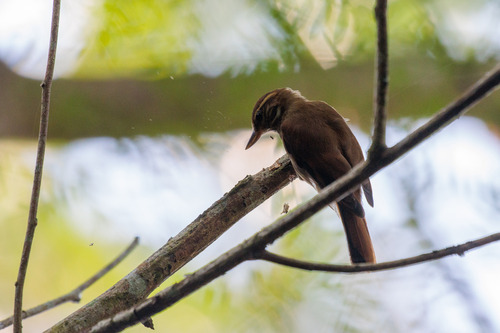
Cinnamon-throated Woodcreeper

Cinnamon-throated Woodcreeper

Dendrexetastes rufigula

Silhouette: Sheatherius · PhyloPic

LCLeast ConcernNTVUENCR
Daily sighting probability ~10% · With luck
at Yasuní National Park

In 3 days ~40% in a week ~60%

434 Verified sightings at Yasuní National Park From 2019 to 2026
1,252 In all 6 parks
September Best month
☀️ Diurnal When it's spotted

About the Cinnamon-throated Woodcreeper

The cinnamon-throated woodcreeper (Dendrexetastes rufigula) is a sub-oscine passerine bird in subfamily Dendrocolaptinae of the ovenbird family Furnariidae. It is found in Bolivia, Brazil, Colombia, Ecuador, French Guiana, Guyana, Peru, Suriname, and Venezuela.

The cinnamon-throated woodcreeper is the only member of genus Dendrexetastes. Subspecies D. r. devillei has been proposed as a separate species but differs little from the others in voice. The cinnamon-throated woodcreeper is genetically most closely related to the long-billed woodcreeper (Nasica longirostris).

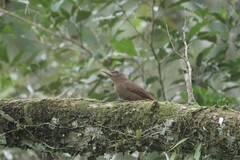
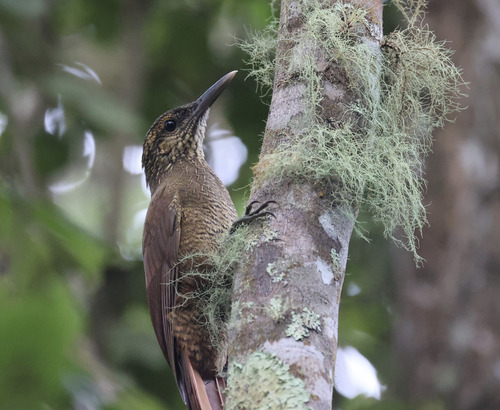
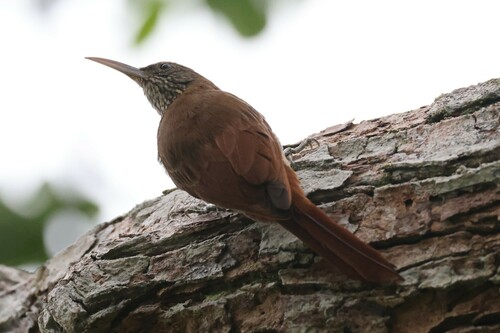
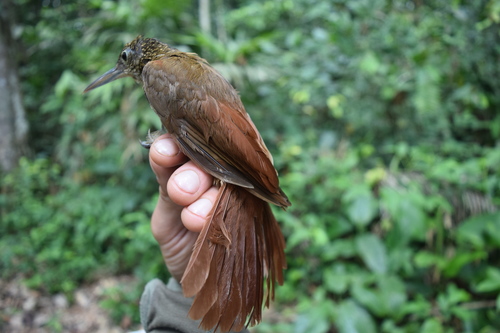
The cinnamon-throated woodcreeper is one of the larger woodcreepers, with a heavy body, short wings, and a short, stout, bill with a slightly hooked tip. It is 22.5 to 27 cm (8.9 to 11 in) long. Males weigh 64 to 74 g (2.3 to 2.6 oz) and females 66 to 77 g (2.3 to 2.7 oz). The sexes are alike. The nominate subspecies D. r. rufigula has mostly medium brown upperparts with a paler crown and rufous... Wikipedia →

Sounds

Song0:14

Brazil · 2026

© JAYRSON ARAUJO DE OLIVEIRA · XC1186233 · CC BY-NC-SA 4.0

Dawn song1:08

Brazil · 2025

© Richard E. Webster · XC1033878 · CC BY-NC-SA 4.0

Canto0:07

Brazil · 2018

© Caio Brito · XC556276 · CC BY-NC-SA 4.0

Global Distribution

Parks Where Found

# Park Country Daily sighting probability
1 Yasuní National Park 🇪🇨 Ecuador
~10%
2 Tambopata National Reserve 🇵🇪 Peru
~10%
3 Manu National Park 🇵🇪 Peru
~10%
4 Amacayacu National Natural Park 🇨🇴 Colombia
~10%
5 Cuyabeno Wildlife Reserve 🇪🇨 Ecuador
~10%
6 Sierra de la Macarena National Park 🇨🇴 Colombia
<5%

Before you go

What are the chances of seeing a Cinnamon-throated Woodcreeper in Yasuní National Park?

With luck

About 10% of wildlife watchers report a Cinnamon-throated Woodcreeper sighting in Yasuní National Park on a given day, based on 434 verified sightings from GBIF citizen-science data from 2019 to 2026. It is the 121st most-seen of the 533 birds we can rate there. Over three days the chance rises to about 40%, and over a week to about 60%, if each day is a fresh chance.

When is the best time to see a Cinnamon-throated Woodcreeper in Yasuní National Park?

March–May and August–September

In those months about 20% of wildlife watchers report a Cinnamon-throated Woodcreeper in Yasuní National Park on a given day, against about 10% in June–July and October–February, the lowest months.

What time of day is best to see a Cinnamon-throated Woodcreeper?

Between 7 and 10 am

Across all the parks we cover, that three-hour window holds the most Cinnamon-throated Woodcreeper sightings with a recorded time, and about 8 in 10 of them come between 6 am and 6 pm: it is a daytime animal.

Is Yasuní National Park the best place to see a Cinnamon-throated Woodcreeper?

Yes

Of the 6 parks where we can rate Cinnamon-throated Woodcreeper sightings, Yasuní National Park has the highest daily chance: about 10%. Next come Tambopata National Reserve (Peru, about 10%) and Manu National Park (Peru, about 10%).

Which relatives of the Cinnamon-throated Woodcreeper live in Yasuní National Park?

Same family: Furnariidae

The closest relatives of the Cinnamon-throated Woodcreeper that you can see in Yasuní National Park (family Furnariidae, Ovenbirds and Woodcreepers) are Buff-throated Woodcreeper (about 30%), Striped Woodcreeper (about 10%) and Long-billed Woodcreeper (about 10%), with each one's daily chance of a sighting.

Where does the Cinnamon-throated Woodcreeper sighting chance come from?

GBIF citizen-science records

It is estimated from how often the Cinnamon-throated Woodcreeper is recorded against all the birds logged in Yasuní National Park (434 verified sightings from 2019 to 2026), calibrated against known sighting rates. Figures are rounded to the nearest 10% because citizen-science data supports honest approximations, not decimals, and months with records from fewer than five people show "—". How it works.

← Back to Yasuní National Park