Tarsier Leaf Frog

Tarsier Leaf Frog

Phyllomedusa tarsius

Silhouette: Dmitry Bogdanov (vectorized by T. Michael Keesey) · PhyloPic

LCLeast ConcernNTVUENCR
Daily sighting probability ~10% · With luck
at Yasuní National Park

In 3 days ~30% in a week ~60%

10 Verified sightings at Yasuní National Park From 2019 to 2026
10 In 1 park
April Best month
🌙 Nocturnal When it's spotted

About the Tarsier Leaf Frog

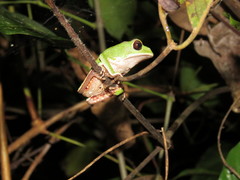
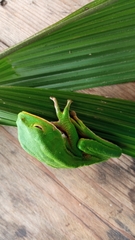
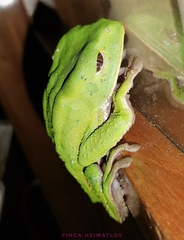
Phyllomedusa tarsius, the brownbelly leaf frog or tarsier leaf frog, is a species of frog in the subfamily Phyllomedusinae. It is found in Brazil, Colombia, Ecuador, Peru, and Venezuela, and possibly Bolivia and Guyana. This frog has been observed as high as 800 meters above sea level.

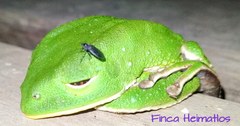
The adult male frog measures 82 mm (3.2 in) to 90 mm (3.5 in) in snout-vent length. The adult female frog measures 110 mm. The skin of the dorsum is green and some of the toes are brown and white. The belly is white and orange in color, and the throat is white. Their eyes are a mixture of orange, red, and black in color.

This frog is arboreal and nocturnal. Male frogs perch on tall plants near ponds and sing for females. The females lay 200–500 eggs per clutch in nests that they form out of leaves overhanging ponds. The female puts a jellylike substance on the eggs to prevent desiccation. When the tadpoles hatch, they fall out of the nest into the water below.

Scientists list this frog as least concern of extinction despite the considerable habitat degradation that has taken place in its range, which includes deforestation, overgrazing, and agriculture. However, the frog has shown such an ability to survive in altered habitats that the presumed population is quite large. Wikipedia →

Sounds

Recording

Venezuela · 1978

© M.S. Hoogmoed · Xeno · CC BY 4.0

Global Distribution

Parks Where Found

# Park Country Daily sighting probability
1 Yasuní National Park 🇪🇨 Ecuador
~10%

More parks will be added in future updates.

Before you go

What are the chances of seeing a Tarsier Leaf Frog in Yasuní National Park?

With luck

About 10% of wildlife watchers report a Tarsier Leaf Frog sighting in Yasuní National Park on a given day, based on 10 verified sightings from GBIF citizen-science data from 2019 to 2026. It is the 33rd most-seen of the 49 amphibians we can rate there. Over three days the chance rises to about 30%, and over a week to about 60%, if each day is a fresh chance.

When is the best time to see a Tarsier Leaf Frog in Yasuní National Park?

April and October

In those months about 30% of wildlife watchers report a Tarsier Leaf Frog in Yasuní National Park on a given day, against under 5% in May–July, September and November–January, the lowest months.

What time of day is best to see a Tarsier Leaf Frog?

Between 8 and 11 pm

Across all the parks we cover, that three-hour window holds the most Tarsier Leaf Frog sightings with a recorded time, and about 8 in 10 of them come between 6 pm and 6 am: it is mostly seen at night.

Where else can you see a Tarsier Leaf Frog?

Only Yasuní National Park, in our data

Yasuní National Park is the only park on Wallace's Line with enough records to rate Tarsier Leaf Frog sightings: about 10% of wildlife watchers there report one on a given day.

Where does the Tarsier Leaf Frog sighting chance come from?

GBIF citizen-science records

It is estimated from how often the Tarsier Leaf Frog is recorded against all the amphibians logged in Yasuní National Park (10 verified sightings from 2019 to 2026), calibrated against known sighting rates. Figures are rounded to the nearest 10% because citizen-science data supports honest approximations, not decimals, and months with records from fewer than five people show "—". How it works.

← Back to Yasuní National Park