Zimmermann's Poison Frog

Zimmermann's Poison Frog

Ranitomeya variabilis

Silhouette: Steven Traver · PhyloPic

LCLeast ConcernNTVUENCR
Daily sighting probability ~20% · Possible
at Yasuní National Park

In 3 days ~50% in a week ~80%

23 Verified sightings at Yasuní National Park From 2019 to 2026
23 In 1 park
August Best month
☀️🌙 Day & Night When it's spotted

About the Zimmermann's Poison Frog

Ranitomeya variabilis, formerly known as Dendrodates variabilis, is a species of small poison dart frog distributed in northern Peru, along the eastern slope of Andes in the upper Rio Huallaga drainage basin. Its common name, Zimmerman's poison frog, is named after Elke Zimmermann, a German zoologist who described the morph of this species and differentiated it from D. ventrimaculatus. The species was formerly considered to be synonymous with Ranitomeya ventrimaculata.

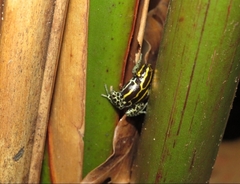
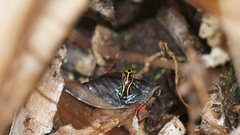
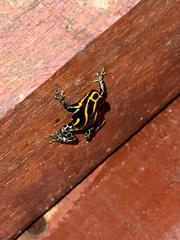
Ranitomeya variabilis usually has a bright yellow body with deep blue limbs, and black spots or stripes across the ventral side of the body. The colors change in some geographic locations. R. variabilis has different mimicry relationships with two other species. Like other frogs in the same family, R. variabilis has toxic skin alkaloid which repels potential predators.

R. variabilis are cannibalistic even as tadpoles, so adult male parents may allow tadpoles to jump on their backs and transport them to less crowded areas. Adult R. variabilis use chemical cues to determine the presence of tadpoles and whether they are cannibalistic or not.

R. variabilis are characterized by a black spot... Wikipedia →

Sounds

Recording0:23

French Guiana · 2024

© Augustin Bussac · XC929079 · CC BY-NC-SA 4.0

Global Distribution

Parks Where Found

# Park Country Daily sighting probability
1 Yasuní National Park 🇪🇨 Ecuador
~20%

More parks will be added in future updates.

Zoos & Centres Where Found

# Zoo / Centre Country
1 Prague Zoo 🇨🇿 Czechia In captivity
2 National Zoological Park 🇺🇸 United States In captivity
3 Aquarium of the Pacific 🇺🇸 United States In captivity
4 New England Aquarium 🇺🇸 United States In captivity
5 Rákosův pavilon 🇨🇿 Czechia In captivity
6 Velemlokárium 🇨🇿 Czechia In captivity

Before you go

What are the chances of seeing a Zimmermann's Poison Frog in Yasuní National Park?

Possible

About 20% of wildlife watchers report a Zimmermann's Poison Frog sighting in Yasuní National Park on a given day, based on 23 verified sightings from GBIF citizen-science data from 2019 to 2026. It is the 15th most-seen of the 49 amphibians we can rate there. Over three days the chance rises to about 50%, and over a week to about 80%, if each day is a fresh chance.

When is the best time to see a Zimmermann's Poison Frog in Yasuní National Park?

August and October

In those months about 30% of wildlife watchers report a Zimmermann's Poison Frog in Yasuní National Park on a given day, against under 5% in September and December, the lowest months.

What time of day is best to see a Zimmermann's Poison Frog?

Between 7 and 10 pm

Across all the parks we cover, that three-hour window holds the most Zimmermann's Poison Frog sightings with a recorded time, and about half of them come between 6 am and 6 pm: it is seen both by day and at night.

Where else can you see a Zimmermann's Poison Frog?

Only Yasuní National Park, in our data

Yasuní National Park is the only park on Wallace's Line with enough records to rate Zimmermann's Poison Frog sightings: about 20% of wildlife watchers there report one on a given day.

Where does the Zimmermann's Poison Frog sighting chance come from?

GBIF citizen-science records

It is estimated from how often the Zimmermann's Poison Frog is recorded against all the amphibians logged in Yasuní National Park (23 verified sightings from 2019 to 2026), calibrated against known sighting rates. Figures are rounded to the nearest 10% because citizen-science data supports honest approximations, not decimals, and months with records from fewer than five people show "—". How it works.

← Back to Yasuní National Park