Black-billed Magpie

Black-billed Magpie

Pica hudsonia

Silhouette: T. Michael Keesey · PhyloPic

LCLeast ConcernNTVUENCR
Daily sighting probability ~30% · Possible
at Yellowstone National Park

In 3 days ~70% in a week ~90%

2,205 Verified sightings at Yellowstone National Park From 2019 to 2026
19,511 In all 16 parks
November Best month
☀️ Diurnal When it's spotted

About the Black-billed Magpie

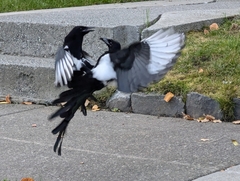
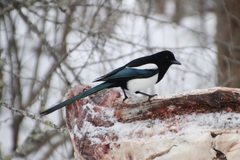
The black-billed magpie (Pica hudsonia), also known as the American magpie, is a bird in the corvid family found in the western half of North America. It is black and white, with the wings and tail showing black areas and iridescent hints of blue and blue-green. It was formerly treated as a subspecies of Pica pica (Eurasian magpie), but was separated as a species in its own in 2000 based on genetic studies.

This species prefers generally open habitats with clumps of trees, but can also commonly be found in farmlands and suburban areas. Historically associated with bison herds, it now lands on the backs of cattle to glean ticks and insects from them. Black-billed magpies commonly follow large predators, such as wolves, to scavenge from their kills. The species also walks or hops on the ground, where it obtains food items such as beetles, grasshoppers, worms, and small rodents.

The black-billed magpie builds domed nests which are made up of twigs and are located near the top of trees, usually housing six to seven eggs. Incubation, by the female only, starts when the clutch is complete, and lasts 16–21 days. The nestling period is three to four weeks. Black-billed magpies in the wild have a lifespan of six to seven years.

Black-billed magpies have a long history with humans, being featured in stories told by Indigenous tribes of the Great Plains. Where persecuted it becomes very wary, but otherwise it is fairly tolerant of human presence. Due to their perceived negative impact on cattle and game birds, black-billed magpies were hunted as a pest during the 1900s, and their population suffered as a result. Today, they are considered a species of least concern by the IUCN, and they are commonly seen throughout their range. Wikipedia →

Sounds

Begging call1:02

United States · 2009

© Paul Driver · XC778435 · CC BY-NC-SA 4.0

Call0:41

United States · 1990

© Peter Ward and Ken Hall · XC614155 · CC BY-NC-SA 4.0

Alarm call0:14

United States · 2015

© Eric Hough · XC291049 · CC BY-NC-SA 4.0

Global Distribution

Parks Where Found

# Park Country Daily sighting probability
1 Katmai National Park 🇺🇸 United States
~70%
2 Rocky Mountain National Park 🇺🇸 United States
~70%
3 Denali National Park 🇺🇸 United States
~60%
4 Banff National Park 🇨🇦 Canada
~50%
5 Badlands National Park 🇺🇸 United States
~50%
6 Kluane National Park 🇨🇦 Canada
~40%
7 Jasper National Park 🇨🇦 Canada
~40%
8 Yellowstone National Park 🇺🇸 United States
~30%
9 Grand Teton National Park 🇺🇸 United States
~30%
10 Riding Mountain National Park 🇨🇦 Canada
~30%
11 Wrangell-St. Elias National Park 🇺🇸 United States
~20%
12 Elk Island National Park 🇨🇦 Canada
~20%
13 Kenai Fjords National Park 🇺🇸 United States
~10%
14 Glacier National Park 🇺🇸 United States
~10%
15 Voyageurs National Park 🇺🇸 United States
<5%
16 Zion National Park 🇺🇸 United States
<5%

Cities Where Found

# City Country Daily sighting probability
1 Edmonton 🇨🇦 Canada
~90%
2 Anchorage 🇺🇸 United States
~80%
3 Calgary 🇨🇦 Canada
~80%
4 Denver 🇺🇸 United States
~50%
5 Salt Lake City 🇺🇸 United States
~50%
6 Seattle 🇺🇸 United States
<5%

Zoos & Centres Where Found

# Zoo / Centre Country
1 San Diego Zoo 🇺🇸 United States In captivity
2 Birmingham Zoo 🇺🇸 United States In captivity
3 Philadelphia Zoo 🇺🇸 United States In captivity
4 Carolina Raptor Center 🇺🇸 United States In captivity
5 Cascades Raptor Center 🇺🇸 United States In captivity

Before you go

What are the chances of seeing a Black-billed Magpie in Yellowstone National Park?

Possible

About 30% of wildlife watchers report a Black-billed Magpie sighting in Yellowstone National Park on a given day, based on 2,205 verified sightings from GBIF citizen-science data from 2019 to 2026. It is the 23rd most-seen of the 197 birds we can rate there. Over three days the chance rises to about 70%, and over a week to about 90%, if each day is a fresh chance.

When is the best time to see a Black-billed Magpie in Yellowstone National Park?

March and November

In those months about 60% of wildlife watchers report a Black-billed Magpie in Yellowstone National Park on a given day, against about 20% in July and August, the lowest months.

What time of day is best to see a Black-billed Magpie?

Between 9 am and noon

Across all the parks we cover, that three-hour window holds the most Black-billed Magpie sightings with a recorded time, and about 8 in 10 of them come between 6 am and 6 pm: it is a daytime animal.

Which relatives of the Black-billed Magpie live in Yellowstone National Park?

Same family: Corvidae

The closest relatives of the Black-billed Magpie that you can see in Yellowstone National Park (family Corvidae, Crows, Jays, and Magpies) are Common Raven (about 80%), Clark's Nutcracker (about 40%) and Gray Jay (about 20%), with each one's daily chance of a sighting.

Where does the Black-billed Magpie sighting chance come from?

GBIF citizen-science records

It is estimated from how often the Black-billed Magpie is recorded against all the birds logged in Yellowstone National Park (2,205 verified sightings from 2019 to 2026), calibrated against known sighting rates. Figures are rounded to the nearest 10% because citizen-science data supports honest approximations, not decimals, and months with records from fewer than five people show "—". How it works.

← Back to Yellowstone National Park