Clark's Nutcracker

Clark's Nutcracker

Nucifraga columbiana

Silhouette: Joshua Fowler · PhyloPic

LCLeast ConcernNTVUENCR
Daily sighting probability ~40% · Likely
at Yellowstone National Park

In 3 days ~80% in a week >90%

2,904 Verified sightings at Yellowstone National Park From 2019 to 2026
12,222 In all 11 parks
March Best month
☀️ Diurnal When it's spotted

About the Clark's Nutcracker

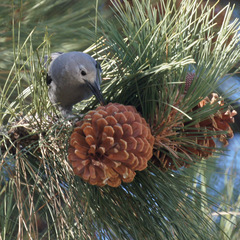
Clark's nutcracker (Nucifraga columbiana), also known as Clark's crow, is a passerine bird in the family Corvidae, native to the mountains of western North America. The nutcracker is an omnivore, but subsists mainly on pine nuts, burying seeds in the ground in the late summer and fall, and then retrieving them in the winter and spring by memory. The bird was described by the Lewis and Clark Expedition, with William Clark first observing it in 1805 along the banks of the Salmon River, a tributary of the Columbia River.

In William Clark's initial description of the bird, he mistakenly described it as a woodpecker, writing "I saw today [a] bird of the woodpecker kind, which fed on pine burrs. Its bill and tail white; the wings black; every other part of a light brown, and about the size of a robin."

Clark's nutcracker's scientific name literally means "nutcracker of the Columbia". In 1806, Meriwether Lewis recorded a more detailed description from specimens collected along the Clearwater River in Idaho. A skin collected by the expedition was obtained by the ornithologist Alexander Wilson, who used it to produce an engraving for his American Ornithology work... Wikipedia →

Sounds

Call0:04

United States · 2026

© Ed Pandolfino · XC1153564 · CC BY-NC-SA 4.0

Uncertain0:11

United States · 2021

© Ned Bohman · XC640375 · CC BY-NC-SA 4.0

Begging call0:43

Canada · 1987

© Peter Ward and Ken Hall · XC612666 · CC BY-NC-SA 4.0

Global Distribution

Parks Where Found

# Park Country Daily sighting probability
1 Yellowstone National Park 🇺🇸 United States
~40%
2 Banff National Park 🇨🇦 Canada
~30%
3 Rocky Mountain National Park 🇺🇸 United States
~30%
4 Grand Teton National Park 🇺🇸 United States
~20%
5 Jasper National Park 🇨🇦 Canada
~20%
6 Yosemite National Park 🇺🇸 United States
~20%
7 Glacier National Park 🇺🇸 United States
~10%
8 Sequoia and Kings Canyon National Parks 🇺🇸 United States
~10%
9 Grand Canyon National Park 🇺🇸 United States
~10%
10 Zion National Park 🇺🇸 United States
<5%
11 Olympic National Park 🇺🇸 United States
<5%

Before you go

What are the chances of seeing a Clark's Nutcracker in Yellowstone National Park?

Likely

About 40% of wildlife watchers report a Clark's Nutcracker sighting in Yellowstone National Park on a given day, based on 2,904 verified sightings from GBIF citizen-science data from 2019 to 2026. It is the 10th most-seen of the 197 birds we can rate there. Over three days the chance rises to about 80%, and over a week to over 90%, if each day is a fresh chance.

When is the best time to see a Clark's Nutcracker in Yellowstone National Park?

March and September–October

In those months about 70% of wildlife watchers report a Clark's Nutcracker in Yellowstone National Park on a given day, against about 20% in May and June, the lowest months.

What time of day is best to see a Clark's Nutcracker?

Between 10 am and 1 pm

Across all the parks we cover, that three-hour window holds the most Clark's Nutcracker sightings with a recorded time, and about 9 in 10 of them come between 6 am and 6 pm: it is a daytime animal.

Is Yellowstone National Park the best place to see a Clark's Nutcracker?

Yes

Of the 11 parks where we can rate Clark's Nutcracker sightings, Yellowstone National Park has the highest daily chance: about 40%. Next come Banff National Park (Canada, about 30%) and Rocky Mountain National Park (United States, about 30%).

Which relatives of the Clark's Nutcracker live in Yellowstone National Park?

Same family: Corvidae

The closest relatives of the Clark's Nutcracker that you can see in Yellowstone National Park (family Corvidae, Crows, Jays, and Magpies) are Common Raven (about 80%), Black-billed Magpie (about 30%) and Gray Jay (about 20%), with each one's daily chance of a sighting.

Where does the Clark's Nutcracker sighting chance come from?

GBIF citizen-science records

It is estimated from how often the Clark's Nutcracker is recorded against all the birds logged in Yellowstone National Park (2,904 verified sightings from 2019 to 2026), calibrated against known sighting rates. Figures are rounded to the nearest 10% because citizen-science data supports honest approximations, not decimals, and months with records from fewer than five people show "—". How it works.

← Back to Yellowstone National Park