Yellow-pine Chipmunk

Yellow-pine Chipmunk

Tamias amoenus

Silhouette: Chloé Schmidt · PhyloPic

Daily sighting probability ~20% · Possible
at Yellowstone National Park

In 3 days ~40% in a week ~70%

79 Verified sightings at Yellowstone National Park From 2019 to 2026
445 In all 5 parks
September Best month
☀️ Diurnal When it's spotted

About the Yellow-pine Chipmunk

The yellow-pine chipmunk (Neotamias amoenus) is a species of order Rodentia in the family Sciuridae. It is found in parts of Canada and the United States. These chipmunks are normally found in brush-covered areas, and in California, they inhabit an elevation range of around 975 to 2,900 metres (3,200 to 9,510 ft).

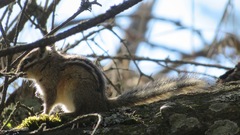
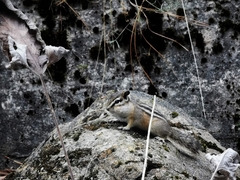
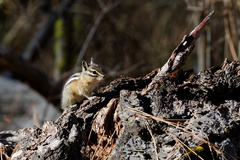
Their body color is dark and reddish, mixed with cinnamon, with five longitudinal dark (black or mixed black) stripes that are separated by four lighter stripes. The outer pair of pale stripes is creamy white and narrower, and the more median pair is a gray or smoke gray. The sides of the head each have three dark stripes, with two lighter in between, and the crown is black or smoke gray.

Males and females have similar brain size and roughly the same tail length, ear length from notch, and length of lower tooth row, but females are larger in other body measurements; average body mass varies, with large males weighing an average of 49.7 g (1.75 oz) and large females averaging 53.5 g (1.89 oz). Though male-biased size sexual dimorphism is common among mammals, N. amoenus exhibits female-biased dimorphism.

In some areas, where range overlap with the least chipmunk... Wikipedia →

Global Distribution

Parks Where Found

# Park Country Daily sighting probability
1 Olympic National Park 🇺🇸 United States
~30%
2 Glacier National Park 🇺🇸 United States
~20%
3 Yellowstone National Park 🇺🇸 United States
~20%
4 Grand Teton National Park 🇺🇸 United States
~10%
5 Banff National Park 🇨🇦 Canada
~10%

Before you go

What are the chances of seeing a Yellow-pine Chipmunk in Yellowstone National Park?

Possible

About 20% of wildlife watchers report a Yellow-pine Chipmunk sighting in Yellowstone National Park on a given day, based on 79 verified sightings from GBIF citizen-science data from 2019 to 2026. It is the 21st most-seen of the 32 mammals we can rate there. Over three days the chance rises to about 40%, and over a week to about 70%, if each day is a fresh chance.

When is the best time to see a Yellow-pine Chipmunk in Yellowstone National Park?

August and September

In those months about 30% of wildlife watchers report a Yellow-pine Chipmunk in Yellowstone National Park on a given day, against under 5% in November to February, the lowest months.

What time of day is best to see a Yellow-pine Chipmunk?

Between 10 am and 1 pm

Across all the parks we cover, that three-hour window holds the most Yellow-pine Chipmunk sightings with a recorded time, and about 9 in 10 of them come between 6 am and 6 pm: it is a daytime animal.

Is Yellowstone National Park the best place to see a Yellow-pine Chipmunk?

3rd of 5

Of the 5 parks where we can rate Yellow-pine Chipmunk sightings, Yellowstone National Park ranks 3rd at about 20%. The best odds are in Olympic National Park (United States, about 30%) and Glacier National Park (United States, about 20%).

Which relatives of the Yellow-pine Chipmunk live in Yellowstone National Park?

Same genus: Tamias

The closest relatives of the Yellow-pine Chipmunk that you can see in Yellowstone National Park (genus Tamias, Eastern Chipmunks) are Least Chipmunk (about 20%) and Uinta Chipmunk (about 10%), with each one's daily chance of a sighting.

Where does the Yellow-pine Chipmunk sighting chance come from?

GBIF citizen-science records

It is estimated from how often the Yellow-pine Chipmunk is recorded against all the mammals logged in Yellowstone National Park (79 verified sightings from 2019 to 2026), calibrated against known sighting rates. Figures are rounded to the nearest 10% because citizen-science data supports honest approximations, not decimals, and months with records from fewer than five people show "—". How it works.

← Back to Yellowstone National Park