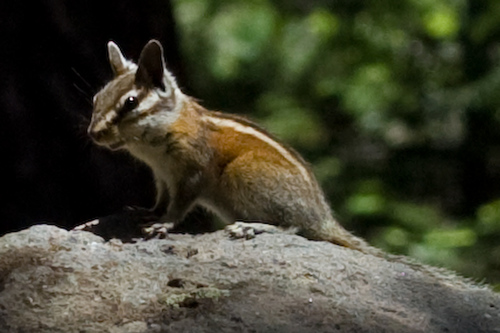

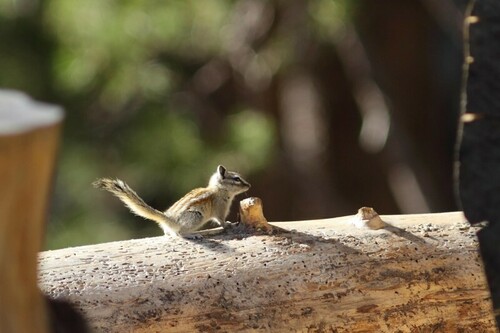
Lodgepole Chipmunk

Lodgepole Chipmunk

Tamias speciosus

Silhouette: Chloé Schmidt · PhyloPic

Daily sighting probability ~20% · Possible
at Yosemite National Park

In 3 days ~40% in a week ~70%

50 Verified sightings at Yosemite National Park From 2019 to 2026
143 In all 2 parks
October Best month
☀️ Diurnal When it's spotted

About the Lodgepole Chipmunk

The Lodgepole chipmunk (Neotamias speciosus) is a species of rodent in the family Sciuridae. It is found in the U.S. state of California at elevations from 1,500 to 3,000 metres (4,900 to 9,800 ft). The Lodgepole chipmunk has a variety of common names including: Tahoe chipmunk, Sequoia chipmunk, Mt. Pinos chipmunk, and San Bernardino chipmunk.

Females are larger than males. Female Lodgepole chipmunks have an average body weight of 55-69 grams whereas males on average are 50-60 grams. Along with weight, body length in females ranges 197–229 mm (7.8–9.0 in), while males are 200–222 mm (7.9–8.7 in). Body patterns remain consistent in both sexes as they exhibit characteristic white dorsal and facial stripes, where the central dorsal stripes are less prominent and closer to yellow-white than the lateral white stripes. In comparison to other close relatives, this species has darker and broader facial stripes. Other notable body patterns include dark black dorsal stripes, a lack of a black stripe underneath the prominent white lateral stripe, bright orange color on sides and orange-gray coloring on the shoulders, a gray under-belly, and a gray rump. The top of the head, the... Wikipedia →

Sounds

Recording0:09

United States · 2020

© madfox · iNaturalist · CC BY-NC 4.0

Global Distribution

Parks Where Found

# Park Country Daily sighting probability
1 Sequoia and Kings Canyon National Parks 🇺🇸 United States
~30%
2 Yosemite National Park 🇺🇸 United States
~20%

Before you go

What are the chances of seeing a Lodgepole Chipmunk in Yosemite National Park?

Possible

About 20% of wildlife watchers report a Lodgepole Chipmunk sighting in Yosemite National Park on a given day, based on 50 verified sightings from GBIF citizen-science data from 2019 to 2026. It is the 12th most-seen of the 21 mammals we can rate there. Over three days the chance rises to about 40%, and over a week to about 70%, if each day is a fresh chance.

When is the best time to see a Lodgepole Chipmunk in Yosemite National Park?

October

In that month about 30% of wildlife watchers report a Lodgepole Chipmunk in Yosemite National Park on a given day, against under 5% in December to April, the lowest months. That is one of Yosemite National Park's driest months, with about 45 mm of rain against 220 mm in January.

What time of day is best to see a Lodgepole Chipmunk?

Between 10 am and 1 pm

Across all the parks we cover, that three-hour window holds the most Lodgepole Chipmunk sightings with a recorded time, and about 9 in 10 of them come between 6 am and 6 pm: it is a daytime animal.

Is Yosemite National Park the best place to see a Lodgepole Chipmunk?

2nd of 2

Of the 2 parks where we can rate Lodgepole Chipmunk sightings, Yosemite National Park ranks 2nd at about 20%. The best odds are in Sequoia and Kings Canyon National Parks (United States, about 30%).

Which relatives of the Lodgepole Chipmunk live in Yosemite National Park?

Same genus: Tamias

The closest relatives of the Lodgepole Chipmunk that you can see in Yosemite National Park (genus Tamias, Eastern Chipmunks) are Alpine Chipmunk (about 10%) and Long-eared Chipmunk (about 10%), with each one's daily chance of a sighting.

Where does the Lodgepole Chipmunk sighting chance come from?

GBIF citizen-science records

It is estimated from how often the Lodgepole Chipmunk is recorded against all the mammals logged in Yosemite National Park (50 verified sightings from 2019 to 2026), calibrated against known sighting rates. Figures are rounded to the nearest 10% because citizen-science data supports honest approximations, not decimals, and months with records from fewer than five people show "—". How it works.

← Back to Yosemite National Park