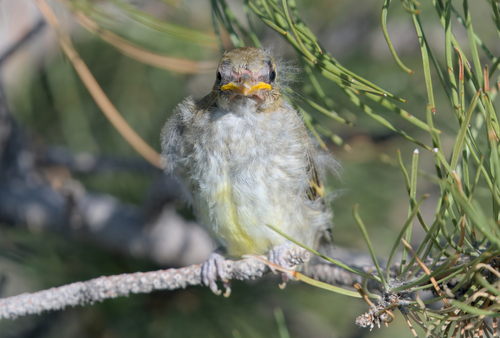
Oak Titmouse

Oak Titmouse

Baeolophus inornatus

Silhouette: Sheatherius · PhyloPic

LCLeast ConcernNTVUENCR
Daily sighting probability <5% · Rare
at Yosemite National Park

In 3 days ~10% in a week ~20%

97 Verified sightings at Yosemite National Park From 2019 to 2026
1,213 In all 4 parks
December Best month
☀️ Diurnal When it's spotted

About the Oak Titmouse

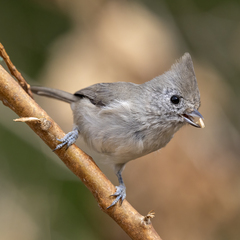
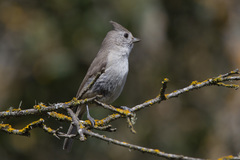
The oak titmouse (Baeolophus inornatus) is a passerine bird in the tit family Paridae. The American Ornithologists' Union split the plain titmouse into the oak titmouse and the juniper titmouse in 1996, due to distinct differences in song, preferred habitat, and genetic makeup.

The oak titmouse is a small, brown-tinged gray bird with a small tuft or crest. The face is plain, and the undersides are a lighter gray. Sexes are similar, as there is very little to no sexual dimorphism. This species lives year-round on the Pacific slope, resident from southern Oregon south through California west of the Sierra Nevada to Baja California, but its range surrounds the central San Joaquin Valley. It prefers open woodlands of warm, dry oak and oak-pine at low to mid-elevations but can also be found in forests as long as adequate oak trees are present. With these habitats, the oak titmouse lives typically in Quercus agrifolia (coast live oak) and Quercus lobata (valley oak); which provides sufficient cavities, dense foliage, and twig piles that those oaks provide, oak titmouse utilizes such sources for nesting.

However, the rural residential sprawl and vineyard... Wikipedia →

Sounds

Song0:39

United States · 2026

© Ed Pandolfino · XC1089607 · CC BY-NC-SA 4.0

Call0:19

United States · 2022

© Paul Marvin · XC710735 · CC BY-NC-SA 4.0

Alarm call0:38

United States · 1995

© Richard E. Webster · XC350946 · CC BY-NC-SA 4.0

Global Distribution

Parks Where Found

# Park Country Daily sighting probability
1 Sequoia and Kings Canyon National Parks 🇺🇸 United States
~40%
2 Joshua Tree National Park 🇺🇸 United States
~10%
3 Yosemite National Park 🇺🇸 United States
<5%
4 Channel Islands National Park 🇺🇸 United States
<5%

Cities Where Found

# City Country Daily sighting probability
1 Sacramento 🇺🇸 United States
~70%
2 San Francisco 🇺🇸 United States
~20%
3 Los Angeles 🇺🇸 United States
~10%
4 San Diego 🇺🇸 United States
<5%

Before you go

What are the chances of seeing an Oak Titmouse in Yosemite National Park?

Rare

Under 5% of wildlife watchers report an Oak Titmouse sighting in Yosemite National Park on a given day, based on 97 verified sightings from GBIF citizen-science data from 2019 to 2026. It is the 112th most-seen of the 169 birds we can rate there. Over three days the chance rises to about 10%, and over a week to about 20%, if each day is a fresh chance.

When is the best time to see an Oak Titmouse in Yosemite National Park?

December

In that month about 20% of wildlife watchers report an Oak Titmouse in Yosemite National Park on a given day, against under 5% in May to November, the lowest months. That is one of Yosemite National Park's wettest months, with about 180 mm of rain against 25 mm in September.

What time of day is best to see an Oak Titmouse?

Between 8 and 11 am

Across all the parks we cover, that three-hour window holds the most Oak Titmouse sightings with a recorded time, and about 9 in 10 of them come between 6 am and 6 pm: it is a daytime animal.

Is Yosemite National Park the best place to see an Oak Titmouse?

3rd of 4

Of the 4 parks where we can rate Oak Titmouse sightings, Yosemite National Park ranks 3rd at under 5%. The best odds are in Sequoia and Kings Canyon National Parks (United States, about 40%) and Joshua Tree National Park (United States, about 10%).

Where does the Oak Titmouse sighting chance come from?

GBIF citizen-science records

It is estimated from how often the Oak Titmouse is recorded against all the birds logged in Yosemite National Park (97 verified sightings from 2019 to 2026), calibrated against known sighting rates. Figures are rounded to the nearest 10% because citizen-science data supports honest approximations, not decimals, and months with records from fewer than five people show "—". How it works.

← Back to Yosemite National Park