Red-breasted Nuthatch

Red-breasted Nuthatch

Sitta canadensis

Silhouette: Alan and Elaine Wilson (Modified) · PhyloPic

LCLeast ConcernNTVUENCR
Daily sighting probability ~60% · Likely
at Yosemite National Park

In 3 days ~90% in a week >90%

2,482 Verified sightings at Yosemite National Park From 2019 to 2026
30,755 In all 34 parks
September Best month
☀️ Diurnal When it's spotted

About the Red-breasted Nuthatch

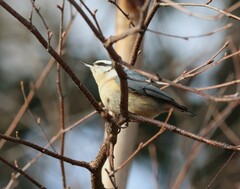
The red-breasted nuthatch (Sitta canadensis) is a small songbird. The adult has blue-grey upperparts with cinnamon underparts, a white throat and face with a black stripe through the eyes, a straight grey bill and a black crown. Its call, which has been likened to a tin trumpet, is high-pitched and nasal. It breeds in coniferous forests across Canada, Alaska and the northeastern and western United States. Though often a permanent resident, it regularly irrupts further south if its food supply fails. There are records of vagrants occurring as far south as the Gulf Coast and northern Mexico. It forages on the trunks and large branches of trees, often descending head first, sometimes catching insects in flight. It eats mainly insects and seeds, especially from conifers. It excavates its nest in dead wood, often close to the ground, smearing the entrance with pitch.

In 1760, the French zoologist Mathurin Jacques Brisson included a description of the red-breasted nuthatch in his Ornithologie based on a specimen collected in Canada. He used the French name Le torchepot de Canada and the Latin Sitta Canadensis. Although Brisson coined Latin names for the species, these usually... Wikipedia →

Sounds

Call0:24

United States · 2026

© Ed Pandolfino · XC1153731 · CC BY-NC-SA 4.0

Alarm call0:23

United States · 2022

© AUDEVARD Aurélien · XC1048899 · CC BY-NC-SA 4.0

Song0:05

Canada · 2022

© Sunny Tseng · XC753160 · CC BY-NC-SA 4.0

Global Distribution

Parks Where Found

# Park Country Daily sighting probability
1 Jasper National Park 🇨🇦 Canada
~60%
2 Yosemite National Park 🇺🇸 United States
~60%
3 Isle Royale National Park 🇺🇸 United States
~50%
4 Voyageurs National Park 🇺🇸 United States
~50%
5 Glacier National Park 🇺🇸 United States
~50%
6 Banff National Park 🇨🇦 Canada
~50%
7 Acadia National Park 🇺🇸 United States
~50%
8 Sequoia and Kings Canyon National Parks 🇺🇸 United States
~40%
9 Grand Teton National Park 🇺🇸 United States
~40%
10 Kluane National Park 🇨🇦 Canada
~30%
11 Olympic National Park 🇺🇸 United States
~30%
12 Rocky Mountain National Park 🇺🇸 United States
~30%
13 Grand Canyon National Park 🇺🇸 United States
~30%
14 Riding Mountain National Park 🇨🇦 Canada
~20%
15 Yellowstone National Park 🇺🇸 United States
~20%
16 Point Pelee National Park 🇨🇦 Canada
~20%
17 Zion National Park 🇺🇸 United States
~20%
18 Great Smoky Mountains National Park 🇺🇸 United States
~10%
19 Elk Island National Park 🇨🇦 Canada
~10%
20 Wrangell-St. Elias National Park 🇺🇸 United States
~10%
21 Cape Breton Highlands National Park 🇨🇦 Canada
~10%
22 Guadalupe Mountains National Park 🇺🇸 United States
~10%
23 Redwood National Park 🇺🇸 United States
~10%
24 Denali National Park 🇺🇸 United States
~10%
25 Great Bear Rainforest 🇨🇦 Canada
~10%
26 Gros Morne National Park 🇨🇦 Canada
~10%
27 Channel Islands National Park 🇺🇸 United States
<5%
28 Shenandoah National Park 🇺🇸 United States
<5%
29 Joshua Tree National Park 🇺🇸 United States
<5%
30 Death Valley National Park 🇺🇸 United States
<5%
31 Pacific Rim National Park Reserve 🇨🇦 Canada
<5%
32 Big Bend National Park 🇺🇸 United States
<5%
33 Kenai Fjords National Park 🇺🇸 United States
<5%
34 Badlands National Park 🇺🇸 United States
<5%

Cities Where Found

# City Country Daily sighting probability
1 Edmonton 🇨🇦 Canada
~60%
2 Calgary 🇨🇦 Canada
~50%
3 Portland 🇺🇸 United States
~40%
4 Anchorage 🇺🇸 United States
~40%
5 Seattle 🇺🇸 United States
~40%
6 Vancouver 🇨🇦 Canada
~20%
7 Toronto 🇨🇦 Canada
~20%
8 Denver 🇺🇸 United States
~20%
9 Las Vegas 🇺🇸 United States
~10%
10 Salt Lake City 🇺🇸 United States
~10%

Before you go

What are the chances of seeing a Red-breasted Nuthatch in Yosemite National Park?

Likely

About 60% of wildlife watchers report a Red-breasted Nuthatch sighting in Yosemite National Park on a given day, based on 2,482 verified sightings from GBIF citizen-science data from 2019 to 2026. It is the 7th most-seen of the 169 birds we can rate there. Over three days the chance rises to about 90%, and over a week to over 90%, if each day is a fresh chance.

When is the best time to see a Red-breasted Nuthatch in Yosemite National Park?

September

In that month about 80% of wildlife watchers report a Red-breasted Nuthatch in Yosemite National Park on a given day, against about 40% in January and February, the lowest months. That is one of Yosemite National Park's driest months, with about 25 mm of rain against 220 mm in January.

What time of day is best to see a Red-breasted Nuthatch?

Between 10 am and 1 pm

Across all the parks we cover, that three-hour window holds the most Red-breasted Nuthatch sightings with a recorded time, and about 9 in 10 of them come between 6 am and 6 pm: it is a daytime animal.

Is Yosemite National Park the best place to see a Red-breasted Nuthatch?

Among the best

Of the 34 parks where we can rate Red-breasted Nuthatch sightings, Yosemite National Park ranks 2nd at about 60%, level with the leaders once rounded. The best odds are in Jasper National Park (Canada, about 60%). All parks ranked.

Which relatives of the Red-breasted Nuthatch live in Yosemite National Park?

Same genus: Sitta

The closest relatives of the Red-breasted Nuthatch that you can see in Yosemite National Park (genus Sitta, Nuthatches) are White-breasted Nuthatch (about 10%) and Pygmy Nuthatch (about 10%), with each one's daily chance of a sighting.

Where does the Red-breasted Nuthatch sighting chance come from?

GBIF citizen-science records

It is estimated from how often the Red-breasted Nuthatch is recorded against all the birds logged in Yosemite National Park (2,482 verified sightings from 2019 to 2026), calibrated against known sighting rates. Figures are rounded to the nearest 10% because citizen-science data supports honest approximations, not decimals, and months with records from fewer than five people show "—". How it works.

← Back to Yosemite National Park