California Condor

California Condor

Gymnogyps californianus

Silhouette: Stacy Spensley (Modified) · PhyloPic

LCNTVUENCRCritically Endangered
Daily sighting probability ~20% · Possible
at Zion National Park

In 3 days ~50% in a week ~80%

968 Verified sightings at Zion National Park From 2019 to 2026
3,814 In all 3 parks
January Best month
☀️ Diurnal When it's spotted

About the California Condor

The California condor (Gymnogyps californianus) is a New World vulture and the largest North American land bird. It became extinct in the wild in 1987 when all remaining wild individuals were captured, but has since been reintroduced to northern Arizona and southern Utah (including the Grand Canyon area and Zion National Park), the coastal mountains of California, and northern Baja California in Mexico. It is the only surviving member of the genus Gymnogyps, although four extinct members of the genus are also known. The species is listed by IUCN as critically endangered, and similarly considered Critically Imperiled by NatureServe.

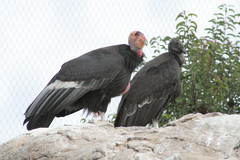
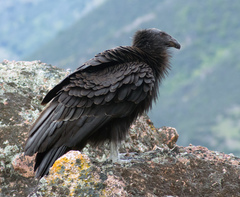
The plumage is black with patches of white on the underside of the wings; the head is largely bald, with skin color ranging from gray on young birds to yellow and bright orange on breeding adults. Its 3.0 m (9.8 ft) wingspan is the widest of any North American bird, and its weight of up to 14 kg (31 lb) nearly equals that of the trumpeter swan, the heaviest among native North American bird species. The condor is a scavenger and eats large amounts of carrion. It is one of the world's longest-living birds, with a lifespan of up to 60 years.

Condor numbers dramatically declined in the 20th century due to agricultural chemicals (DDT), poaching, lead poisoning, and habitat destruction. A conservation plan put in place by the United States government led to the capture of all the remaining wild condors by 1987, with a total population of 27 individuals. These surviving birds were bred at the San Diego Wild Animal Park and the Los Angeles Zoo. Numbers rose through captive breeding, and beginning in 1991, condors were reintroduced into the wild. Since then, their population has grown, but the California condor remains one of the world's rarest bird species. In December 2025, the Fish and Wildlife Service updated the world population to 607. The condor is a significant bird to many Californian Native American groups and plays an important role in several of their traditional myths. Wikipedia →

Global Distribution

Parks Where Found

# Park Country Daily sighting probability
1 Grand Canyon National Park 🇺🇸 United States
~20%
2 Zion National Park 🇺🇸 United States
~20%
3 Redwood National Park 🇺🇸 United States
~10%

Zoos & Centres Where Found

# Zoo / Centre Country
1 San Diego Zoo 🇺🇸 United States In captivity
2 San Diego Zoo Safari Park 🇺🇸 United States In captivity
3 Los Angeles Zoo 🇺🇸 United States In captivity
4 Oakland Zoo 🇺🇸 United States In captivity
5 Phoenix Zoo 🇺🇸 United States In captivity
6 Oregon Zoo 🇺🇸 United States In captivity
7 Chapultepec Zoo 🇲🇽 Mexico In captivity
8 California Living Museum 🇺🇸 United States In captivity
9 Santa Barbara Zoo 🇺🇸 United States In captivity
10 OdySea Aquarium 🇺🇸 United States In captivity
11 Kung Fu Corals 🇺🇸 United States In captivity
12 ResQue Ranch Inc. 🇺🇸 United States In captivity
13 Selig Zoo 🇺🇸 United States In captivity
14 Ty Warner Sea Center 🇺🇸 United States In captivity

Before you go

What are the chances of seeing a California Condor in Zion National Park?

Possible

About 20% of wildlife watchers report a California Condor sighting in Zion National Park on a given day, based on 968 verified sightings from GBIF citizen-science data from 2019 to 2026. It is the 32nd most-seen of the 183 birds we can rate there. Over three days the chance rises to about 50%, and over a week to about 80%, if each day is a fresh chance.

When is the best time to see a California Condor in Zion National Park?

January

In that month about 40% of wildlife watchers report a California Condor in Zion National Park on a given day, against about 10% in February and December, the lowest months. That is one of Zion National Park's wettest months, with about 70 mm of rain against almost none in June.

What time of day is best to see a California Condor?

Between 10 am and 1 pm

Across all the parks we cover, that three-hour window holds the most California Condor sightings with a recorded time, and about 9 in 10 of them come between 6 am and 6 pm: it is a daytime animal.

Is Zion National Park the best place to see a California Condor?

Among the best

Of the 3 parks where we can rate California Condor sightings, Zion National Park ranks 2nd at about 20%, level with the leaders once rounded. The best odds are in Grand Canyon National Park (United States, about 20%).

Where does the California Condor sighting chance come from?

GBIF citizen-science records

It is estimated from how often the California Condor is recorded against all the birds logged in Zion National Park (968 verified sightings from 2019 to 2026), calibrated against known sighting rates. Figures are rounded to the nearest 10% because citizen-science data supports honest approximations, not decimals, and months with records from fewer than five people show "—". How it works.

← Back to Zion National Park