Larder Beetle

Larder Beetle

Dermestes lardarius

Daily sighting probability ~10% · With luck
at Acadia National Park

In 3 days ~20% in a week ~30%

9 Verified sightings at Acadia National Park From 2019 to 2026
9 In 1 park
March Best month
☀️ Diurnal When it's spotted

About the Larder Beetle

Dermestes lardarius, commonly known as the larder beetle or moisture bug, is a species of beetle in the family Dermestidae, the skin beetles. It is found worldwide. It is a common pest of households and storage facilities ("larders") in much of the world. It eats animal products, such as dried meats and fish, pet food, skins and hides, feathers, cheese, and museum specimens such as dried insects. It may also eat plant material that is high in protein, such as grain.

The larva is longer than the adult and is covered in reddish brown or black setae. It has two back-curved, spine-like appendages on the posterior end. The larva of the black larder beetle has less strongly curved appendages. Mature larvae of both species tend to bore into hard substrates such as wood, cork, and plaster to pupate.

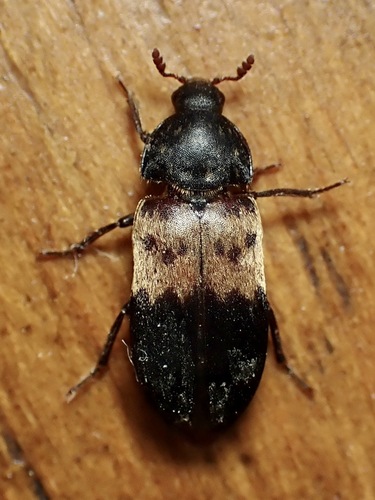
Adult larder beetles are generally 8,5 mm to 9,5 mm long and are dark brown with a broad, pale yellow spotted band across the upper portion of the elytra. The band contains three black dots arranged in a triangle shape. The sternum and legs of the larder beetle are covered in fine, yellow setae. Adult larder beetles are typically found outdoors in protected areas during the winter, but during the spring and early summer they enter buildings. Females lay approximately 135 eggs near a food source, and the eggs will hatch in about 12 days. The life cycle of larder beetles lasts around 40 to 50 days. Wikipedia →
Global Distribution

Parks Where Found

# Park Country Daily sighting probability
1 Acadia National Park 🇺🇸 United States
~10%

More parks will be added in future updates.

Cities Where Found

# City Country Daily sighting probability
1 Anchorage 🇺🇸 United States
~10%
2 Kharkiv 🇺🇦 Ukraine
~10%
3 Helsinki 🇫🇮 Finland
~10%
4 Edmonton 🇨🇦 Canada
~10%
5 Calgary 🇨🇦 Canada
~10%
6 Novosibirsk 🇷🇺 Russia
~10%
7 Kazan 🇷🇺 Russia
<5%
8 Minneapolis [Saint Paul] 🇺🇸 United States
<5%
9 Kyiv 🇺🇦 Ukraine
<5%
10 Saint Petersburg 🇷🇺 Russia
<5%

Before you go

What are the chances of seeing a Larder Beetle in Acadia National Park?

With luck

About 10% of wildlife watchers report a Larder Beetle sighting in Acadia National Park on a given day, based on 9 verified sightings from GBIF citizen-science data from 2019 to 2026. It is the 224th most-seen of the 405 insects we can rate there. Over three days the chance rises to about 20%, and over a week to about 30%, if each day is a fresh chance.

When is the best time to see a Larder Beetle in Acadia National Park?

February and March

In those months about 20% of wildlife watchers report a Larder Beetle in Acadia National Park on a given day, against under 5% in June–August and October–January, the lowest months.

What time of day is best to see a Larder Beetle?

Between noon and 3 pm

Across all the parks we cover, that three-hour window holds the most Larder Beetle sightings with a recorded time, and about 9 in 10 of them come between 6 am and 6 pm: it is a daytime animal.

Where else can you see a Larder Beetle?

Only Acadia National Park, in our data

Acadia National Park is the only park on Wallace's Line with enough records to rate Larder Beetle sightings: about 10% of wildlife watchers there report one on a given day.

Which relatives of the Larder Beetle live in Acadia National Park?

Same order: Coleoptera

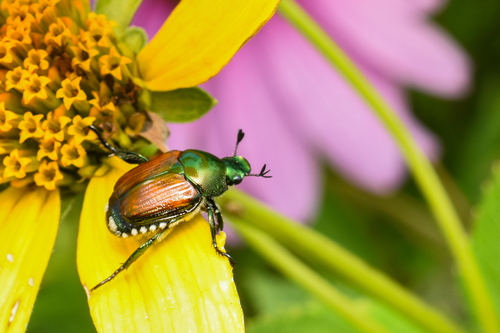
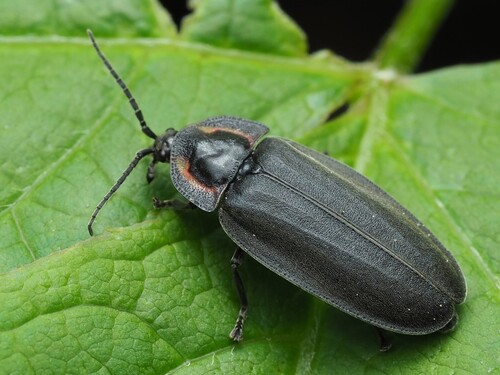
The closest relatives of the Larder Beetle that you can see in Acadia National Park (order Coleoptera, Beetles) are Asian Lady Beetle (about 30%), Japanese Beetle (about 30%) and Winter Firefly (about 20%), with each one's daily chance of a sighting.

Where does the Larder Beetle sighting chance come from?

GBIF citizen-science records

It is estimated from how often the Larder Beetle is recorded against all the insects logged in Acadia National Park (9 verified sightings from 2019 to 2026), calibrated against known sighting rates. Figures are rounded to the nearest 10% because citizen-science data supports honest approximations, not decimals, and months with records from fewer than five people show "—". How it works.

← Back to Acadia National Park