About the White-Spotted Sawyer
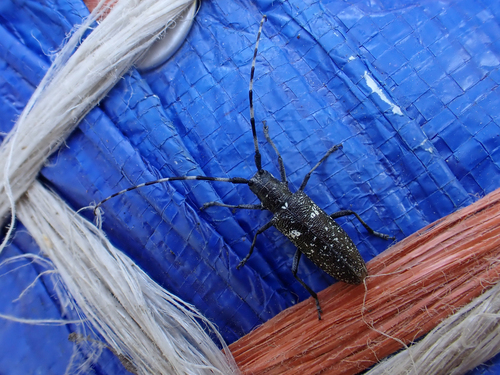
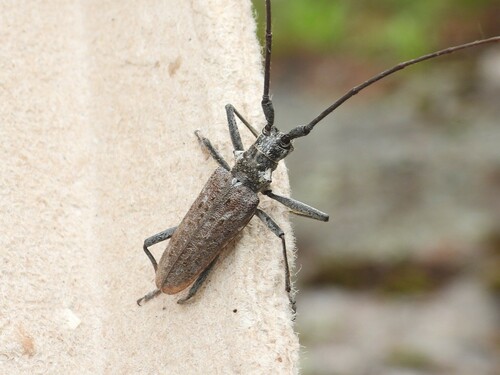
Monochamus scutellatus, commonly known as the white-spotted sawyer or spruce sawyer or spruce bug or a hair-eater, is a common wood-boring beetle found throughout North America. It is a species native to North America. Adults are large-bodied and black, with very long antennae; in males, they can be up to twice the body length, but in females they are only slightly longer than body length. Both sexes have a white spot on the base of the wings, and may have white spots covering the wings. Both males and females also have a spine on the side of the prothorax. Most research done on M. scutellatus focuses on their relationship with burned forests and the logging industry, with interest also being shown in their mating behaviours.
Adults feed preferentially on members of the pine and spruce families for up to seven days after emerging between mid-June and mid-August. After mating, females chew small egg niches into dead or dying trees or logs, into which they deposit one egg each. Both sexes mate repeatedly with different partners, and females have been found to lay between 15 and 20 eggs on average per lifetime. Once the larvae hatch, they burrow into the phloem and... Wikipedia →