
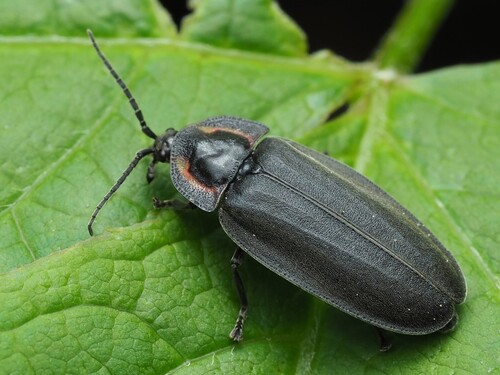
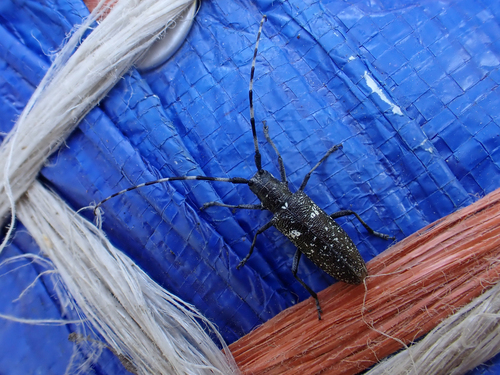
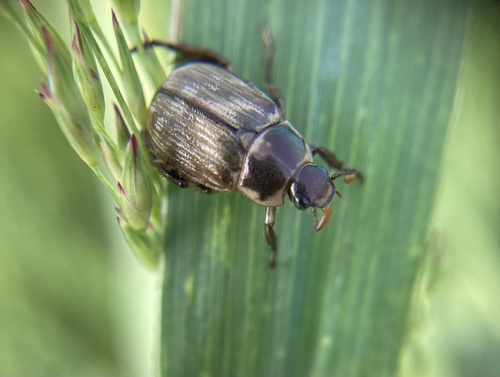
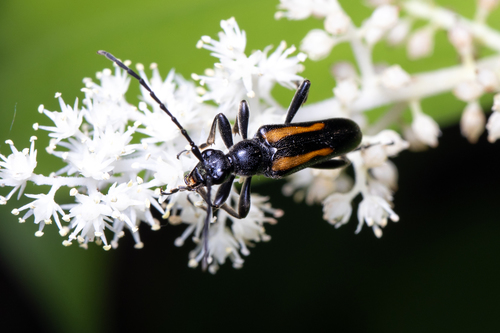

Bronze Ground Beetle

Bronze Ground Beetle

Carabus nemoralis

Daily sighting probability ~10% · With luck
at Acadia National Park

In 3 days ~30% in a week ~60%

45 Verified sightings at Acadia National Park From 2019 to 2026
261 In all 11 parks
April Best month
☀️🌙 Day & Night When it's spotted

About the Bronze Ground Beetle

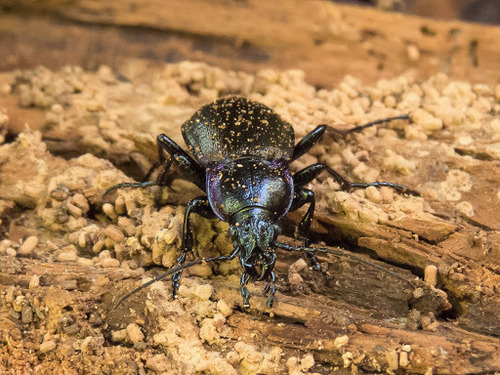
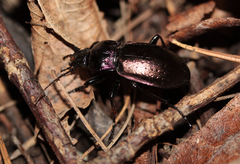
Carabus nemoralis (commonly called the "Bronze carabid") is a ground beetle common in central and northern Europe, as well as Iceland and Canada. While native to Europe, it has been introduced to and is expanding its range throughout North America. It is 20-25mm long and found in many habitats in Great Britain.

Carabus nemoralis is a beneficial predator as it eats the agricultural pest Deroceras reticulatum slug in its young stage and also its eggs. Use of Carabus nemoralis as a biocontrol agent for multiple pests in large scale farming operations have been tested in recent years. Larvae are voracious hunters, resembling rove beetles. They can be found preying on annelids and slugs during early summer months.

It is known that some Carabus nemoralis populations will regurgitate foul-smelling brownish-red liquid as a defense mechanism against predators. Specimens can also fire fecal matter at high speed to a considerable distance, if picked up or otherwise threatened.

Carabus nemoralis typically has one breeding period in the spring with eggs hatching in autumn of the same year. The adults are found all... Wikipedia →

Global Distribution

Parks Where Found

# Park Country Daily sighting probability
1 Białowieża National Park 🇵🇱 Poland
~30%
2 Acadia National Park 🇺🇸 United States
~10%
3 Cape Breton Highlands National Park 🇨🇦 Canada
~10%
4 Pyrénées National Park 🇫🇷 France
~10%
5 Cévennes National Park 🇫🇷 France
~10%
6 Cairngorms National Park 🇬🇧 United Kingdom
~10%
7 Great Bear Rainforest 🇨🇦 Canada
~10%
8 Wadden Sea National Park 🇩🇪 Germany
~10%
9 Bavarian Forest National Park 🇩🇪 Germany
~10%
10 Glacier National Park 🇺🇸 United States
~10%
11 Olympic National Park 🇺🇸 United States
<5%

Cities Where Found

# City Country Daily sighting probability
1 Helsinki 🇫🇮 Finland
~20%
2 Seattle 🇺🇸 United States
~10%
3 Copenhagen 🇩🇰 Denmark
~10%
4 Calgary 🇨🇦 Canada
~10%
5 Nizhny Novgorod 🇷🇺 Russia
~10%
6 Edmonton 🇨🇦 Canada
~10%
7 Kyiv 🇺🇦 Ukraine
~10%
8 Vancouver 🇨🇦 Canada
~10%
9 Portland 🇺🇸 United States
~10%
10 Montreal 🇨🇦 Canada
~10%

Before you go

What are the chances of seeing a Bronze Ground Beetle in Acadia National Park?

With luck

About 10% of wildlife watchers report a Bronze Ground Beetle sighting in Acadia National Park on a given day, based on 45 verified sightings from GBIF citizen-science data from 2019 to 2026. It is the 58th most-seen of the 405 insects we can rate there. Over three days the chance rises to about 30%, and over a week to about 60%, if each day is a fresh chance.

When is the best time to see a Bronze Ground Beetle in Acadia National Park?

April

In that month about 30% of wildlife watchers report a Bronze Ground Beetle in Acadia National Park on a given day, against under 5% in November to February, the lowest months.

What time of day is best to see a Bronze Ground Beetle?

Between 11 am and 2 pm

Across all the parks we cover, that three-hour window holds the most Bronze Ground Beetle sightings with a recorded time, and about 7 in 10 of them come between 6 am and 6 pm: it is seen both by day and at night.

Is Acadia National Park the best place to see a Bronze Ground Beetle?

2nd of 11

Of the 11 parks where we can rate Bronze Ground Beetle sightings, Acadia National Park ranks 2nd at about 10%. The best odds are in Białowieża National Park (Poland, about 30%).

Where does the Bronze Ground Beetle sighting chance come from?

GBIF citizen-science records

It is estimated from how often the Bronze Ground Beetle is recorded against all the insects logged in Acadia National Park (45 verified sightings from 2019 to 2026), calibrated against known sighting rates. Figures are rounded to the nearest 10% because citizen-science data supports honest approximations, not decimals, and months with records from fewer than five people show "—". How it works.

← Back to Acadia National Park