Manx Shearwater

Manx Shearwater

Puffinus puffinus

Silhouette: PhyloPic

LCLeast ConcernNTVUENCR
Daily sighting probability <5% · Rare
at Acadia National Park

In 3 days <5%

29 Verified sightings at Acadia National Park From 2019 to 2026
151 In all 7 parks
July Best month
☀️ Diurnal When it's spotted

About the Manx Shearwater

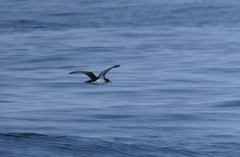
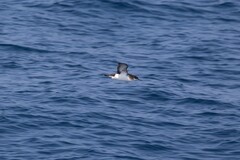
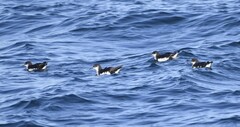
The Manx shearwater (Puffinus puffinus) is a medium-sized shearwater in the seabird family Procellariidae. The scientific name of this species records a name shift: Manx shearwaters were called Manks puffins in the 17th century. Puffin is an Anglo-Norman word (Middle English pophyn) for the cured carcasses of nestling shearwaters. The Atlantic puffin acquired the name much later, possibly because of its similar nesting habits.

The shearwaters form part of the family Procellariidae, a widespread group containing nearly 100 species of medium to large seabirds. They have long, narrow wings and the characteristic "tube nose". Although it was considered a monotypic species, recently an endemic subspecies for the Canary Islands has been proposed P. puffinus canariensis. The large genus Puffinus includes several species formerly considered to be subspecies of the Manx shearwater, including the yelkouan shearwater, Balearic shearwater, Hutton's shearwater, black-vented shearwater, fluttering shearwater, Townsend's shearwater and the Hawaiian shearwater. Of these, the Hawaiian and possibly Townsend's shearwaters seem to be most closely related to the Manx shearwater.

Three extinct... Wikipedia →

Sounds

Song1:08

United Kingdom · 2026

© Anthony McGeehan · XC1165882 · CC BY-NC-SA 4.0

Nocturnal flight call0:18

United Kingdom · 2025

© Sean Morris · XC993117 · CC BY-NC-SA 4.0

Call0:54

United Kingdom · 2022

© Shaun Micklewright · XC746587 · CC BY-NC-SA 4.0

Global Distribution

Parks Where Found

# Park Country Daily sighting probability
1 Kenai Fjords National Park 🇺🇸 United States
<5%
2 Península Valdés 🇦🇷 Argentina
<5%
3 Snowdonia National Park 🇬🇧 United Kingdom
<5%
4 Table Mountain National Park 🇿🇦 South Africa
<5%
5 Great Bear Rainforest 🇨🇦 Canada
<5%
6 Acadia National Park 🇺🇸 United States
<5%
7 Wadden Sea National Park 🇩🇪 Germany
<5%

Cities Where Found

# City Country Daily sighting probability
1 Dakar 🇸🇳 Senegal
~20%
2 Dublin 🇮🇪 Ireland
<5%
3 Boston 🇺🇸 United States
<5%
4 Seattle 🇺🇸 United States
<5%

Before you go

What are the chances of seeing a Manx Shearwater in Acadia National Park?

Rare

Under 5% of wildlife watchers report a Manx Shearwater sighting in Acadia National Park on a given day, based on 29 verified sightings from GBIF citizen-science data from 2019 to 2026. It is the 202nd most-seen of the 243 birds we can rate there. Over three days the chance rises to under 5%, if each day is a fresh chance.

When is the best time to see a Manx Shearwater in Acadia National Park?

Any time of year

In every month with enough records, under 5% of wildlife watchers report a Manx Shearwater in Acadia National Park on a given day, so our monthly data shows no clear season.

What time of day is best to see a Manx Shearwater?

Between 8 and 11 am

Across all the parks we cover, that three-hour window holds the most Manx Shearwater sightings with a recorded time, and nearly all of them come between 6 am and 6 pm: it is a daytime animal.

Is Acadia National Park the best place to see a Manx Shearwater?

Among the best

Of the 7 parks where we can rate Manx Shearwater sightings, Acadia National Park ranks 6th at under 5%, level with the leaders once rounded. The best odds are in Kenai Fjords National Park (United States, under 5%), Península Valdés (Argentina, under 5%) and Snowdonia National Park (United Kingdom, under 5%).

Where does the Manx Shearwater sighting chance come from?

GBIF citizen-science records

It is estimated from how often the Manx Shearwater is recorded against all the birds logged in Acadia National Park (29 verified sightings from 2019 to 2026), calibrated against known sighting rates. Figures are rounded to the nearest 10% because citizen-science data supports honest approximations, not decimals, and months with records from fewer than five people show "—". How it works.

← Back to Acadia National Park