Angola Swallow

Angola Swallow

Hirundo angolensis

Silhouette: Matt Wilkins · PhyloPic

LCLeast ConcernNTVUENCR
Daily sighting probability ~20% · Possible
at Akagera National Park

In 3 days ~40% in a week ~70%

95 Verified sightings at Akagera National Park From 2019 to 2026
2,416 In all 13 parks
July Best month
☀️ Diurnal When it's spotted

About the Angola Swallow

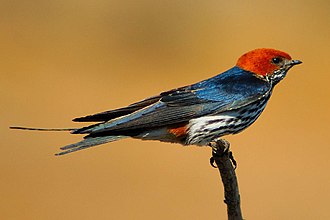
The Angola swallow (Hirundo angolensis) is a species of swallow that is native to the Afrotropics. They measure 15 cm and weigh 16 to 19 g. The plumage of the forehead, throat and upper breast is coloured deep rufous-chestnut. The crown and upperparts are a shiny steel-blue. Flight and tail feathers are black, the latter with large white windows.

They frequent a variety of open habitats up to the fringes of forest, whether altered by man or natural. Their diet consists of a variety of flying insects. They may forage alone or in flocks, and emit a weak twittering. Their breeding season and abundance depends much on their region of residence, and a few undertake migrations.

It is found in Angola, Burundi, Democratic Republic of the Congo, Gabon, Kenya, Malawi, Namibia, Rwanda, Tanzania, Uganda, and Zambia. It has been considered conspecific with the Red-chested swallow, but is generally taken as a full species in a species complex that includes Barn, Red-chested, Pacific, Welcome, White-throated and Ethiopian swallows.

There are two subspecies, but intermediate forms occur: H. a. angolensis – type from... Wikipedia →

Sounds

Song0:22

Zambia · 2023

© Dries Van de Loock · XC860438 · CC BY-NC-ND 4.0

Call0:39

Uganda · 2022

© Peter Boesman · XC739707 · CC BY-NC-ND 4.0

Flight call0:23

Tanzania · 2017

© Frank Lambert · XC429729 · CC BY-NC-ND 4.0

Global Distribution

Parks Where Found

# Park Country Daily sighting probability
1 Nyungwe National Park 🇷🇼 Rwanda
~30%
2 Bwindi Impenetrable National Park 🇺🇬 Uganda
~30%
3 Virunga National Park 🇨🇩 Democratic Republic of the Congo
~20%
4 Kibale National Park 🇺🇬 Uganda
~20%
5 Akagera National Park 🇷🇼 Rwanda
~20%
6 Queen Elizabeth National Park 🇺🇬 Uganda
~20%
7 Murchison Falls National Park 🇺🇬 Uganda
~20%
8 Lake Mburo National Park 🇺🇬 Uganda
~10%
9 Semuliki National Park 🇺🇬 Uganda
~10%
10 Volcanoes National Park 🇷🇼 Rwanda
~10%
11 Masai Mara National Reserve 🇰🇪 Kenya
<5%
12 Serengeti National Park 🇹🇿 Tanzania
<5%
13 Kidepo Valley National Park 🇺🇬 Uganda
<5%

Cities Where Found

# City Country Daily sighting probability
1 Kigali 🇷🇼 Rwanda
~10%
2 Luanda 🇦🇴 Angola
~10%
3 Kampala 🇺🇬 Uganda
~10%
4 Brazzaville 🇨🇬 Republic of the Congo
~10%

Before you go

What are the chances of seeing an Angola Swallow in Akagera National Park?

Possible

About 20% of wildlife watchers report an Angola Swallow sighting in Akagera National Park on a given day, based on 95 verified sightings from GBIF citizen-science data from 2019 to 2026. It is the 105th most-seen of the 320 birds we can rate there. Over three days the chance rises to about 40%, and over a week to about 70%, if each day is a fresh chance.

When is the best time to see an Angola Swallow in Akagera National Park?

July

In that month about 30% of wildlife watchers report an Angola Swallow in Akagera National Park on a given day, against about 10% in March–May, September and November–January, the lowest months. That is one of Akagera National Park's driest months, with almost no rain against 110 mm in November.

What time of day is best to see an Angola Swallow?

Between 7 and 10 am

Across all the parks we cover, that three-hour window holds the most Angola Swallow sightings with a recorded time, and about 9 in 10 of them come between 6 am and 6 pm: it is a daytime animal.

Where does the Angola Swallow sighting chance come from?

GBIF citizen-science records

It is estimated from how often the Angola Swallow is recorded against all the birds logged in Akagera National Park (95 verified sightings from 2019 to 2026), calibrated against known sighting rates. Figures are rounded to the nearest 10% because citizen-science data supports honest approximations, not decimals, and months with records from fewer than five people show "—". How it works.

← Back to Akagera National Park