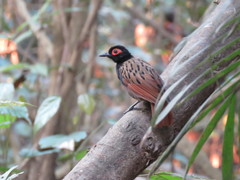
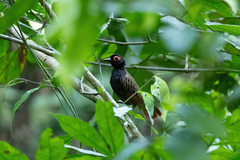
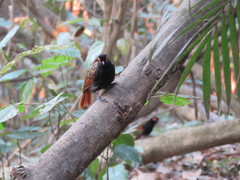

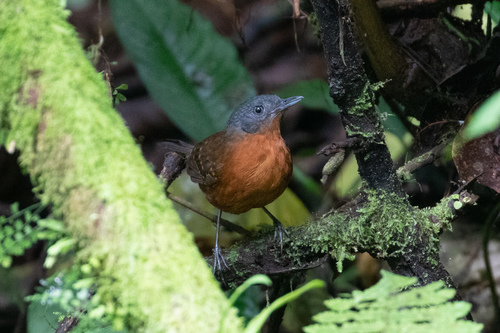
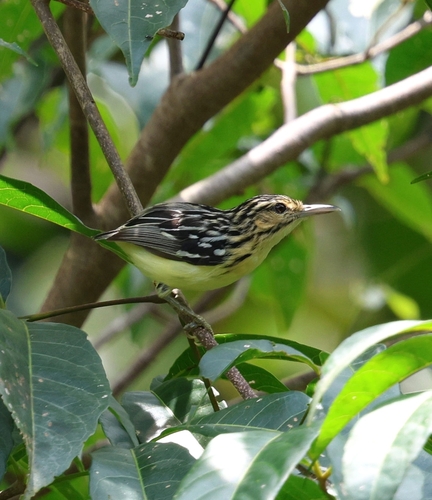
Black-spotted Bare-eye

Black-spotted Bare-eye

Phlegopsis nigromaculata

Silhouette: Sheatherius · PhyloPic

LCLeast ConcernNTVUENCR
Daily sighting probability ~10% · With luck
at Amacayacu National Natural Park

In 3 days ~20% in a week ~40%

51 Verified sightings at Amacayacu National Natural Park From 2019 to 2026
784 In all 5 parks
August Best month
☀️ Diurnal When it's spotted

About the Black-spotted Bare-eye

The black-spotted bare-eye (Phlegopsis nigromaculata) is a species of insectivore passerine bird in subfamily Thamnophilinae of family Thamnophilidae, the "typical antbirds". It is found in Bolivia, Brazil, Colombia, Ecuador, and Peru.

The black-spotted bare-eye was described by the French naturalists Alcide d'Orbigny and Frédéric de Lafresnaye in 1837 and given the binomial name Myothera nigro-maculata. The specific epithet combines the Latin words niger for "black" and maculatus for "spotted".

The black-spotted bare-eye has these four subspecies: The sexes are alike. Both have a large ring of bare red skin around the eye. Adults of the nominate subspecies P. n. nigromaculata have a black head, neck, throat, and upper belly. Their upperparts are light olive with lengthwise oval black spots that have pale yellowish olive-brown edges. Their flight feathers are cinnamon-rufous and their tail... Wikipedia →

Sounds

Alarm call0:33

Ecuador · 2026

© Manuel Sánchez-Nivicela · XC1181985 · CC BY-NC-ND 4.0

Song0:06

Brazil · 2023

© JAYRSON ARAUJO DE OLIVEIRA · XC830319 · CC BY-NC-SA 4.0

Call0:23

Brazil · 2021

© Felipe Arantes · XC694220 · CC BY-NC-SA 4.0

Global Distribution

Parks Where Found

# Park Country Daily sighting probability
1 Tambopata National Reserve 🇵🇪 Peru
~10%
2 Amacayacu National Natural Park 🇨🇴 Colombia
~10%
3 Manu National Park 🇵🇪 Peru
~10%
4 Yasuní National Park 🇪🇨 Ecuador
<5%
5 Cuyabeno Wildlife Reserve 🇪🇨 Ecuador
<5%

Before you go

What are the chances of seeing a Black-spotted Bare-eye in Amacayacu National Natural Park?

With luck

About 10% of wildlife watchers report a Black-spotted Bare-eye sighting in Amacayacu National Natural Park on a given day, based on 51 verified sightings from GBIF citizen-science data from 2019 to 2026. It is the 201st most-seen of the 436 birds we can rate there. Over three days the chance rises to about 20%, and over a week to about 40%, if each day is a fresh chance.

When is the best time to see a Black-spotted Bare-eye in Amacayacu National Natural Park?

August

In that month about 30% of wildlife watchers report a Black-spotted Bare-eye in Amacayacu National Natural Park on a given day, against under 5% in December to June, the lowest months. That is one of Amacayacu National Natural Park's driest months, with about 160 mm of rain against 390 mm in March.

What time of day is best to see a Black-spotted Bare-eye?

Between 8 and 11 am

Across all the parks we cover, that three-hour window holds the most Black-spotted Bare-eye sightings with a recorded time, and about 9 in 10 of them come between 6 am and 6 pm: it is a daytime animal.

Is Amacayacu National Natural Park the best place to see a Black-spotted Bare-eye?

Among the best

Of the 5 parks where we can rate Black-spotted Bare-eye sightings, Amacayacu National Natural Park ranks 2nd at about 10%, level with the leaders once rounded. The best odds are in Tambopata National Reserve (Peru, about 10%).

Which relatives of the Black-spotted Bare-eye live in Amacayacu National Natural Park?

Same family: Thamnophilidae

The closest relatives of the Black-spotted Bare-eye that you can see in Amacayacu National Natural Park (family Thamnophilidae, Typical Antbirds) are Peruvian Warbling-Antbird (about 30%), Barred Antshrike (about 20%) and Mouse-colored Antshrike (about 20%), with each one's daily chance of a sighting.

Where does the Black-spotted Bare-eye sighting chance come from?

GBIF citizen-science records

It is estimated from how often the Black-spotted Bare-eye is recorded against all the birds logged in Amacayacu National Natural Park (51 verified sightings from 2019 to 2026), calibrated against known sighting rates. Figures are rounded to the nearest 10% because citizen-science data supports honest approximations, not decimals, and months with records from fewer than five people show "—". How it works.

← Back to Amacayacu National Natural Park