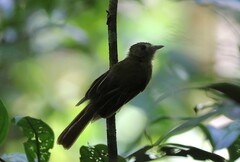
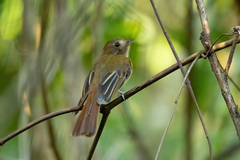
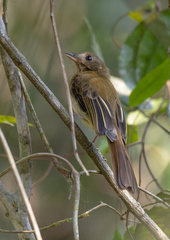

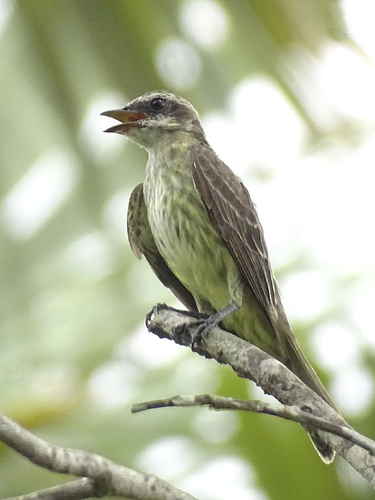
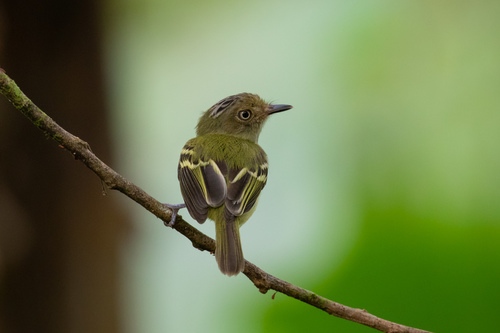
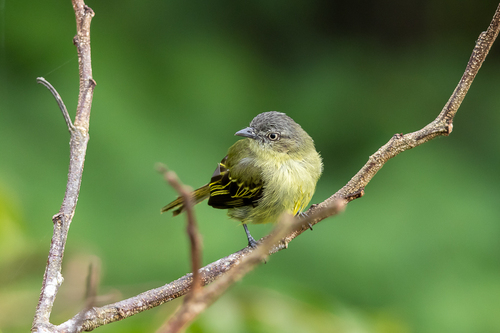
Brownish Flycatcher

Brownish Flycatcher

Cnipodectes subbrunneus

Silhouette: Emily Willoughby · PhyloPic

LCLeast ConcernNTVUENCR
Daily sighting probability ~20% · Possible
at Amacayacu National Natural Park

In 3 days ~40% in a week ~70%

110 Verified sightings at Amacayacu National Natural Park From 2019 to 2026
314 In all 4 parks
January Best month
☀️ Diurnal When it's spotted

About the Brownish Flycatcher

The brownish twistwing (Cnipodectes subbrunneus) is a species of bird in the family Tyrannidae, the tyrant flycatchers. It is found in Bolivia, Brazil, Colombia, Ecuador, Panama, and Peru. The brownish twistwing was originally described in 1860 as Cyclorhynchus subbrunneus. It eventually acquired the English name "brownish flycatcher" and still later was called "brown flycatcher" by a few authors. Following suggestions put forward in 1994 taxonomists gradually adopted the name brownish twistwing. It was the sole member of genus Cnipodectes until the rufous twistwing (C. superrufus) was described in 2007.

The brownish twistwing is 14 to 18 cm (5.5 to 7.1 in) long. The sexes have almost the same plumage; males are larger than females. Adult males of the nominate subspecies are mostly dull brown. They have a slight grayish tinge on the crown, buff lores, and prominent rictal bristles. Their wings are somewhat duskier with thin rufous-buff edges on the coverts and tertials. Their outer primaries have stiff twisted... Wikipedia →

Sounds

Song0:59

Ecuador · 2019

© Jerome Fischer · XC476291 · CC BY-NC-SA 4.0

Call1:09

Brazil · 2019

© GABRIEL LEITE · XC474607 · CC BY-NC-SA 4.0

Alarm call0:38

Ecuador · 1994

© Niels Krabbe · XC249076 · CC BY-SA 4.0

Global Distribution

Parks Where Found

# Park Country Daily sighting probability
1 Amacayacu National Natural Park 🇨🇴 Colombia
~20%
2 Darién National Park 🇵🇦 Panama
<5%
3 Yasuní National Park 🇪🇨 Ecuador
<5%
4 Soberanía National Park 🇵🇦 Panama
<5%

Before you go

What are the chances of seeing a Brownish Flycatcher in Amacayacu National Natural Park?

Possible

About 20% of wildlife watchers report a Brownish Flycatcher sighting in Amacayacu National Natural Park on a given day, based on 110 verified sightings from GBIF citizen-science data from 2019 to 2026. It is the 95th most-seen of the 436 birds we can rate there. Over three days the chance rises to about 40%, and over a week to about 70%, if each day is a fresh chance.

When is the best time to see a Brownish Flycatcher in Amacayacu National Natural Park?

January

In that month about 30% of wildlife watchers report a Brownish Flycatcher in Amacayacu National Natural Park on a given day, against about 10% in February–March, May–August and November–December, the lowest months.

What time of day is best to see a Brownish Flycatcher?

Between 9 am and noon

Across all the parks we cover, that three-hour window holds the most Brownish Flycatcher sightings with a recorded time, and about 9 in 10 of them come between 6 am and 6 pm: it is a daytime animal.

Is Amacayacu National Natural Park the best place to see a Brownish Flycatcher?

Yes

Of the 4 parks where we can rate Brownish Flycatcher sightings, Amacayacu National Natural Park has the highest daily chance: about 20%. Next come Darién National Park (Panama, under 5%) and Yasuní National Park (Ecuador, under 5%).

Which relatives of the Brownish Flycatcher live in Amacayacu National Natural Park?

Same family: Tyrannidae

The closest relatives of the Brownish Flycatcher that you can see in Amacayacu National Natural Park (family Tyrannidae, Tyrant Flycatchers) are Tropical Kingbird (about 40%), Great Kiskadee (about 40%) and Yellow-crowned Tyrannulet (about 30%), with each one's daily chance of a sighting.

Where does the Brownish Flycatcher sighting chance come from?

GBIF citizen-science records

It is estimated from how often the Brownish Flycatcher is recorded against all the birds logged in Amacayacu National Natural Park (110 verified sightings from 2019 to 2026), calibrated against known sighting rates. Figures are rounded to the nearest 10% because citizen-science data supports honest approximations, not decimals, and months with records from fewer than five people show "—". How it works.

← Back to Amacayacu National Natural Park