
Plumbeous Antbird

Plumbeous Antbird

Myrmeciza hyperythra

Silhouette: Sheatherius · PhyloPic

Daily sighting probability <5% · Rare
at Amacayacu National Natural Park

In 3 days ~10% in a week ~30%

31 Verified sightings at Amacayacu National Natural Park From 2019 to 2026
1,050 In all 5 parks
October Best month
☀️ Diurnal When it's spotted

About the Plumbeous Antbird

The plumbeous antbird (Myrmelastes hyperythrus) is a species of bird in subfamily Thamnophilinae of family Thamnophilidae, the "typical antbirds". It is found in Bolivia, Brazil, Colombia, Ecuador, and Peru. The plumbeous antbird was described by the English zoologist Philip Sclater in 1855 and given the binomial name Thamnophilus hyperythrus. The specific name combines the Ancient Greek words hupo "beneath" and eruthros "red". Alternatively, the name may be from the Greek word huperuthros for "reddish". The current genus Myrmelastes was introduced by Sclater in 1858 with the plumbeous antbird as the type species. This placement was confirmed by a genetic study published in 2013.

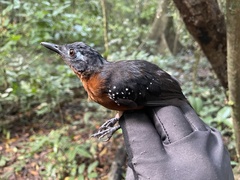
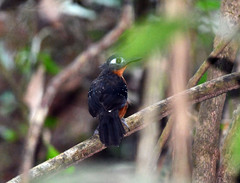
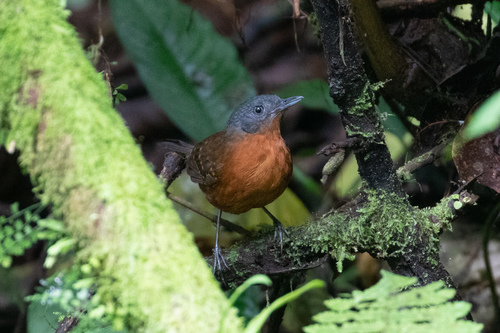
The plumbeous antbird is monotypic. The plumbeous antbird is 17 to 18 cm (6.7 to 7.1 in) long and weighs 38 to 44 g (1.3 to 1.6 oz). Males are mostly dark slaty gray. Their wings and tail are blackish gray with white spots at the tips of the wing coverts. They have a large area of bare light blue skin around their eye. Females have dark slaty gray upperparts, wings, and tail like males. Their underparts are bright rufous with a brown tinge on their flanks and... Wikipedia →

Sounds

Recording0:24

Peru · 2008

© dbeadle · iNaturalist · CC BY-NC 4.0

Recording0:44

Brazil · 2020

© Marllus Rafael Almeida · iNaturalist · CC BY-NC 4.0

Recording0:34

Brazil · 2024

© Luciano Bernardes · iNaturalist · CC BY-NC 4.0

Global Distribution

Parks Where Found

# Park Country Daily sighting probability
1 Tambopata National Reserve 🇵🇪 Peru
~10%
2 Yasuní National Park 🇪🇨 Ecuador
~10%
3 Manu National Park 🇵🇪 Peru
~10%
4 Cuyabeno Wildlife Reserve 🇪🇨 Ecuador
~10%
5 Amacayacu National Natural Park 🇨🇴 Colombia
<5%

Before you go

What are the chances of seeing a Plumbeous Antbird in Amacayacu National Natural Park?

Rare

Under 5% of wildlife watchers report a Plumbeous Antbird sighting in Amacayacu National Natural Park on a given day, based on 31 verified sightings from GBIF citizen-science data from 2019 to 2026. It is the 270th most-seen of the 436 birds we can rate there. Over three days the chance rises to about 10%, and over a week to about 30%, if each day is a fresh chance.

When is the best time to see a Plumbeous Antbird in Amacayacu National Natural Park?

January–February and October

In those months about 10% of wildlife watchers report a Plumbeous Antbird in Amacayacu National Natural Park on a given day, against under 5% in March–September and November–December, the lowest months.

What time of day is best to see a Plumbeous Antbird?

Between 9 am and noon

Across all the parks we cover, that three-hour window holds the most Plumbeous Antbird sightings with a recorded time, and about 7 in 10 of them come between 6 am and 6 pm: it is a daytime animal.

Is Amacayacu National Natural Park the best place to see a Plumbeous Antbird?

5th of 5

Of the 5 parks where we can rate Plumbeous Antbird sightings, Amacayacu National Natural Park ranks 5th at under 5%. The best odds are in Tambopata National Reserve (Peru, about 10%), Yasuní National Park (Ecuador, about 10%) and Manu National Park (Peru, about 10%).

Where does the Plumbeous Antbird sighting chance come from?

GBIF citizen-science records

It is estimated from how often the Plumbeous Antbird is recorded against all the birds logged in Amacayacu National Natural Park (31 verified sightings from 2019 to 2026), calibrated against known sighting rates. Figures are rounded to the nearest 10% because citizen-science data supports honest approximations, not decimals, and months with records from fewer than five people show "—". How it works.

← Back to Amacayacu National Natural Park