Western Pygmy Marmoset

Western Pygmy Marmoset

Cebuella pygmaea

Silhouette: T. Michael Keesey · PhyloPic

LCNTVUVulnerableENCR
Daily sighting probability ~30% · Possible
at Amacayacu National Natural Park

In 3 days ~60% in a week ~90%

23 Verified sightings at Amacayacu National Natural Park From 2019 to 2026
122 In all 3 parks
February Best month
☀️ Diurnal When it's spotted

About the Western Pygmy Marmoset

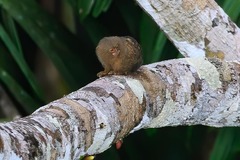
The western pygmy marmoset (Cebuella pygmaea) is a marmoset species, a very small New World monkey found in the northwestern Amazon rainforest in Brazil, Colombia, Ecuador, and Peru. It was formerly regarded as conspecific with the similar eastern pygmy marmoset, which has whitish underparts. Although the western pygmy marmoset occurs further west than the eastern pygmy marmoset, the primary separators of their ranges are the Amazon River (Solimões River) and Marañón River, with the western occurring to the north of them and the eastern to the south.

The western pygmy marmoset is the world's smallest monkey. Pygmy marmosets have only a slight degree of sexual dimorphism; in the wild the average male weighs 110 g (3.9 oz), which is slightly smaller than the average female at 122 g (4.3 oz). Fully grown western pygmy marmosets have an average body length of 13 cm (5.1 in), and a tail marked with black rings that is on average longer than their bodies at 20 cm (7.9 in). They have fluffy "brownish-gold fur with black ticking on their shoulders, backs, and heads, while their ventral fur is light yellow to white". There are very little visible physical differences... Wikipedia →

Sounds

Call0:20

Colombia · 1987

© Frank Lambert · XC1031607 · CC BY-NC-ND 4.0

Territorial call0:11

Brazil · 2008

© Dante Buzzetti · XC959862 · CC BY-NC-SA 4.0

Recording0:07

Colombia · 2024

© Moses J. Michelsohn · iNaturalist · CC BY-NC 4.0

Global Distribution

Parks Where Found

# Park Country Daily sighting probability
1 Yasuní National Park 🇪🇨 Ecuador
~30%
2 Amacayacu National Natural Park 🇨🇴 Colombia
~30%
3 Cuyabeno Wildlife Reserve 🇪🇨 Ecuador
~10%

Zoos & Centres Where Found

# Zoo / Centre Country
1 ZooParc de Beauval 🇫🇷 France In captivity
2 Natura Artis Magistra 🇳🇱 Netherlands In captivity
3 Zoo Pilsen 🇨🇿 Czechia In captivity
4 Zoobotánico Jerez 🇪🇸 Spain In captivity
5 Parque Temático Hacienda Nápoles 🇨🇴 Colombia In captivity
6 Minnesota Zoo 🇺🇸 United States In captivity
7 Bronx Zoo 🇺🇸 United States In captivity
8 Tallinn Zoo 🇪🇪 Estonia In captivity
9 Dallas Zoo 🇺🇸 United States In captivity
10 Jacksonville Zoo and Gardens 🇺🇸 United States In captivity
11 Yaroslavl Zoo 🇷🇺 Russia In captivity
12 Colchester Zoo 🇬🇧 United Kingdom In captivity
13 Edinburgh Zoo 🇬🇧 United Kingdom In captivity
14 Calgary Zoo 🇨🇦 Canada In captivity
15 Darling Downs Zoo 🇦🇺 Australia In captivity
16 Tierwelt Herberstein 🇦🇹 Austria In captivity
17 Wilhelma 🇩🇪 Germany In captivity
18 Parc Zoologique et Botanique de Mulhouse 🇫🇷 France In captivity
19 Perth Zoo 🇦🇺 Australia In captivity
20 Zoologischer Garten Magdeburg 🇩🇪 Germany In captivity
21 Auckland Zoo 🇳🇿 New Zealand In captivity
22 Faunia 🇪🇸 Spain In captivity
23 bioparco 🇮🇹 Italy In captivity
24 Plock Zoo 🇵🇱 Poland In captivity
25 Tiergarten Straubing 🇩🇪 Germany In captivity
26 Hertfordshire Zoo 🇬🇧 United Kingdom In captivity
27 Parque de las Leyendas 🇵🇪 Peru In captivity
28 Skopje Zoo 🇲🇰 North Macedonia In captivity
29 Santa Ana Zoo 🇺🇸 United States In captivity
30 Pyrénées Animal Park 🇫🇷 France In captivity
31 Touroparc Zoo 🇫🇷 France In captivity
32 Hong Kong Zoological and Botanical Gardens 🇨🇳 China In captivity
33 Zoo de Córdoba 🇪🇸 Spain In captivity
34 Parque de la Conservación 🇨🇴 Colombia In captivity
35 Santillana Zoo 🇪🇸 Spain In captivity
36 Papiliorama 🇨🇭 Switzerland In captivity
37 Zoo Lagos 🇵🇹 Portugal In captivity
38 zoologico de barranquilla 🇨🇴 Colombia In captivity
39 Randers Tropical Zoo 🇩🇰 Denmark In captivity
40 Adventure Aquarium 🇺🇸 United States In captivity
41 Aquarium Barcelona 🇪🇸 Spain In captivity
42 Castellar Zoo 🇪🇸 Spain In captivity
43 Ковчег 🇷🇺 Russia In captivity
44 't Brinkie 🇳🇱 Netherlands In captivity
45 Aquarium River of Zaragoza 🇪🇸 Spain In captivity
46 Jenkinson's Aquarium 🇺🇸 United States In captivity
47 Tropical World 🇮🇪 Ireland In captivity
48 Baltic Sea Science Center 🇸🇪 Sweden In captivity
49 akwarium warszawskiego ZOO 🇵🇱 Poland In captivity
50 Bangkok Aquarium 🇹🇭 Thailand In captivity

Before you go

What are the chances of seeing a Western Pygmy Marmoset in Amacayacu National Natural Park?

Possible

About 30% of wildlife watchers report a Western Pygmy Marmoset sighting in Amacayacu National Natural Park on a given day, based on 23 verified sightings from GBIF citizen-science data from 2019 to 2026. It is the 5th most-seen of the 9 mammals we can rate there. Over three days the chance rises to about 60%, and over a week to about 90%, if each day is a fresh chance.

When is the best time to see a Western Pygmy Marmoset in Amacayacu National Natural Park?

February and October

In those months about 40% of wildlife watchers report a Western Pygmy Marmoset in Amacayacu National Natural Park on a given day, against under 5% in March and December, the lowest months.

What time of day is best to see a Western Pygmy Marmoset?

Between 3 and 6 pm

Across all the parks we cover, that three-hour window holds the most Western Pygmy Marmoset sightings with a recorded time, and about 9 in 10 of them come between 6 am and 6 pm: it is a daytime animal.

Is Amacayacu National Natural Park the best place to see a Western Pygmy Marmoset?

Among the best

Of the 3 parks where we can rate Western Pygmy Marmoset sightings, Amacayacu National Natural Park ranks 2nd at about 30%, level with the leaders once rounded. The best odds are in Yasuní National Park (Ecuador, about 30%).

Where does the Western Pygmy Marmoset sighting chance come from?

GBIF citizen-science records

It is estimated from how often the Western Pygmy Marmoset is recorded against all the mammals logged in Amacayacu National Natural Park (23 verified sightings from 2019 to 2026), calibrated against known sighting rates. Figures are rounded to the nearest 10% because citizen-science data supports honest approximations, not decimals, and months with records from fewer than five people show "—". How it works.

← Back to Amacayacu National Natural Park