Andean Swift

Andean Swift

Aeronautes andecolus

Silhouette: Aviceda (vectorized by T. Michael Keesey) · PhyloPic

LCLeast ConcernNTVUENCR
Daily sighting probability ~10% · With luck
at Amboró National Park

In 3 days ~20% in a week ~30%

25 Verified sightings at Amboró National Park From 2019 to 2026
63 In all 2 parks
September Best month
☀️ Diurnal When it's spotted

About the Andean Swift

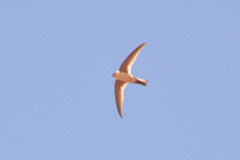
The Andean swift (Aeronautes andecolus) is a species of bird in subfamily Apodinae of the swift family Apodidae. It is found in Argentina, Bolivia, Chile, and Peru. The Andean swift was at one time placed in genus Micropus which was later merged into Aeronautes, and also in genus Apus from which it was split.

The Andean swift is about 14 cm (5.5 in) long. It has sharply pointed wings and a long deeply forked tail. The sexes are alike. Adults of the nominate subspecies have mostly black upperparts with a white collar and band on the rump. Their face and underparts are mostly white to off-white with mottled buff on the flanks and vent. Its tail is shorter and less deeply forked, its white plumage is purer, and it has darker undertail coverts.

Subspecies A. a. parvulus of the Andean swift is the northernmost; it is found on the western... Wikipedia →

Sounds

Call0:34

Bolivia · 2021

© Richard E. Webster · XC708139 · CC BY-NC-SA 4.0

Flight call0:37

Chile · 2015

© Fabrice Schmitt · XC336399 · CC BY-NC-SA 4.0

Song1:15

Chile · 2001

© Alvaro Jaramillo · XC60141 · CC BY-NC-ND 2.5

Global Distribution

Parks Where Found

# Park Country Daily sighting probability
1 Amboró National Park 🇧🇴 Bolivia
~10%
2 Lauca National Park 🇨🇱 Chile
~10%

Cities Where Found

# City Country Daily sighting probability
1 La Paz 🇧🇴 Bolivia
~30%
2 Arequipa 🇵🇪 Peru
<5%

Before you go

What are the chances of seeing an Andean Swift in Amboró National Park?

With luck

About 10% of wildlife watchers report an Andean Swift sighting in Amboró National Park on a given day, based on 25 verified sightings from GBIF citizen-science data from 2019 to 2026. It is the 122nd most-seen of the 273 birds we can rate there. Over three days the chance rises to about 20%, and over a week to about 30%, if each day is a fresh chance.

When is the best time to see an Andean Swift in Amboró National Park?

May, July and September

In those months about 10% of wildlife watchers report an Andean Swift in Amboró National Park on a given day, against under 5% in August and October–April, the lowest months. June has too few records to rate.

What time of day is best to see an Andean Swift?

Between 8 and 11 am

Across all the parks we cover, that three-hour window holds the most Andean Swift sightings with a recorded time, and about 9 in 10 of them come between 6 am and 6 pm: it is a daytime animal.

Is Amboró National Park the best place to see an Andean Swift?

Yes

Of the 2 parks where we can rate Andean Swift sightings, Amboró National Park has the highest daily chance: about 10%. Next come Lauca National Park (Chile, about 10%).

Where does the Andean Swift sighting chance come from?

GBIF citizen-science records

It is estimated from how often the Andean Swift is recorded against all the birds logged in Amboró National Park (25 verified sightings from 2019 to 2026), calibrated against known sighting rates. Figures are rounded to the nearest 10% because citizen-science data supports honest approximations, not decimals, and months with records from fewer than five people show "—". How it works.

← Back to Amboró National Park