Black-backed Grosbeak

Black-backed Grosbeak

Pheucticus aureoventris

Silhouette: Sheatherius · PhyloPic

LCLeast ConcernNTVUENCR
Daily sighting probability <5% · Rare
at Amboró National Park

In 3 days ~10% in a week ~20%

14 Verified sightings at Amboró National Park From 2019 to 2026
50 In all 4 parks
May Best month
☀️ Diurnal When it's spotted

About the Black-backed Grosbeak

The black-backed grosbeak (Pheucticus aureoventris) is a bird in the family Cardinalidae, the cardinals or cardinal grosbeaks. It is found in Argentina, Brazil, Bolivia, Colombia, Ecuador, Paraguay, Peru, and Venezuela. They are often kept as cagebirds.

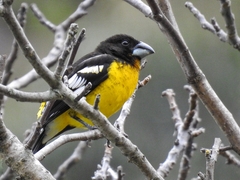
There is some evidence that the black-backed grosbeak may be paraphyletic with respect to golden grosbeak (Pheucticus chrysogaster). Their ranges overlap in Peru. The black-backed grosbeak is approximately 22 cm (8.7 in) long and weighs 43.8 to 66.2 grams (1.54 to 2.34 oz). All of the subspecies except P. a. crissalis are very similar. The males' upperparts are black with a yellow shoulder patch; the closed wings show white patches. The chin, throat, and upper breast are also black. The lower breast and belly are bright yellow with a variable amount of black flecking on the sides and flanks. The female is similar but browner and has... Wikipedia →

Sounds

Song0:22

Peru · 2022

© David F. Belmonte · XC707848 · CC BY-NC-SA 4.0

Call0:23

Argentina · 2013

© Peter Boesman · XC272629 · CC BY-NC-ND 4.0

?0:38

Colombia · 2010

© Pablo Florez · XC75983 · CC BY-NC-ND 2.5

Global Distribution

Parks Where Found

# Park Country Daily sighting probability
1 Amboró National Park 🇧🇴 Bolivia
<5%
2 El Impenetrable National Park 🇦🇷 Argentina
<5%
3 Chingaza National Natural Park 🇨🇴 Colombia
<5%
4 Manu National Park 🇵🇪 Peru
<5%

Cities Where Found

# City Country Daily sighting probability
1 Bogota 🇨🇴 Colombia
~10%
2 Cochabamba 🇧🇴 Bolivia
~10%
3 Santa Cruz de la Sierra 🇧🇴 Bolivia
<5%

Zoos & Centres Where Found

# Zoo / Centre Country
1 Temaikén 🇦🇷 Argentina In captivity

Before you go

What are the chances of seeing a Black-backed Grosbeak in Amboró National Park?

Rare

Under 5% of wildlife watchers report a Black-backed Grosbeak sighting in Amboró National Park on a given day, based on 14 verified sightings from GBIF citizen-science data from 2019 to 2026. It is the 155th most-seen of the 273 birds we can rate there. Over three days the chance rises to about 10%, and over a week to about 20%, if each day is a fresh chance.

When is the best time to see a Black-backed Grosbeak in Amboró National Park?

May and October

In those months about 10% of wildlife watchers report a Black-backed Grosbeak in Amboró National Park on a given day, against under 5% in July–September and November–April, the lowest months. June has too few records to rate.

What time of day is best to see a Black-backed Grosbeak?

Between 7 and 10 am

Across all the parks we cover, that three-hour window holds the most Black-backed Grosbeak sightings with a recorded time, and about 9 in 10 of them come between 6 am and 6 pm: it is a daytime animal.

Is Amboró National Park the best place to see a Black-backed Grosbeak?

Yes

Of the 4 parks where we can rate Black-backed Grosbeak sightings, Amboró National Park has the highest daily chance: under 5%. Next come El Impenetrable National Park (Argentina, under 5%) and Chingaza National Natural Park (Colombia, under 5%).

Where does the Black-backed Grosbeak sighting chance come from?

GBIF citizen-science records

It is estimated from how often the Black-backed Grosbeak is recorded against all the birds logged in Amboró National Park (14 verified sightings from 2019 to 2026), calibrated against known sighting rates. Figures are rounded to the nearest 10% because citizen-science data supports honest approximations, not decimals, and months with records from fewer than five people show "—". How it works.

← Back to Amboró National Park


