
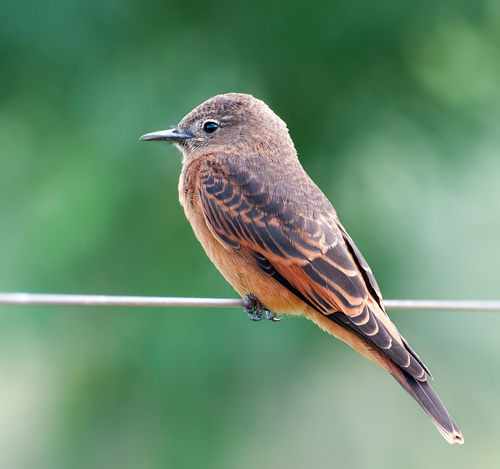
Black Phoebe

Black Phoebe

Sayornis nigricans

Silhouette: Emily Willoughby · PhyloPic

LCLeast ConcernNTVUENCR
Daily sighting probability ~60% · Likely
at Amboró National Park

In 3 days ~90% in a week >90%

311 Verified sightings at Amboró National Park From 2019 to 2026
20,260 In all 45 parks
March Best month
☀️ Diurnal When it's spotted

About the Black Phoebe

The black phoebe (Sayornis nigricans) is a passerine bird in the tyrant-flycatcher family. It breeds from southwest Oregon and California south through Central and South America. It occurs year-round throughout most of its range and migrates less than the other birds in its genus though its northern populations are partially migratory. Six subspecies are commonly recognized although two are occasionally combined as a separate species, the white-winged phoebe.

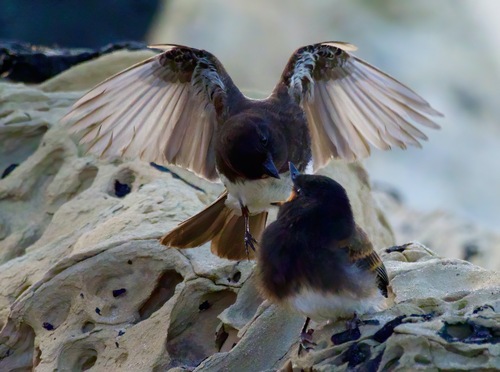
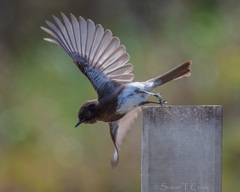
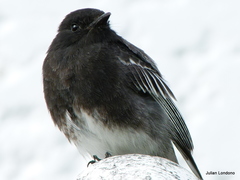
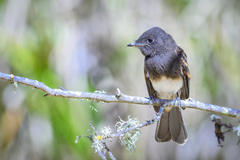
The black phoebe has predominantly black plumage, with a white belly and undertail coverts. The sexes are identical in color, and juveniles have brown feather tips and brown wing-bars. Its song is a repeated tee-hee, tee ho. It lives in a variety of habitats but is always near water. It is mainly insectivorous and waits on a perch before sallying out and catching its prey in the air. It makes an open cup nest which is placed under a cliff or a bridge and cemented in its place with mud.

The black phoebe is a medium-sized flycatcher, being 16 cm (6.3 in) in length and weighing 15 to 22 g (0.5 to 0.8 oz). It has predominantly black plumage, with white on its belly and undertail coverts. The white forms an inverted... Wikipedia →

Sounds

Call1:18

Mexico · 2026

© Manuel Grosselet · XC1084262 · CC BY-NC-SA 4.0

Song1:23

United States · 2023

© Richard E. Webster · XC1078224 · CC BY-NC-SA 4.0

Dawn song1:06

Ecuador · 2020

© Peter de Rouw · XC600258 · CC BY-NC-SA 4.0

Global Distribution

Parks Where Found

# Park Country Daily sighting probability
1 Channel Islands National Park 🇺🇸 United States
~70%
2 Amboró National Park 🇧🇴 Bolivia
~60%
3 Death Valley National Park 🇺🇸 United States
~40%
4 Lago de Yojoa 🇭🇳 Honduras
~40%
5 Chagres National Park 🇵🇦 Panama
~30%
6 Farallones de Cali National Natural Park 🇨🇴 Colombia
~30%
7 Volcán Barú National Park 🇵🇦 Panama
~30%
8 Big Bend National Park 🇺🇸 United States
~30%
9 Bahía de Loreto National Park 🇲🇽 Mexico
~30%
10 Redwood National Park 🇺🇸 United States
~30%
11 Yosemite National Park 🇺🇸 United States
~30%
12 Sequoia and Kings Canyon National Parks 🇺🇸 United States
~20%
13 Zion National Park 🇺🇸 United States
~20%
14 El Vizcaíno Biosphere Reserve 🇲🇽 Mexico
~20%
15 Cumbres de Monterrey National Park 🇲🇽 Mexico
~20%
16 Cerro Azul Meámbar National Park 🇭🇳 Honduras
~20%
17 Henri Pittier National Park 🇻🇪 Venezuela
~10%
18 Los Nevados National Natural Park 🇨🇴 Colombia
~10%
19 El Triunfo 🇲🇽 Mexico
~10%
20 Cabo Pulmo National Park 🇲🇽 Mexico
~10%
21 La Amistad International Park (Panama) 🇵🇦 Panama
~10%
22 Joshua Tree National Park 🇺🇸 United States
~10%
23 Pico Bonito National Park 🇭🇳 Honduras
~10%
24 Tapantí-Macizo de la Muerte National Park 🇨🇷 Costa Rica
~10%
25 Los Quetzales National Park 🇨🇷 Costa Rica
~10%
26 Braulio Carrillo National Park 🇨🇷 Costa Rica
~10%
27 Saguaro National Park 🇺🇸 United States
~10%
28 Arenal Volcano National Park 🇨🇷 Costa Rica
~10%
29 Sierra de la Macarena National Park 🇨🇴 Colombia
~10%
30 Podocarpus National Park 🇪🇨 Ecuador
~10%
31 Cusuco National Park 🇭🇳 Honduras
~10%
32 Grand Canyon National Park 🇺🇸 United States
~10%
33 Manu National Park 🇵🇪 Peru
~10%
34 Chirripó National Park 🇨🇷 Costa Rica
~10%
35 Reserva de la Biosfera Mariposa Monarca 🇲🇽 Mexico
<5%
36 Rincón de la Vieja National Park 🇨🇷 Costa Rica
<5%
37 Poás Volcano National Park 🇨🇷 Costa Rica
<5%
38 Irazú Volcano National Park 🇨🇷 Costa Rica
<5%
39 Guadalupe Mountains National Park 🇺🇸 United States
<5%
40 Cañón del Sumidero National Park 🇲🇽 Mexico
<5%
41 Monteverde Cloud Forest Reserve 🇨🇷 Costa Rica
<5%
42 Chingaza National Natural Park 🇨🇴 Colombia
<5%
43 Cockscomb Basin Wildlife Sanctuary 🇧🇿 Belize
<5%
44 Manuel Antonio National Park 🇨🇷 Costa Rica
<5%
45 Tenorio Volcano National Park 🇨🇷 Costa Rica
<5%

Cities Where Found

# City Country Daily sighting probability
1 Tijuana 🇲🇽 México
~80%
2 Sacramento 🇺🇸 United States
~80%
3 Los Angeles 🇺🇸 United States
~80%
4 San Francisco 🇺🇸 United States
~70%
5 San Diego 🇺🇸 United States
~70%
6 Mesa 🇺🇸 United States
~50%
7 Monterrey 🇲🇽 México
~30%
8 León 🇲🇽 México
~20%
9 Las Vegas 🇺🇸 United States
~20%
10 Toluca 🇲🇽 México
~20%

Before you go

What are the chances of seeing a Black Phoebe in Amboró National Park?

Likely

About 60% of wildlife watchers report a Black Phoebe sighting in Amboró National Park on a given day, based on 311 verified sightings from GBIF citizen-science data from 2019 to 2026. It is the 11th most-seen of the 273 birds we can rate there. Over three days the chance rises to about 90%, and over a week to over 90%, if each day is a fresh chance.

When is the best time to see a Black Phoebe in Amboró National Park?

March

In that month about 70% of wildlife watchers report a Black Phoebe in Amboró National Park on a given day, against about 40% in February, the lowest month. June has too few records to rate.

What time of day is best to see a Black Phoebe?

Between 10 am and 1 pm

Across all the parks we cover, that three-hour window holds the most Black Phoebe sightings with a recorded time, and about 9 in 10 of them come between 6 am and 6 pm: it is a daytime animal.

Is Amboró National Park the best place to see a Black Phoebe?

2nd of 45

Of the 45 parks where we can rate Black Phoebe sightings, Amboró National Park ranks 2nd at about 60%. The best odds are in Channel Islands National Park (United States, about 70%). All parks ranked.

Where does the Black Phoebe sighting chance come from?

GBIF citizen-science records

It is estimated from how often the Black Phoebe is recorded against all the birds logged in Amboró National Park (311 verified sightings from 2019 to 2026), calibrated against known sighting rates. Figures are rounded to the nearest 10% because citizen-science data supports honest approximations, not decimals, and months with records from fewer than five people show "—". How it works.

← Back to Amboró National Park