

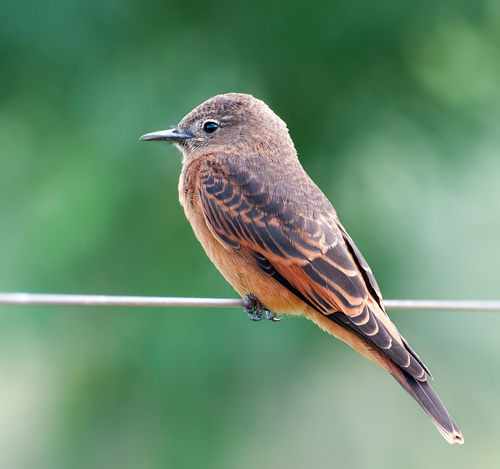
Straneck's Tyrannulet

Straneck's Tyrannulet

Serpophaga griseicapilla

Silhouette: Emily Willoughby · PhyloPic

LCLeast ConcernNTVUENCR
Daily sighting probability <5% · Rare
at Amboró National Park

In 3 days <5% in a week ~10%

6 Verified sightings at Amboró National Park From 2019 to 2026
137 In all 5 parks
August Best month
☀️ Diurnal When it's spotted

About the Straneck's Tyrannulet

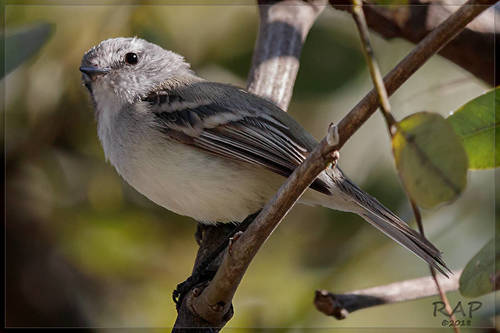
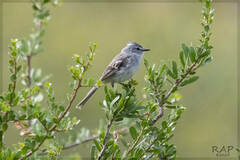
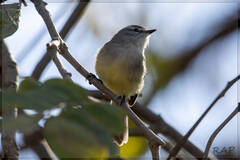
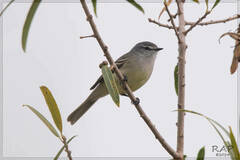
Straneck's tyrannulet (Serpophaga griseicapilla), also known as the monte tyrannulet and grey-crowned tyrannulet, is a small species of bird in the family Tyrannidae, the tyrant flycatchers. It is found in Argentina, Bolivia, Brazil, Paraguay, and Uruguay.

Straneck's tyrannulet has a confusing taxonomic history. It had been known since the 1990s by the binomial Serpophaga griseiceps, which had previously been assigned to specimens that were later recognized as immatures of what was then the white-bellied tyrannulet (Serpophaga munda) and so was invalid. Roberto Straneck formally described the species and assigned its current binomial in 2007. It was later given its English name in his honor.

Straneck's tyrannulet is monotypic. Straneck's tyrannulet is 9 to 11 cm (3.5 to 4.3 in) long and weighs 4.4 to 7.5 g (0.16 to 0.26 oz). The sexes have the same plumage. Adults have a gray crown and nape with a hidden bit of white on some black central crown feathers. They have a thin white supercilium, a white crescent under the eye, and a dark gray line through the eye on an otherwise grayish white face. Their upperparts are olivaceous brown. Their... Wikipedia →

Sounds

Recording0:17

Paraguay · 2026

© Guillermo Menéndez (gmmv80) · XC1154660 · CC BY-NC-SA 4.0

Song0:05

Brazil · 2025

© Miguel Angelo Biz · XC1003064 · CC BY-NC-SA 4.0

Call1:01

Argentina · 2020

© AGUSTIN ESMORIS - Birding Puerto Madryn Tours · XC607531 · CC BY-NC-SA 4.0

Global Distribution

Parks Where Found

# Park Country Daily sighting probability
1 El Impenetrable National Park 🇦🇷 Argentina
~30%
2 El Palmar National Park 🇦🇷 Argentina
<5%
3 Península Valdés 🇦🇷 Argentina
<5%
4 Amboró National Park 🇧🇴 Bolivia
<5%
5 Iberá National Park 🇦🇷 Argentina
<5%

Cities Where Found

# City Country Daily sighting probability
1 Rosario 🇦🇷 Argentina
~30%
2 Cordoba 🇦🇷 Argentina
~20%
3 Buenos Aires 🇦🇷 Argentina
~10%
4 Santa Cruz de la Sierra 🇧🇴 Bolivia
~10%
5 Asuncion 🇵🇾 Paraguay
<5%
6 Montevideo 🇺🇾 Uruguay
<5%

Before you go

What are the chances of seeing a Straneck's Tyrannulet in Amboró National Park?

Rare

Under 5% of wildlife watchers report a Straneck's Tyrannulet sighting in Amboró National Park on a given day, based on 6 verified sightings from GBIF citizen-science data from 2019 to 2026. It is the 235th most-seen of the 273 birds we can rate there. Over three days the chance rises to under 5%, and over a week to about 10%, if each day is a fresh chance.

When is the best time to see a Straneck's Tyrannulet in Amboró National Park?

August

In that month about 10% of wildlife watchers report a Straneck's Tyrannulet in Amboró National Park on a given day, against under 5% in July and September–May, the lowest months. That is one of Amboró National Park's driest months, with about 90 mm of rain against 340 mm in January. June has too few records to rate.

What time of day is best to see a Straneck's Tyrannulet?

Between 9 am and noon

Across all the parks we cover, that three-hour window holds the most Straneck's Tyrannulet sightings with a recorded time, and about 9 in 10 of them come between 6 am and 6 pm: it is a daytime animal.

Is Amboró National Park the best place to see a Straneck's Tyrannulet?

4th of 5

Of the 5 parks where we can rate Straneck's Tyrannulet sightings, Amboró National Park ranks 4th at under 5%. The best odds are in El Impenetrable National Park (Argentina, about 30%), El Palmar National Park (Argentina, under 5%) and Península Valdés (Argentina, under 5%).

Where does the Straneck's Tyrannulet sighting chance come from?

GBIF citizen-science records

It is estimated from how often the Straneck's Tyrannulet is recorded against all the birds logged in Amboró National Park (6 verified sightings from 2019 to 2026), calibrated against known sighting rates. Figures are rounded to the nearest 10% because citizen-science data supports honest approximations, not decimals, and months with records from fewer than five people show "—". How it works.

← Back to Amboró National Park