Blackish Nightjar

Blackish Nightjar

Nyctipolus nigrescens

Silhouette: Sheatherius · PhyloPic

LCLeast ConcernNTVUENCR
Daily sighting probability <5% · Rare
at Anavilhanas National Park

In 3 days ~10% in a week ~20%

15 Verified sightings at Anavilhanas National Park From 2019 to 2026
167 In all 4 parks
November Best month
☀️🌙 Day & Night When it's spotted

About the Blackish Nightjar

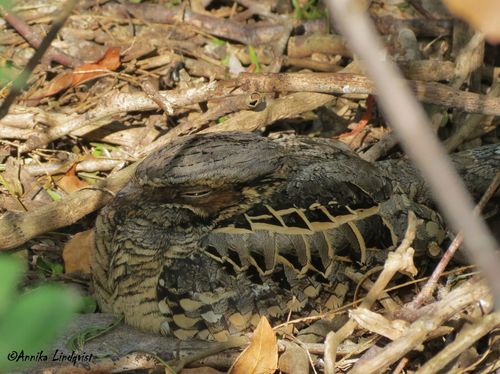
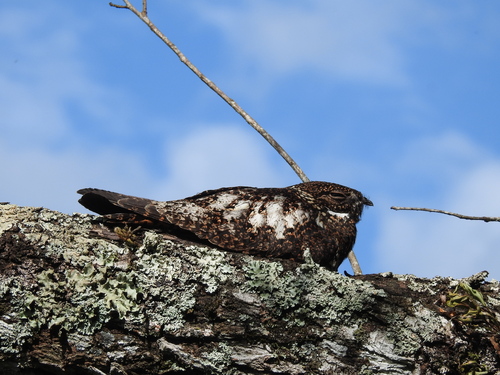
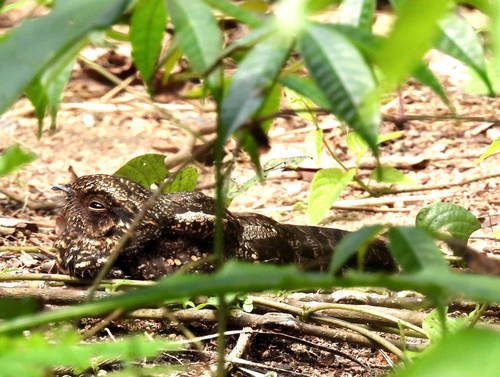
The blackish nightjar (Nyctipolus nigrescens) is a species of bird in the family Caprimulgidae. It is found in Brazil, Bolivia, Colombia, Ecuador, French Guiana, Guyana, Peru, Suriname, and Venezuela. The blackish nightjar was originally placed in genus Caprimulgus, but DNA analyses show that it and its sister species pygmy nightjar (Nyctipolus hirundinaceus) require their own genus. The blackish nightjar is monotypic.

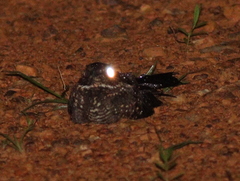
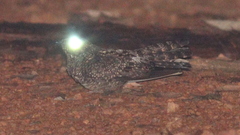
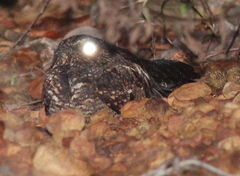
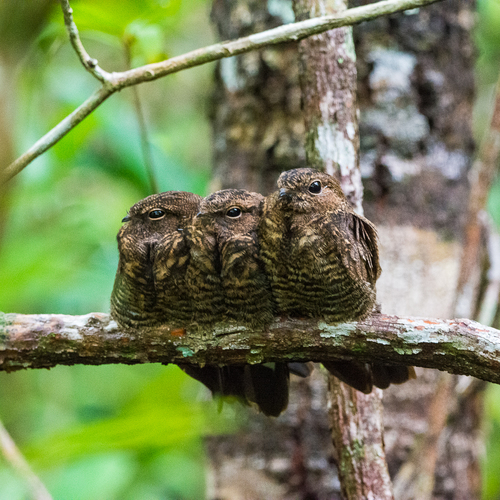
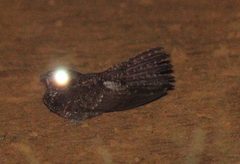
The blackish nightjar is 19.5 to 21.5 cm (7.7 to 8.5 in) long and weighs 32 to 39 g (1.1 to 1.4 oz). Its upperparts are blackish brown with tawny, grayish white, and cinnamon spots. Its tail is dark brown with indistinct lighter bars and mottling and (on the male) a white tip. The underparts to the belly are dark brown with paler baring; the belly and flanks are buffy with darker barring. The throat has a small white patch on either side. In flight the wing shows a small white band.

The blackish nightjar is found east of the Andes in Peru, Ecuador, and southern Colombia, and across southern Colombia through southern Venezuela and the Guianas into northeastern and north-central Brazil. They... Wikipedia →
Sounds

Song0:58

Brazil · 2023

© JAYRSON ARAUJO DE OLIVEIRA · XC780733 · CC BY-NC-SA 4.0

Flight call0:14

Peru · 2003

© Daniel F. Lane · XC257049 · CC BY-NC-SA 4.0

Call0:42

French Guiana · 2012

© Jon King · XC122513 · CC BY-NC-SA 3.0

Global Distribution

Parks Where Found

# Park Country Daily sighting probability
1 Podocarpus National Park 🇪🇨 Ecuador
<5%
2 Anavilhanas National Park 🇧🇷 Brazil
<5%
3 Sierra de la Macarena National Park 🇨🇴 Colombia
<5%
4 Yasuní National Park 🇪🇨 Ecuador
<5%

Before you go

What are the chances of seeing a Blackish Nightjar in Anavilhanas National Park?

Rare

Under 5% of wildlife watchers report a Blackish Nightjar sighting in Anavilhanas National Park on a given day, based on 15 verified sightings from GBIF citizen-science data from 2019 to 2026. It is the 190th most-seen of the 291 birds we can rate there. Over three days the chance rises to about 10%, and over a week to about 20%, if each day is a fresh chance.

When is the best time to see a Blackish Nightjar in Anavilhanas National Park?

November

In that month about 20% of wildlife watchers report a Blackish Nightjar in Anavilhanas National Park on a given day, against under 5% in August–October and December–June, the lowest months.

What time of day is best to see a Blackish Nightjar?

Between 4 and 7 pm

Across all the parks we cover, that three-hour window holds the most Blackish Nightjar sightings with a recorded time, and about 6 in 10 of them come between 6 am and 6 pm: it is seen both by day and at night.

Is Anavilhanas National Park the best place to see a Blackish Nightjar?

Among the best

Of the 4 parks where we can rate Blackish Nightjar sightings, Anavilhanas National Park ranks 2nd at under 5%, level with the leaders once rounded. The best odds are in Podocarpus National Park (Ecuador, under 5%).

Which relatives of the Blackish Nightjar live in Anavilhanas National Park?

Same family: Caprimulgidae

The closest relatives of the Blackish Nightjar that you can see in Anavilhanas National Park (family Caprimulgidae, Nightjars and Allies) are Band-tailed Nighthawk (about 20%), Common Pauraque (about 10%) and Ladder-tailed Nightjar (about 10%), with each one's daily chance of a sighting.

Where does the Blackish Nightjar sighting chance come from?

GBIF citizen-science records

It is estimated from how often the Blackish Nightjar is recorded against all the birds logged in Anavilhanas National Park (15 verified sightings from 2019 to 2026), calibrated against known sighting rates. Figures are rounded to the nearest 10% because citizen-science data supports honest approximations, not decimals, and months with records from fewer than five people show "—". How it works.

← Back to Anavilhanas National Park