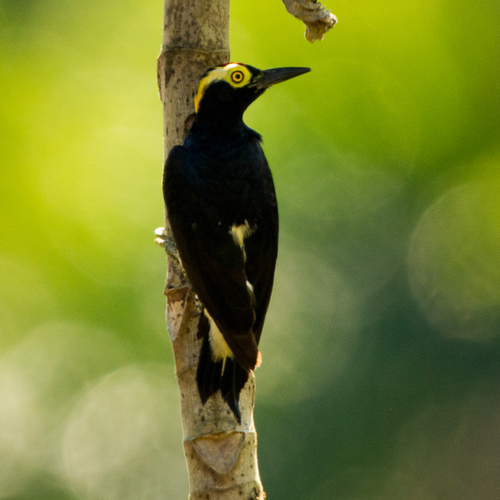
Yellow-billed Jacamar

Yellow-billed Jacamar

Galbula albirostris

Silhouette: FJDegrange · PhyloPic

LCLeast ConcernNTVUENCR
Daily sighting probability <5% · Rare
at Anavilhanas National Park

In 3 days ~10%

9 Verified sightings at Anavilhanas National Park From 2019 to 2026
131 In all 4 parks
February Best month
☀️ Diurnal When it's spotted

About the Yellow-billed Jacamar

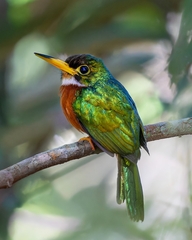
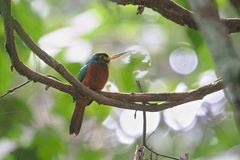
The yellow-billed jacamar (Galbula albirostris) is a species of bird in the family Galbulidae. It is found in Brazil, Colombia, Ecuador, French Guiana, Guyana, Peru, Suriname, and Venezuela. The yellow-billed jacamar was placed in its own genus, Pslilpornis, in the early 20th century; that genus was merged into Galbula by the middle of the century. It and the blue-necked jacamar (Galbula cyanicollis) were later considered conspecific but have been treated as a superspecies since approximately 1974. The yellow-billed jacamar has two subspecies, the nominate Galbula albirostris albirostris and G. a. chalcocephala.

The nominate yellow-billed jacamar is 18 to 21 cm (7.1 to 8.3 in) long and weighs 16 to 24 g (0.56 to 0.85 oz). The male's crown is glossy copper or purplish and the rest of the upper parts are emerald green. The chin is buff, the throat white, and the rest of the underparts are pale reddish cinnamon. The female has paler underparts and a reddish buff throat.

Subspecies G. a. chalcocephala is also 18 to 21 cm (7.1 to 8.3 in) long but a little lighter, weighing 16.9 to 22.9 g (0.60 to 0.81 oz). Compared to the nominate, its crown... Wikipedia →

Sounds

Alarm call0:28

Ecuador · 2025

© Manuel Sánchez-Nivicela · XC1169942 · CC BY-NC-ND 4.0

Call0:39

French Guiana · 2026

© Paul Lenrumé · XC1151485 · CC BY-NC-SA 4.0

Song1:30

Guyana · 2020

© Barry Edmonston · XC526126 · CC BY-NC-SA 4.0

Global Distribution

Parks Where Found

# Park Country Daily sighting probability
1 Yasuní National Park 🇪🇨 Ecuador
<5%
2 Sierra de la Macarena National Park 🇨🇴 Colombia
<5%
3 Anavilhanas National Park 🇧🇷 Brazil
<5%
4 Amacayacu National Natural Park 🇨🇴 Colombia
<5%

Before you go

What are the chances of seeing a Yellow-billed Jacamar in Anavilhanas National Park?

Rare

Under 5% of wildlife watchers report a Yellow-billed Jacamar sighting in Anavilhanas National Park on a given day, based on 9 verified sightings from GBIF citizen-science data from 2019 to 2026. It is the 240th most-seen of the 291 birds we can rate there. Over three days the chance rises to about 10%, if each day is a fresh chance.

When is the best time to see a Yellow-billed Jacamar in Anavilhanas National Park?

February and July

In those months about 10% of wildlife watchers report a Yellow-billed Jacamar in Anavilhanas National Park on a given day, against under 5% in March–June and August–January, the lowest months.

What time of day is best to see a Yellow-billed Jacamar?

Between 8 and 11 am

Across all the parks we cover, that three-hour window holds the most Yellow-billed Jacamar sightings with a recorded time, and about 9 in 10 of them come between 6 am and 6 pm: it is a daytime animal.

Is Anavilhanas National Park the best place to see a Yellow-billed Jacamar?

Among the best

Of the 4 parks where we can rate Yellow-billed Jacamar sightings, Anavilhanas National Park ranks 3rd at under 5%, level with the leaders once rounded. The best odds are in Yasuní National Park (Ecuador, under 5%) and Sierra de la Macarena National Park (Colombia, under 5%).

Which relatives of the Yellow-billed Jacamar live in Anavilhanas National Park?

Same genus: Galbula

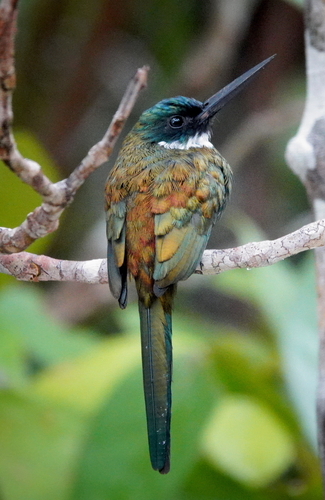
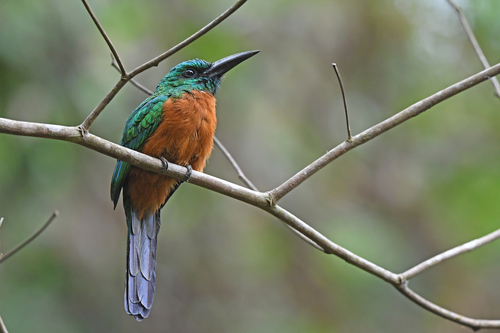
The closest relatives of the Yellow-billed Jacamar that you can see in Anavilhanas National Park (genus Galbula, Typical Jacamars) are Green-tailed Jacamar (about 30%) and Paradise Jacamar (about 10%), with each one's daily chance of a sighting.

Where does the Yellow-billed Jacamar sighting chance come from?

GBIF citizen-science records

It is estimated from how often the Yellow-billed Jacamar is recorded against all the birds logged in Anavilhanas National Park (9 verified sightings from 2019 to 2026), calibrated against known sighting rates. Figures are rounded to the nearest 10% because citizen-science data supports honest approximations, not decimals, and months with records from fewer than five people show "—". How it works.

← Back to Anavilhanas National Park