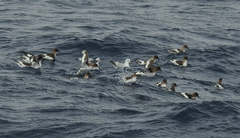
The Antarctic petrel (Thalassoica antarctica) is a boldly marked dark brown and white petrel, found in Antarctica, most commonly in the Ross and Weddell Seas. They eat Antarctic krill, fish, and small squid. They feed while swimming but can dive from both the surface and the air.
Captain James Cook saw the Antarctic petrel on his second voyage to the south Pacific. In 1773 both Cook and the naturalist Georg Forster mentioned the petrel in their separate accounts of the voyage. Forster wrote: On the 17th, in the forenoon, we crossed the antarctic circle, and advanced into the southern frigid zone, which had hitherto remained impenetrable to all navigators. Some days before this period we had seen a new species of petrel, of a brown colour, with a white belly and rump, and a large white spot on the wings, which we now named the antarctic petrel, as we saw great flights of twenty on thirty of them hereabouts, of which we shot many that
unfortunately never fell into the ship. Based on these reports in 1783 the French polymath Georges-Louis Leclerc, Comte de Buffon included the petrel as "Le pétrel antarctique ou Damier brun" in his Histoire Naturelle des...