Black-browed Albatross

Black-browed Albatross

Thalassarche melanophris

Silhouette: Edwin Price · PhyloPic

LCLeast ConcernNTVUENCR
Daily sighting probability ~30% · Possible
at Antarctic Peninsula & South Shetland Islands

In 3 days ~70% in a week ~90%

512 Verified sightings at Antarctic Peninsula & South Shetland Islands From 2019 to 2026
2,992 In all 11 parks
March Best month
☀️ Diurnal When it's spotted

About the Black-browed Albatross

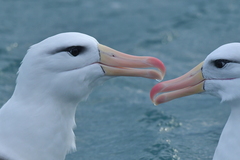
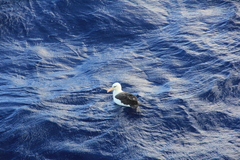
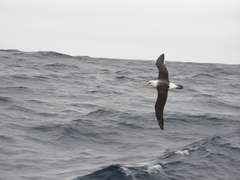
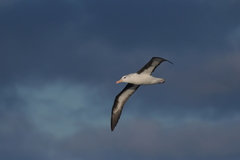
The black-browed albatross (Thalassarche melanophris), also known as the black-browed mollymawk, is a large seabird of the albatross family Diomedeidae; it is the most widespread and common member of its family. Mollymawks are albatrosses in the family Diomedeidae and order Procellariiformes, which also includes shearwaters, fulmars, storm petrels, and diving petrels. These birds share certain identifying features. They have nasal passages that attach to the upper bill called naricorns, although the nostrils on the albatross are on the sides of the bill. The bills of Procellariiformes are also unique in that they are split into between seven and nine horny plates. They produce a stomach oil made up of wax esters and triglycerides that is stored in the proventriculus. This is used against predators as well as being an energy-rich food source for chicks and also for the adults during their long flights. The albatross also has a salt gland above the nasal passage which helps to remove salt from the ocean water that they imbibe. The gland excretes a high saline solution through the bird's nose.

In 1998, Robertson and Nunn published their view that the Campbell albatross...

Wikipedia →

Sounds

Call0:10

United Kingdom · 2024

© Pepe Rojas · XC952602 · CC BY-NC-SA 4.0

?0:14

United Kingdom · 2011

© Robson Silva e Silva · XC92372 · CC BY-NC-ND 2.5

Call1:10

Brazil · 2024

© JAYRSON ARAUJO DE OLIVEIRA · XC927126 · CC BY-NC-SA 4.0

Global Distribution

Parks Where Found

# Park Country Daily sighting probability
1 South Georgia and the South Sandwich Islands 🇬🇸 South Georgia and the South Sandwich Islands
~60%
2 Falkland Islands 🇫🇰 Falkland Islands
~50%
3 Antarctic Peninsula & South Shetland Islands 🇦🇶 Antarctica
~30%
4 Tierra del Fuego National Park 🇦🇷 Argentina
~10%
5 Península Valdés 🇦🇷 Argentina
~10%
6 Booderee National Park 🇦🇺 Australia
<5%
7 Royal National Park 🇦🇺 Australia
<5%
8 Great Otway National Park 🇦🇺 Australia
<5%
9 Table Mountain National Park 🇿🇦 South Africa
<5%
10 Phillip Island Nature Park 🇦🇺 Australia
<5%
11 Fiordland National Park 🇳🇿 New Zealand
<5%

Cities Where Found

# City Country Daily sighting probability
1 Montevideo 🇺🇾 Uruguay
<5%
2 Sydney 🇦🇺 Australia
<5%

Zoos & Centres Where Found

# Zoo / Centre Country
1 Wellington Zoo 🇳🇿 New Zealand In captivity
2 Southern African Foundation for the Conservation of Coastal Birds 🇿🇦 South Africa In captivity

Before you go

What are the chances of seeing a Black-browed Albatross in Antarctic Peninsula & South Shetland Islands?

Possible

About 30% of wildlife watchers report a Black-browed Albatross sighting in Antarctic Peninsula & South Shetland Islands on a given day, based on 512 verified sightings from GBIF citizen-science data from 2019 to 2026. It is the 15th most-seen of the 29 birds we can rate there. Over three days the chance rises to about 70%, and over a week to about 90%, if each day is a fresh chance.

When is the best time to see a Black-browed Albatross in Antarctic Peninsula & South Shetland Islands?

March

In that month about 50% of wildlife watchers report a Black-browed Albatross in Antarctic Peninsula & South Shetland Islands on a given day, against about 10% in October, the lowest month. April to September have too few records to rate.

What time of day is best to see a Black-browed Albatross?

Between 9 am and noon

Across all the parks we cover, that three-hour window holds the most Black-browed Albatross sightings with a recorded time, and nearly all of them come between 6 am and 6 pm: it is a daytime animal.

Is Antarctic Peninsula & South Shetland Islands the best place to see a Black-browed Albatross?

3rd of 11

Of the 11 parks where we can rate Black-browed Albatross sightings, Antarctic Peninsula & South Shetland Islands ranks 3rd at about 30%. The best odds are in South Georgia and the South Sandwich Islands (South Georgia and the South Sandwich Islands, about 60%) and Falkland Islands (Falkland Islands, about 50%).

Where does the Black-browed Albatross sighting chance come from?

GBIF citizen-science records

It is estimated from how often the Black-browed Albatross is recorded against all the birds logged in Antarctic Peninsula & South Shetland Islands (512 verified sightings from 2019 to 2026), calibrated against known sighting rates. Figures are rounded to the nearest 10% because citizen-science data supports honest approximations, not decimals, and months with records from fewer than five people show "—". How it works.

← Back to Antarctic Peninsula & South Shetland Islands