Wilson's Storm Petrel

Wilson's Storm Petrel

Oceanites oceanicus

Silhouette: Mark Hannaford (photo), John E. McCormack, Michael G. Harvey, Brant C. Faircloth, Nicholas G. Crawford, Travis C. Glenn, Robb T. Brumfield & T. Michael Keesey · PhyloPic

LCLeast ConcernNTVUENCR
Daily sighting probability ~90% · Very likely
at Antarctic Peninsula & South Shetland Islands
2,670 Verified sightings at Antarctic Peninsula & South Shetland Islands From 2019 to 2026
3,779 In all 8 parks
March Best month
☀️ Diurnal When it's spotted

About the Wilson's Storm Petrel

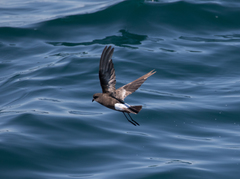
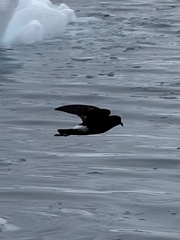
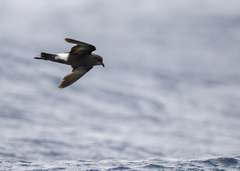
Wilson's storm petrel (Oceanites oceanicus), also known as Wilson's petrel, is a small seabird of the austral storm petrel family Oceanitidae. It is one of the most abundant bird species in the world and has a circumpolar distribution mainly in the seas of the southern hemisphere but extending northwards during the summer of the northern hemisphere. The world population was estimated in 2022 as stable at 8–20 million birds. In 2010 it had been estimated at 12–30 million. A 1998 book had estimated more than 50 million pairs. The name commemorates the Scottish-American ornithologist Alexander Wilson. The genus name Oceanites refers to the mythical Oceanids, the three thousand daughters of Tethys. The species name is from Latin oceanus, "ocean".

Originally described in the genus Procellaria it has been placed under the genus Oceanites. Two or three subspecies are recognized and one population maorianus from New Zealand may be extinct. The nominate population breeds from Cape Horn to the Kerguelen Islands while exasperatus breeds along the Antarctic coast in the South Shetland and other islands. The population from Tierra del Fuego was described as chilensis (=wollastoni...

Wikipedia →

Sounds

Alarm call0:09

Chile · 2024

© Fabrice Schmitt · XC882200 · CC BY-NC-SA 4.0

Song0:46

France · 2019

© Hichem MACHOUK · XC622693 · CC BY-NC-SA 4.0

Call0:16

Antarctica · 2011

© McKenzie · XC401263 · CC BY-NC-SA 4.0

Global Distribution

Parks Where Found

# Park Country Daily sighting probability
1 Antarctic Peninsula & South Shetland Islands 🇦🇶 Antarctica
~90%
2 South Georgia and the South Sandwich Islands 🇬🇸 South Georgia and the South Sandwich Islands
~70%
3 Paracas National Reserve 🇵🇪 Peru
~10%
4 Falkland Islands 🇫🇰 Falkland Islands
<5%
5 Acadia National Park 🇺🇸 United States
<5%
6 Raja Ampat 🇮🇩 Indonesia
<5%
7 Table Mountain National Park 🇿🇦 South Africa
<5%
8 Merritt Island National Wildlife Refuge 🇺🇸 United States
<5%

Cities Where Found

# City Country Daily sighting probability
1 Dakar 🇸🇳 Senegal
~10%
2 Kozhikode 🇮🇳 India
<5%
3 Kollam 🇮🇳 India
<5%
4 Mumbai 🇮🇳 India
<5%
5 Santiago 🇨🇱 Chile
<5%
6 Kochi 🇮🇳 India
<5%
7 Perth 🇦🇺 Australia
<5%
8 Lima 🇵🇪 Peru
<5%
9 Colombo [Sri Jayawardenepura Kotte] 🇱🇰 Sri Lanka
<5%
10 Boston 🇺🇸 United States
<5%

Before you go

What are the chances of seeing a Wilson's Storm Petrel in Antarctic Peninsula & South Shetland Islands?

Very likely

About 90% of wildlife watchers report a Wilson's Storm Petrel sighting in Antarctic Peninsula & South Shetland Islands on a given day, based on 2,670 verified sightings from GBIF citizen-science data from 2019 to 2026. It is the most-seen of the 29 birds we can rate there.

When is the best time to see a Wilson's Storm Petrel in Antarctic Peninsula & South Shetland Islands?

February and March

In those months over 90% of wildlife watchers report a Wilson's Storm Petrel in Antarctic Peninsula & South Shetland Islands on a given day, against about 40% in October, the lowest month. April to September have too few records to rate.

What time of day is best to see a Wilson's Storm Petrel?

Between 8 and 11 am

Across all the parks we cover, that three-hour window holds the most Wilson's Storm Petrel sightings with a recorded time, and about 8 in 10 of them come between 6 am and 6 pm: it is a daytime animal.

Is Antarctic Peninsula & South Shetland Islands the best place to see a Wilson's Storm Petrel?

Yes

Of the 8 parks where we can rate Wilson's Storm Petrel sightings, Antarctic Peninsula & South Shetland Islands has the highest daily chance: about 90%. Next come South Georgia and the South Sandwich Islands (South Georgia and the South Sandwich Islands, about 70%) and Paracas National Reserve (Peru, about 10%).

Where does the Wilson's Storm Petrel sighting chance come from?

GBIF citizen-science records

It is estimated from how often the Wilson's Storm Petrel is recorded against all the birds logged in Antarctic Peninsula & South Shetland Islands (2,670 verified sightings from 2019 to 2026), calibrated against known sighting rates. Figures are rounded to the nearest 10% because citizen-science data supports honest approximations, not decimals, and months with records from fewer than five people show "—". How it works.

← Back to Antarctic Peninsula & South Shetland Islands