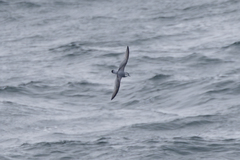
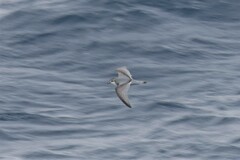
Slender-billed Prion

Slender-billed Prion

Pachyptila belcheri

LCLeast ConcernNTVUENCR
Daily sighting probability <5% · Rare
at Antarctic Peninsula & South Shetland Islands

In 3 days ~10% in a week ~20%

28 Verified sightings at Antarctic Peninsula & South Shetland Islands From 2019 to 2026
144 In all 3 parks
February Best month
☀️ Diurnal When it's spotted

About the Slender-billed Prion

The slender-billed prion (Pachyptila belcheri) or thin-billed prion, is a species of petrel, a seabird in the family Procellariidae. It is found in the southern oceans. The slender-billed prion was formally described in 1912 by the Australian born ornithologist Gregory Mathews under the binomial name Heteroprion belcheri. The prion is now placed with the other prions in the genus Pachyptila that was introduced in 1811 by the German zoologist Johann Karl Wilhelm Illiger. The genus name combines the Ancient Greek pakhus meaning "dense" or "thick" with ptilon meaning "feather" or "plumage". The specific epithet belcheri was chosen in recognition of the Australian judge and amateur ornithologist Charles Belcher who had found the first specimens dead on a beach near the town of Geelong in the Australian state of Victoria. The species is considered to be monotypic: no subspecies are recognised.

The name prion comes from the Greek word priōn, meaning "saw", a reference of the serrated edges of the birds' saw-like bill. The slender-billed prion is a member of the Pachyptila genus, which, in combination with the genus Halobaena (whose single species is the blue petrel) makes...

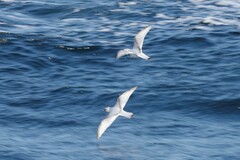
Wikipedia →

Sounds

Call0:06

France · 2020

© Émile Brisson-Curadeau · XC555373 · CC BY-NC-SA 4.0

Global Distribution

Parks Where Found

# Park Country Daily sighting probability
1 South Georgia and the South Sandwich Islands 🇬🇸 South Georgia and the South Sandwich Islands
<5%
2 Falkland Islands 🇫🇰 Falkland Islands
<5%
3 Antarctic Peninsula & South Shetland Islands 🇦🇶 Antarctica
<5%

Before you go

What are the chances of seeing a Slender-billed Prion in Antarctic Peninsula & South Shetland Islands?

Rare

Under 5% of wildlife watchers report a Slender-billed Prion sighting in Antarctic Peninsula & South Shetland Islands on a given day, based on 28 verified sightings from GBIF citizen-science data from 2019 to 2026. It is the 26th most-seen of the 29 birds we can rate there. Over three days the chance rises to about 10%, and over a week to about 20%, if each day is a fresh chance.

When is the best time to see a Slender-billed Prion in Antarctic Peninsula & South Shetland Islands?

February

In that month about 10% of wildlife watchers report a Slender-billed Prion in Antarctic Peninsula & South Shetland Islands on a given day, against under 5% in March and October–January, the lowest months. April to September have too few records to rate.

What time of day is best to see a Slender-billed Prion?

Between 11 am and 2 pm

Across all the parks we cover, that three-hour window holds the most Slender-billed Prion sightings with a recorded time, and about 9 in 10 of them come between 6 am and 6 pm: it is a daytime animal.

Is Antarctic Peninsula & South Shetland Islands the best place to see a Slender-billed Prion?

Among the best

Of the 3 parks where we can rate Slender-billed Prion sightings, Antarctic Peninsula & South Shetland Islands ranks 3rd at under 5%, level with the leaders once rounded. The best odds are in South Georgia and the South Sandwich Islands (South Georgia and the South Sandwich Islands, under 5%) and Falkland Islands (Falkland Islands, under 5%).

Where does the Slender-billed Prion sighting chance come from?

GBIF citizen-science records

It is estimated from how often the Slender-billed Prion is recorded against all the birds logged in Antarctic Peninsula & South Shetland Islands (28 verified sightings from 2019 to 2026), calibrated against known sighting rates. Figures are rounded to the nearest 10% because citizen-science data supports honest approximations, not decimals, and months with records from fewer than five people show "—". How it works.

← Back to Antarctic Peninsula & South Shetland Islands