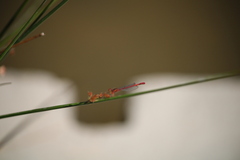
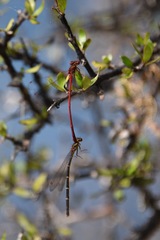
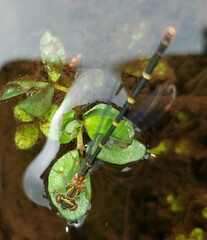
Red Damselfly

Red Damselfly

Xanthocnemis zealandica

Endemic
Daily sighting probability ~30% · Possible
at Aoraki Mount Cook National Park

In 3 days ~60% in a week ~90%

14 Verified sightings at Aoraki Mount Cook National Park From 2019 to 2026
93 In all 4 parks
December Best month
☀️ Diurnal When it's spotted

About the Red Damselfly

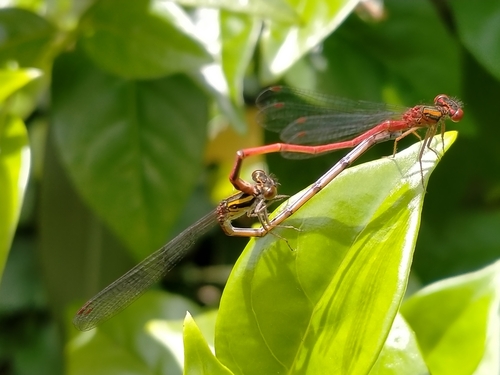
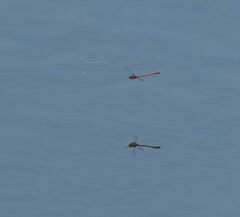
Xanthocnemis zealandica, commonly known as common redcoat damselfly, red damselfly, or red coat damselfly, is one of the most common native New Zealand damselflies. Adult damselflies are often seen flying around vegetation close to streams.

X. zealandica has a 2–3 year life cycle; the shorter one was observed near sea level while the longer one was characteristic to a mid-elevation site (579 m (1,900 ft) above sea level). Some individuals at the lowland sites may even complete their life cycle in one year. X. zealandica nymphs are widespread across New Zealand, occurring in rocky and weedy streams and ponds. It is predominantly a low-altitude species but can reach 1,945 m (6,381 ft) above sea level. The nymphs of the red damselfly are identified by their pointed tail gills and long hairs by the tip.

This species was first described by Robert McLachlan in 1873 and named Telebasis zealandica. Until 1981, it was the only species in the endemic New Zealand genus Xanthocnemis. Xanthocnemis zealandica is the only predominantly red damselfly found in New Zealand. Its name is attributed to the bold red colour of the male, decorated with black markings. Female... Wikipedia →
Global Distribution

Parks Where Found

# Park Country Daily sighting probability
1 Aoraki Mount Cook National Park 🇳🇿 New Zealand
~30%
2 Arthur's Pass National Park 🇳🇿 New Zealand
~20%
3 Fiordland National Park 🇳🇿 New Zealand
~20%
4 Egmont National Park 🇳🇿 New Zealand
~10%

Cities Where Found

# City Country Daily sighting probability
1 Auckland 🇳🇿 New Zealand
~20%

Before you go

What are the chances of seeing a Red Damselfly in Aoraki Mount Cook National Park?

Possible

About 30% of wildlife watchers report a Red Damselfly sighting in Aoraki Mount Cook National Park on a given day, based on 14 verified sightings from GBIF citizen-science data from 2019 to 2026. It is the 7th most-seen of the 10 insects we can rate there. Over three days the chance rises to about 60%, and over a week to about 90%, if each day is a fresh chance.

When is the best time to see a Red Damselfly in Aoraki Mount Cook National Park?

December and January

In those months about 40% of wildlife watchers report a Red Damselfly in Aoraki Mount Cook National Park on a given day, against under 5% in April–May, July and October–November, the lowest months.

What time of day is best to see a Red Damselfly?

Between 11 am and 2 pm

Across all the parks we cover, that three-hour window holds the most Red Damselfly sightings with a recorded time, and about 9 in 10 of them come between 6 am and 6 pm: it is a daytime animal.

Is Aoraki Mount Cook National Park the best place to see a Red Damselfly?

Yes

Of the 4 parks where we can rate Red Damselfly sightings, Aoraki Mount Cook National Park has the highest daily chance: about 30%. Next come Arthur's Pass National Park (New Zealand, about 20%) and Fiordland National Park (New Zealand, about 20%).

Where does the Red Damselfly sighting chance come from?

GBIF citizen-science records

It is estimated from how often the Red Damselfly is recorded against all the insects logged in Aoraki Mount Cook National Park (14 verified sightings from 2019 to 2026), calibrated against known sighting rates. Figures are rounded to the nearest 10% because citizen-science data supports honest approximations, not decimals, and months with records from fewer than five people show "—". How it works.

← Back to Aoraki Mount Cook National Park