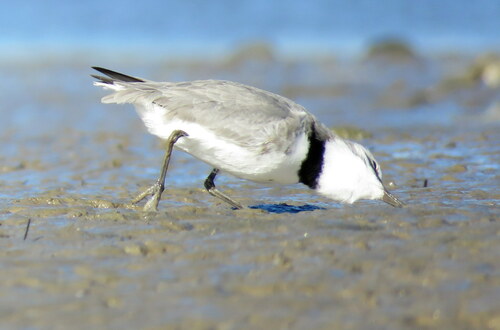
Wrybill

Wrybill

Anarhynchus frontalis

Silhouette: Andy Wilson · PhyloPic

LCNTVUVulnerableENCR Endemic
Daily sighting probability <5% · Rare
at Aoraki Mount Cook National Park

In 3 days ~10% in a week ~20%

6 Verified sightings at Aoraki Mount Cook National Park From 2019 to 2026
6 In 1 park
December Best month
☀️ Diurnal When it's spotted

About the Wrybill

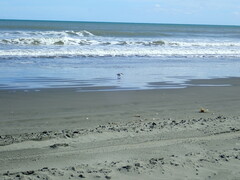
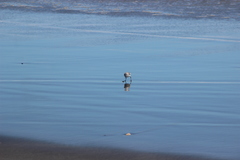
The wrybill or wrybill plover (Anarhynchus frontalis) (Māori: ngutuparore) is a species of plover endemic to New Zealand. It is the only species of bird in the world with a beak that is bent sideways in one direction, always to the right (in the crossbills, e.g. Loxia pytyopsittacus, the tips of the upper and lower mandibles cross because they are bent sideways in opposite directions, sometimes left over right and sometimes right over left). A 2015 study found it to be within the Charadrius clade (although it is now classified in the genus Anarhynchus), with other New Zealand plovers its closest relatives; the nearest being the New Zealand dotterel or New Zealand plover (Anarhynchus obscurus), and then the double-banded plover or banded dotterel (Anarhynchus bicinctus).

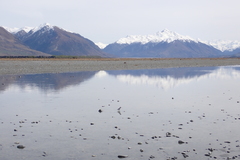
It lays its eggs among the rocks along rivers and distracts intruders by pretending to be in distress and moving away from its clutch. It is rated as vulnerable on the International Union for Conservation of Nature (IUCN)'s Red List of Threatened Species.

French naturalists Jean René Constant Quoy and Joseph Paul Gaimard described the wrybill in 1832. The wrybill is a small, plump plover... Wikipedia →
Sounds

Call0:16

New Zealand · 2000

© Frank Lambert · XC34719 · CC BY-NC-ND 4.0

Call0:17

New Zealand · 2017

© Sander Lagerveld · XC396170 · CC BY-NC-SA 4.0

Recording0:08

New Zealand · 2023

© Samuel Amaris · iNaturalist · CC BY-NC 4.0

Global Distribution

Parks Where Found

# Park Country Daily sighting probability
1 Aoraki Mount Cook National Park 🇳🇿 New Zealand
<5%

More parks will be added in future updates.

Cities Where Found

# City Country Daily sighting probability
1 Auckland 🇳🇿 New Zealand
~10%

Before you go

What are the chances of seeing a Wrybill in Aoraki Mount Cook National Park?

Rare

Under 5% of wildlife watchers report a Wrybill sighting in Aoraki Mount Cook National Park on a given day, based on 6 verified sightings from GBIF citizen-science data from 2019 to 2026. It is the 34th most-seen of the 36 birds we can rate there. Over three days the chance rises to about 10%, and over a week to about 20%, if each day is a fresh chance.

When is the best time to see a Wrybill in Aoraki Mount Cook National Park?

October and December

In those months about 10% of wildlife watchers report a Wrybill in Aoraki Mount Cook National Park on a given day, against under 5% in January–September and November, the lowest months.

What time of day is best to see a Wrybill?

Between 11 am and 2 pm

Across all the parks we cover, that three-hour window holds the most Wrybill sightings with a recorded time, and about 9 in 10 of them come between 6 am and 6 pm: it is a daytime animal.

Where else can you see a Wrybill?

Only Aoraki Mount Cook National Park, in our data

Aoraki Mount Cook National Park is the only park on Wallace's Line with enough records to rate Wrybill sightings: under 5% of wildlife watchers there report one on a given day.

Where does the Wrybill sighting chance come from?

GBIF citizen-science records

It is estimated from how often the Wrybill is recorded against all the birds logged in Aoraki Mount Cook National Park (6 verified sightings from 2019 to 2026), calibrated against known sighting rates. Figures are rounded to the nearest 10% because citizen-science data supports honest approximations, not decimals, and months with records from fewer than five people show "—". How it works.

← Back to Aoraki Mount Cook National Park