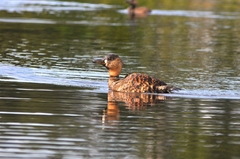
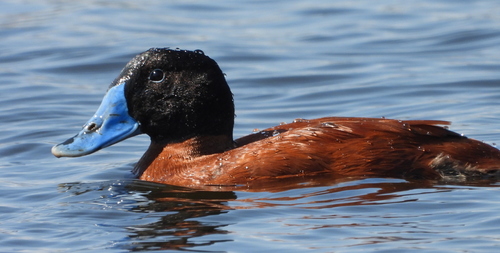
White-backed Duck

White-backed Duck

Thalassornis leuconotus

Silhouette: Sheatherius · PhyloPic

LCLeast ConcernNTVUENCR
Daily sighting probability ~10% · With luck
at Arusha National Park

In 3 days ~20% in a week ~50%

55 Verified sightings at Arusha National Park From 2019 to 2026
819 In all 9 parks
April Best month
☀️ Diurnal When it's spotted

About the White-backed Duck

The white-backed duck (Thalassornis leuconotus) is a waterbird of the family Anatidae. It is distinct from all other ducks, but most closely related to the whistling ducks in the subfamily Dendrocygninae, though also showing some similarities to the stiff-tailed ducks in the subfamily Oxyurinae. It is the only member of the genus Thalassornis.

These birds are well adapted for diving. On occasions they have been observed to stay under water for up to half a minute. They search especially for the bulbs of waterlilies, but also seeds and leaves of waterlilies and other water plants and the young feed on lake flies larvae as well. From danger, they also escape preferentially by diving; hence, the namesake white back is hardly visible in life.

White-backed ducks live in Africa, especially between Senegal and Chad in the west, Ethiopia in the east, and South Africa in the south. Their habitat consists of lakes, ponds, swamps and marshes where they are well camouflaged against predators.

There are two subspecies, Thalassornis leuconotus leuconotus and Thalassornis leuconotus insularis. The latter lives entirely on Madagascar... Wikipedia →

Sounds

Call0:09

South Africa · 2023

© Luke Goddard · XC809424 · CC BY-NC-SA 4.0

Call0:14

Zambia · 2020

© Dries Van de Loock · XC584725 · CC BY-NC-SA 4.0

Global Distribution

Parks Where Found

# Park Country Daily sighting probability
1 iSimangaliso Wetland Park 🇿🇦 South Africa
~30%
2 Arusha National Park 🇹🇿 Tanzania
~10%
3 Amboseli National Park 🇰🇪 Kenya
~10%
4 uMkhuze Game Reserve 🇿🇦 South Africa
<5%
5 Moremi Game Reserve 🇧🇼 Botswana
<5%
6 Garden Route National Park 🇿🇦 South Africa
<5%
7 Hwange National Park 🇿🇼 Zimbabwe
<5%
8 Nairobi National Park 🇰🇪 Kenya
<5%
9 Kruger National Park 🇿🇦 South Africa
<5%

Cities Where Found

# City Country Daily sighting probability
1 Nairobi 🇰🇪 Kenya
~10%
2 Cape Town 🇿🇦 South Africa
<5%

Zoos & Centres Where Found

# Zoo / Centre Country
1 Slimbridge Wetland Centre 🇬🇧 United Kingdom In captivity
2 The Green Zoo Wuppertal 🇩🇪 Germany In captivity
3 Centro Cicogne e Anatidi 🇮🇹 Italy In captivity

Before you go

What are the chances of seeing a White-backed Duck in Arusha National Park?

With luck

About 10% of wildlife watchers report a White-backed Duck sighting in Arusha National Park on a given day, based on 55 verified sightings from GBIF citizen-science data from 2019 to 2026. It is the 171st most-seen of the 373 birds we can rate there. Over three days the chance rises to about 20%, and over a week to about 50%, if each day is a fresh chance.

When is the best time to see a White-backed Duck in Arusha National Park?

April and November

In those months about 20% of wildlife watchers report a White-backed Duck in Arusha National Park on a given day, against under 5% in January–February and May–June, the lowest months. Those are among Arusha National Park's wettest months, with about 320 mm of rain a month against 65 mm in September.

What time of day is best to see a White-backed Duck?

Between 9 am and noon

Across all the parks we cover, that three-hour window holds the most White-backed Duck sightings with a recorded time, and nearly all of them come between 6 am and 6 pm: it is a daytime animal.

Is Arusha National Park the best place to see a White-backed Duck?

2nd of 9

Of the 9 parks where we can rate White-backed Duck sightings, Arusha National Park ranks 2nd at about 10%. The best odds are in iSimangaliso Wetland Park (South Africa, about 30%).

Which relatives of the White-backed Duck live in Arusha National Park?

Same family: Anatidae

The closest relatives of the White-backed Duck that you can see in Arusha National Park (family Anatidae, Ducks, Geese, and Swans) are Egyptian Goose (about 60%), Cape Teal (about 50%) and Southern Pochard (about 40%), with each one's daily chance of a sighting.

Where does the White-backed Duck sighting chance come from?

GBIF citizen-science records

It is estimated from how often the White-backed Duck is recorded against all the birds logged in Arusha National Park (55 verified sightings from 2019 to 2026), calibrated against known sighting rates. Figures are rounded to the nearest 10% because citizen-science data supports honest approximations, not decimals, and months with records from fewer than five people show "—". How it works.

← Back to Arusha National Park