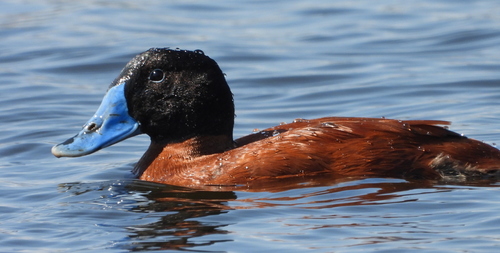
Hottentot Teal

Hottentot Teal

Spatula hottentota

Silhouette: Sheatherius · PhyloPic

LCLeast ConcernNTVUENCR
Daily sighting probability <5% · Rare
at Arusha National Park

In 3 days ~10% in a week ~20%

22 Verified sightings at Arusha National Park From 2019 to 2026
1,822 In all 18 parks
May Best month
☀️ Diurnal When it's spotted

About the Hottentot Teal

The blue-billed teal (Spatula hottentota), also sometimes called spotted teal and formerly Hottentot teal, is a species of dabbling duck of the genus Spatula. It is resident in eastern, southern, and western Africa, from Sudan and Ethiopia west to Niger and Nigeria, and south to South Africa and Namibia, and also in Madagascar. It is generally sedentary, but shows nomadic behaviour in response to water requirements, moving away if drought causes wetlands to dry out.

The blue-billed teal breeds year round, depending on rainfall, and stays in small groups or pairs. They build nests above water in tree stumps and use vegetation. Ducklings leave the nest soon after hatching, and the mother's parenting is limited to providing protection from predators and leading young to feeding areas. This species is omnivorous and prefers smaller shallow bodies of water.

The blue-billed teal is one of the species to which the Agreement on the Conservation of African-Eurasian Migratory Waterbirds (AEWA) applies. The status of the blue-billed teal on the IUCN Red List is Least Concern. Several texts still refer to this species as the Hottentot teal, however, as the word "Hottentot" is an offensive term for the Khoisan people, there has been a movement to change the vernacular name. Wikipedia →

Sounds

Call0:07

Tanzania · 2019

© Peter Boesman · XC510396 · CC BY-NC-ND 4.0

Call0:07

Ethiopia · 2015

© Andrew Spencer · XC210051 · CC BY-NC-SA 4.0

Global Distribution

Parks Where Found

# Park Country Daily sighting probability
1 Amboseli National Park 🇰🇪 Kenya
~30%
2 Ngorongoro Conservation Area 🇹🇿 Tanzania
~20%
3 Lake Nakuru National Park 🇰🇪 Kenya
~20%
4 Moremi Game Reserve 🇧🇼 Botswana
~20%
5 Hwange National Park 🇿🇼 Zimbabwe
~10%
6 iSimangaliso Wetland Park 🇿🇦 South Africa
~10%
7 Chobe National Park 🇧🇼 Botswana
~10%
8 Tarangire National Park 🇹🇿 Tanzania
<5%
9 Gorongosa National Park 🇲🇿 Mozambique
<5%
10 Arusha National Park 🇹🇿 Tanzania
<5%
11 uMkhuze Game Reserve 🇿🇦 South Africa
<5%
12 Kafue National Park 🇿🇲 Zambia
<5%
13 Lake Mburo National Park 🇺🇬 Uganda
<5%
14 Akagera National Park 🇷🇼 Rwanda
<5%
15 Nairobi National Park 🇰🇪 Kenya
<5%
16 Etosha National Park 🇳🇦 Namibia
<5%
17 Serengeti National Park 🇹🇿 Tanzania
<5%
18 Queen Elizabeth National Park 🇺🇬 Uganda
<5%

Cities Where Found

# City Country Daily sighting probability
1 Antananarivo 🇲🇬 Madagascar
~60%
2 Harare 🇿🇼 Zimbabwe
<5%
3 Maputo 🇲🇿 Mozambique
<5%
4 Cape Town 🇿🇦 South Africa
<5%
5 Nairobi 🇰🇪 Kenya
<5%
6 Johannesburg 🇿🇦 South Africa
<5%

Zoos & Centres Where Found

# Zoo / Centre Country
1 Disney's Animal Kingdom 🇺🇸 United States In captivity
2 Busch Gardens Tampa 🇺🇸 United States In captivity
3 Dresden Zoo 🇩🇪 Germany In captivity
4 Parc des oiseaux 🇫🇷 France In captivity
5 Chester Zoo 🇬🇧 United Kingdom In captivity
6 Selwo Aventura 🇪🇸 Spain In captivity
7 Night Safari 🇸🇬 Singapore In captivity
8 Fort Worth Zoo 🇺🇸 United States In captivity
9 Oregon Zoo 🇺🇸 United States In captivity
10 Wildlands 🇳🇱 Netherlands In captivity
11 Singapore Zoo 🇸🇬 Singapore In captivity
12 Wilhelma 🇩🇪 Germany In captivity
13 Houston Zoo 🇺🇸 United States In captivity
14 San Antonio Zoo 🇺🇸 United States In captivity
15 Botanical and Zoological Garden of Tsimbazaza 🇲🇬 Madagascar In captivity
16 Cologne Zoological Garden 🇩🇪 Germany In captivity
17 Philadelphia Zoo 🇺🇸 United States In captivity
18 Bird Paradise 🇸🇬 Singapore In captivity
19 Lincoln Park Zoo 🇺🇸 United States In captivity
20 Rainforest Wild Asia 🇸🇬 Singapore In captivity
21 Le Cornelle 🇮🇹 Italy In captivity
22 River Wonders 🇸🇬 Singapore In captivity
23 Reid Park Zoo 🇺🇸 United States In captivity
24 Bioparc Fuengirola 🇪🇸 Spain In captivity
25 Randers Tropical Zoo 🇩🇰 Denmark In captivity
26 Cologne Zoo Aquarium 🇩🇪 Germany In captivity
27 Domaine des Oiseaux 🇫🇷 France In captivity
28 Snakeroom Serpentarium 🇪🇸 Spain In captivity

Before you go

What are the chances of seeing a Hottentot Teal in Arusha National Park?

Rare

Under 5% of wildlife watchers report a Hottentot Teal sighting in Arusha National Park on a given day, based on 22 verified sightings from GBIF citizen-science data from 2019 to 2026. It is the 247th most-seen of the 373 birds we can rate there. Over three days the chance rises to about 10%, and over a week to about 20%, if each day is a fresh chance.

When is the best time to see a Hottentot Teal in Arusha National Park?

January and April–May

In those months about 10% of wildlife watchers report a Hottentot Teal in Arusha National Park on a given day, against under 5% in February–March and June–December, the lowest months. Those are among Arusha National Park's wettest months, with about 270 mm of rain a month against 65 mm in September.

What time of day is best to see a Hottentot Teal?

Between 7 and 10 am

Across all the parks we cover, that three-hour window holds the most Hottentot Teal sightings with a recorded time, and about 9 in 10 of them come between 6 am and 6 pm: it is a daytime animal.

Which relatives of the Hottentot Teal live in Arusha National Park?

Same family: Anatidae

The closest relatives of the Hottentot Teal that you can see in Arusha National Park (family Anatidae, Ducks, Geese, and Swans) are Egyptian Goose (about 60%), Cape Teal (about 50%) and Southern Pochard (about 40%), with each one's daily chance of a sighting.

Where does the Hottentot Teal sighting chance come from?

GBIF citizen-science records

It is estimated from how often the Hottentot Teal is recorded against all the birds logged in Arusha National Park (22 verified sightings from 2019 to 2026), calibrated against known sighting rates. Figures are rounded to the nearest 10% because citizen-science data supports honest approximations, not decimals, and months with records from fewer than five people show "—". How it works.

← Back to Arusha National Park