Eastern Grey Plantain-eater

Eastern Grey Plantain-eater

Crinifer zonurus

Silhouette: Lisa M. "Pixxl" (photo), John E. McCormack, Michael G. Harvey, Brant C. Faircloth, Nicholas G. Crawford, Travis C. Glenn, Robb T. Brumfield & T. Michael Keesey · PhyloPic

LCLeast ConcernNTVUENCR
Daily sighting probability ~20% · Possible
at Awash National Park

In 3 days ~40% in a week ~70%

22 Verified sightings at Awash National Park From 2019 to 2026
1,521 In all 11 parks
April Best month
☀️ Diurnal When it's spotted

About the Eastern Grey Plantain-eater

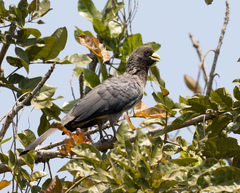
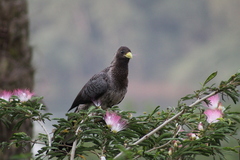
The eastern plantain-eater (Crinifer zonurus) also known as the eastern grey plantain-eater, is a large member of the turaco family, a group of large arboreal near-passerine birds restricted to Africa. This species is a resident breeder in open woodland habitats in tropical east Africa. It lays two or three eggs in a tree platform nest.

These are common, noisy and conspicuous birds, despite lacking the brilliant colours of relatives such as the violet turaco. They are 50 cm (20 in) long, including a long tail, and weigh 392–737 g (13.8–26.0 oz). Their plumage is mainly grey above spotted with brown. The head, erectile crest, neck and breast are brown streaked with silver. The underparts are whitish, heavily streaked with brown.

The eastern plantain-eater has a thick bright yellow bill, and shows a white wing bar in flight. The sexes are identical, but immature individuals have a black woolly head without silver streaking. This bird is similar to the closely related western plantain-eater. However, eastern plantain-eater has white tail bars, and lacks the chest bars and dark wing feather shafts of its western relative.

This species feeds on fruit, especially figs, and other vegetable matter. Wikipedia →

Sounds

Song0:10

Ethiopia · 2014

© Andrew Spencer · XC266672 · CC BY-NC-SA 4.0

Call0:06

Kenya · 2023

© Brendan Sloan · XC824754 · CC BY-NC-ND 4.0

Call0:34

Uganda · 2013

© Bram Piot · XC138434 · CC BY-NC-SA 3.0

Global Distribution

Parks Where Found

# Park Country Daily sighting probability
1 Kidepo Valley National Park 🇺🇬 Uganda
~50%
2 Murchison Falls National Park 🇺🇬 Uganda
~40%
3 Kibale National Park 🇺🇬 Uganda
~30%
4 Awash National Park 🇪🇹 Ethiopia
~20%
5 Queen Elizabeth National Park 🇺🇬 Uganda
~10%
6 Lake Mburo National Park 🇺🇬 Uganda
~10%
7 Virunga National Park 🇨🇩 Democratic Republic of the Congo
~10%
8 Akagera National Park 🇷🇼 Rwanda
~10%
9 Serengeti National Park 🇹🇿 Tanzania
<5%
10 Semuliki National Park 🇺🇬 Uganda
<5%
11 Bwindi Impenetrable National Park 🇺🇬 Uganda
<5%

Cities Where Found

# City Country Daily sighting probability
1 Kampala 🇺🇬 Uganda
~70%

Before you go

What are the chances of seeing an Eastern Grey Plantain-eater in Awash National Park?

Possible

About 20% of wildlife watchers report an Eastern Grey Plantain-eater sighting in Awash National Park on a given day, based on 22 verified sightings from GBIF citizen-science data from 2019 to 2026. It is the 98th most-seen of the 217 birds we can rate there. Over three days the chance rises to about 40%, and over a week to about 70%, if each day is a fresh chance.

When is the best time to see an Eastern Grey Plantain-eater in Awash National Park?

April

In that month about 40% of wildlife watchers report an Eastern Grey Plantain-eater in Awash National Park on a given day, against about 10% in August and October–January, the lowest months. That is one of Awash National Park's wettest months, with about 75 mm of rain against 10 mm in January. February–March, May and September have too few records to rate.

What time of day is best to see an Eastern Grey Plantain-eater?

Between 6 and 9 am

Across all the parks we cover, that three-hour window holds the most Eastern Grey Plantain-eater sightings with a recorded time, and about 8 in 10 of them come between 6 am and 6 pm: it is a daytime animal.

Where does the Eastern Grey Plantain-eater sighting chance come from?

GBIF citizen-science records

It is estimated from how often the Eastern Grey Plantain-eater is recorded against all the birds logged in Awash National Park (22 verified sightings from 2019 to 2026), calibrated against known sighting rates. Figures are rounded to the nearest 10% because citizen-science data supports honest approximations, not decimals, and months with records from fewer than five people show "—". How it works.

← Back to Awash National Park