
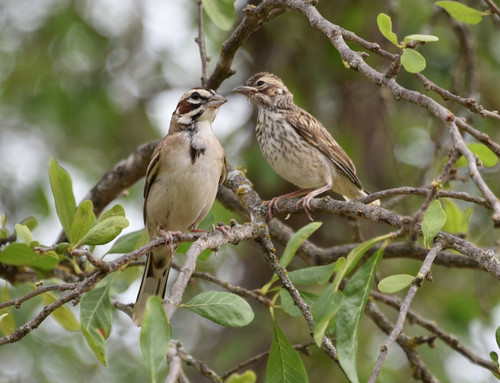
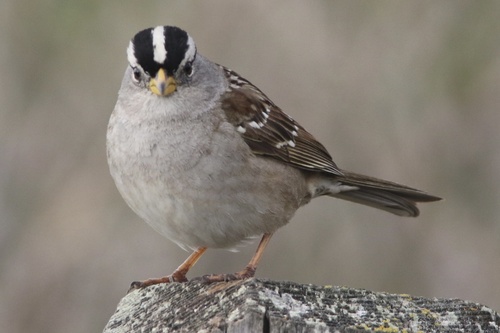
Lark Bunting

Lark Bunting

Calamospiza melanocorys

Silhouette: L. Shyamal · PhyloPic

LCLeast ConcernNTVUENCR
Daily sighting probability ~20% · Possible
at Badlands National Park

In 3 days ~50% in a week ~80%

230 Verified sightings at Badlands National Park From 2019 to 2026
800 In all 6 parks
June Best month
☀️ Diurnal When it's spotted

About the Lark Bunting

The lark bunting (Calamospiza melanocorys) is a medium-sized American bunting native to central and western North America. It was designated the state bird of Colorado in 1931. The lark bunting is monotypic, the only member of the genus Calamospiza, and is not closely related to any other genera. It was first described by J. K. Townsend in 1837, from a specimen collected on a trip he took with Thomas Nuttall, under the name Fringilla bicolor. This is a preoccupied name, so Leonhard Hess Stejneger renamed the species in 1885 Calamospiza melanocorys. By then, the lark bunting had already been given its own genus, the one it is still placed in, by Charles Lucien Bonaparte in 1838.

Lark buntings are small songbirds, with a short, thick, bluish bill. There is a large patch of white on the wings and they have a relatively short tail with white tips at the end of the feathers. Breeding males have an all black body with a large white patch on the upper part of the wing. Nonbreeding males and females look similar and are grayish brown with white stripes.

Measurements: Length: 5.5–7.1 in (140–180 mm) Weight: 1.3–1.5 oz (37–43 g) Wingspan: 9.8–11.0 in (250–280... Wikipedia →

Sounds

Song0:16

United States · 2021

© Sue Riffe · XC665485 · CC BY-NC-SA 4.0

Call0:50

United States · 2015

© Hal Mitchell · XC293299 · CC BY-NC-SA 4.0

Flight song1:12

United States · 2014

© Richard E. Webster · XC185137 · CC BY-NC-SA 4.0

Global Distribution

Parks Where Found

# Park Country Daily sighting probability
1 Badlands National Park 🇺🇸 United States
~20%
2 Big Bend National Park 🇺🇸 United States
~10%
3 Guadalupe Mountains National Park 🇺🇸 United States
<5%
4 Saguaro National Park 🇺🇸 United States
<5%
5 El Vizcaíno Biosphere Reserve 🇲🇽 Mexico
<5%
6 Rocky Mountain National Park 🇺🇸 United States
<5%

Cities Where Found

# City Country Daily sighting probability
1 Monterrey 🇲🇽 México
<5%
2 Denver 🇺🇸 United States
<5%
3 Mesa 🇺🇸 United States
<5%
4 Phoenix 🇺🇸 United States
<5%
5 Vancouver 🇨🇦 Canada
<5%
6 Austin 🇺🇸 United States
<5%
7 Los Angeles 🇺🇸 United States
<5%
8 San Antonio 🇺🇸 United States
<5%
9 Chicago 🇺🇸 United States
<5%
10 San Francisco 🇺🇸 United States
<5%

Before you go

What are the chances of seeing a Lark Bunting in Badlands National Park?

Possible

About 20% of wildlife watchers report a Lark Bunting sighting in Badlands National Park on a given day, based on 230 verified sightings from GBIF citizen-science data from 2019 to 2026. It is the 30th most-seen of the 120 birds we can rate there. Over three days the chance rises to about 50%, and over a week to about 80%, if each day is a fresh chance.

When is the best time to see a Lark Bunting in Badlands National Park?

May and June

In those months about 30% of wildlife watchers report a Lark Bunting in Badlands National Park on a given day, against about 10% in September to April, the lowest months. Those are among Badlands National Park's wettest months, with about 70 mm of rain a month against 15 mm in January.

What time of day is best to see a Lark Bunting?

Between 9 am and noon

Across all the parks we cover, that three-hour window holds the most Lark Bunting sightings with a recorded time, and about 9 in 10 of them come between 6 am and 6 pm: it is a daytime animal.

Is Badlands National Park the best place to see a Lark Bunting?

Yes

Of the 6 parks where we can rate Lark Bunting sightings, Badlands National Park has the highest daily chance: about 20%. Next come Big Bend National Park (United States, about 10%) and Guadalupe Mountains National Park (United States, under 5%).

Which relatives of the Lark Bunting live in Badlands National Park?

Same family: Passerellidae

The closest relatives of the Lark Bunting that you can see in Badlands National Park (family Passerellidae, New World Sparrows) are Lark Sparrow (about 50%), Spotted Towhee (about 40%) and Grasshopper Sparrow (about 20%), with each one's daily chance of a sighting.

Where does the Lark Bunting sighting chance come from?

GBIF citizen-science records

It is estimated from how often the Lark Bunting is recorded against all the birds logged in Badlands National Park (230 verified sightings from 2019 to 2026), calibrated against known sighting rates. Figures are rounded to the nearest 10% because citizen-science data supports honest approximations, not decimals, and months with records from fewer than five people show "—". How it works.

← Back to Badlands National Park