Plains Lubber Grasshopper

Plains Lubber Grasshopper

Brachystola magna

Daily sighting probability ~20% · Possible
at Badlands National Park

In 3 days ~50% in a week ~80%

16 Verified sightings at Badlands National Park From 2019 to 2026
213 In all 4 parks
August Best month
☀️ Diurnal When it's spotted

About the Plains Lubber Grasshopper

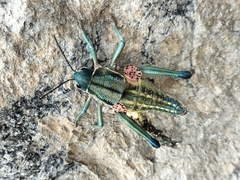
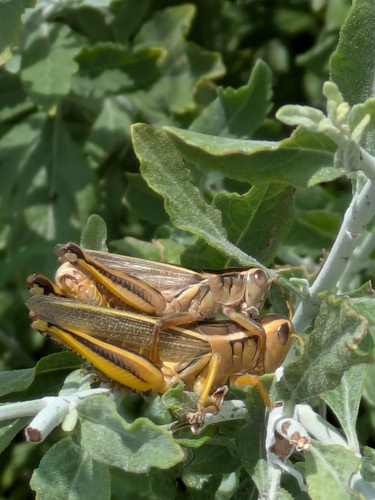
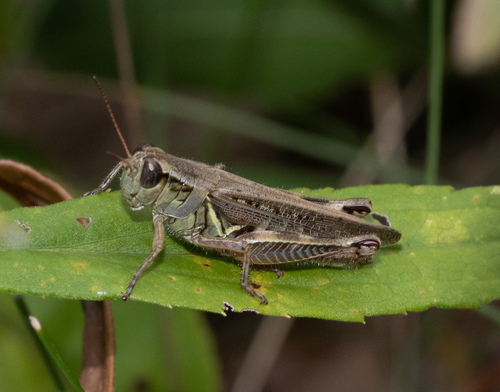
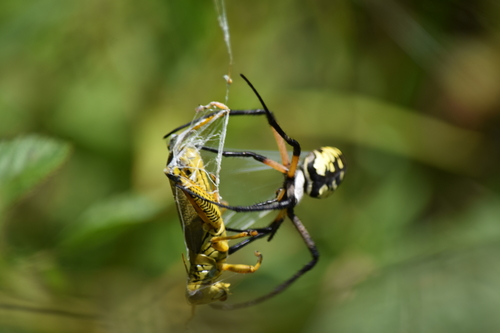
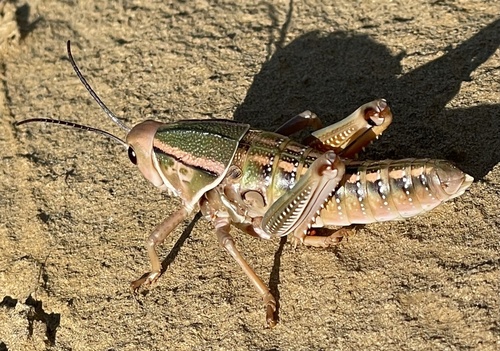
Brachystola magna, the plains lubber grasshopper, western lubber grasshopper or homesteader, is a large species of grasshopper in the family Romaleidae, native to open and semi-open habitats of central and southern United States and northern Mexico.

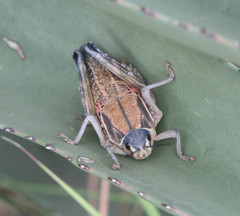
Adults are typically 4–6 cm (1.6–2.4 in) long, with females growing larger than males. It is reddish brown with black dots on its outer wings, however there is some variation in coloration, with more northern variants tending to be greener, and southern ones more brownish-buff. Brachystola magna has extremely small wings and is unable to fly. The antennae are bluish-brown and the legs are reddish near the body with purple tarsi. It has a ridge along the upper and middle region of the abdomen. It is distinguished from Brachystola virescens by its longer antennae and color.

In Wyoming it is found on gravelly ground in the southwest of the state. It does not cause significant damage to crops, and seems to prefer coarse broadleaved plants to crops. It overwinters in the egg, which hatch in the spring and reach adulthood in August.

Walter Sutton's description of reduction division was based on studying the spermatocytes of Brachystola magna. This work was critical in the development of the chromosome theory of inheritance. Wikipedia →
Global Distribution

Parks Where Found

# Park Country Daily sighting probability
1 Guadalupe Mountains National Park 🇺🇸 United States
~40%
2 Big Bend National Park 🇺🇸 United States
~30%
3 Badlands National Park 🇺🇸 United States
~20%
4 Saguaro National Park 🇺🇸 United States
<5%

Before you go

What are the chances of seeing a Plains Lubber Grasshopper in Badlands National Park?

Possible

About 20% of wildlife watchers report a Plains Lubber Grasshopper sighting in Badlands National Park on a given day, based on 16 verified sightings from GBIF citizen-science data from 2019 to 2026. It is the 8th most-seen of the 37 insects we can rate there. Over three days the chance rises to about 50%, and over a week to about 80%, if each day is a fresh chance.

When is the best time to see a Plains Lubber Grasshopper in Badlands National Park?

August

In that month about 40% of wildlife watchers report a Plains Lubber Grasshopper in Badlands National Park on a given day, against under 5% in March–May and October–November, the lowest months.

What time of day is best to see a Plains Lubber Grasshopper?

Between 11 am and 2 pm

Across all the parks we cover, that three-hour window holds the most Plains Lubber Grasshopper sightings with a recorded time, and about 9 in 10 of them come between 6 am and 6 pm: it is a daytime animal.

Is Badlands National Park the best place to see a Plains Lubber Grasshopper?

3rd of 4

Of the 4 parks where we can rate Plains Lubber Grasshopper sightings, Badlands National Park ranks 3rd at about 20%. The best odds are in Guadalupe Mountains National Park (United States, about 40%) and Big Bend National Park (United States, about 30%).

Which relatives of the Plains Lubber Grasshopper live in Badlands National Park?

Same order: Orthoptera

The closest relatives of the Plains Lubber Grasshopper that you can see in Badlands National Park (order Orthoptera, Grasshoppers, Crickets, and Katydids) are Two-Striped Grasshopper (about 40%), Red-Legged Grasshopper (about 10%) and Differential Grasshopper (about 10%), with each one's daily chance of a sighting.

Where does the Plains Lubber Grasshopper sighting chance come from?

GBIF citizen-science records

It is estimated from how often the Plains Lubber Grasshopper is recorded against all the insects logged in Badlands National Park (16 verified sightings from 2019 to 2026), calibrated against known sighting rates. Figures are rounded to the nearest 10% because citizen-science data supports honest approximations, not decimals, and months with records from fewer than five people show "—". How it works.

← Back to Badlands National Park