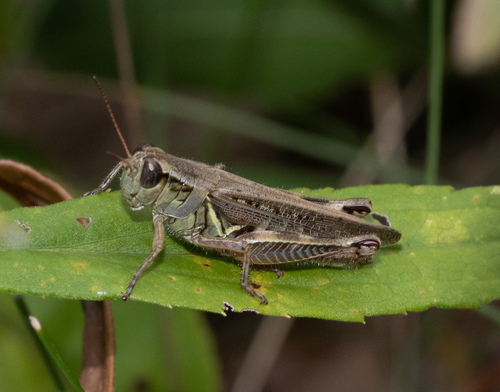
Red-Legged Grasshopper

Red-Legged Grasshopper

Melanoplus femurrubrum

Daily sighting probability ~10% · With luck
at Badlands National Park

In 3 days ~30% in a week ~50%

5 Verified sightings at Badlands National Park From 2019 to 2026
5 In 1 park
August Best month
☀️ Diurnal When it's spotted

About the Red-Legged Grasshopper

Melanoplus femurrubrum, the red-legged grasshopper, is a species of grasshopper belonging to the genus Melanoplus. It is one of the most common grasshoppers found in Mexico, the United States, and Canada. This grasshopper is frequently used as a model organism in scientific studies, due to their abundance throughout North America and behavioral response to changes in climate.

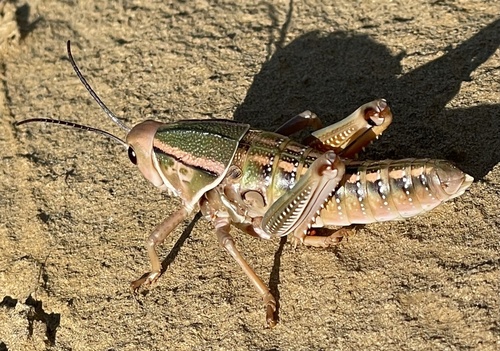
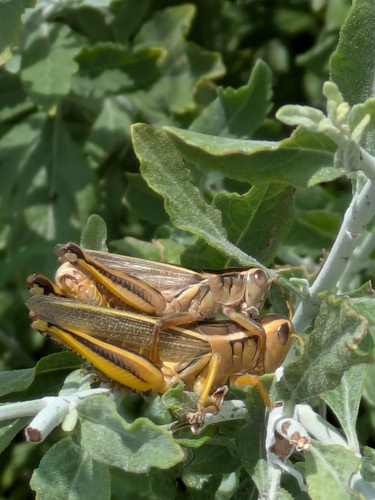
Melanoplus femurrubrum is a medium-sized grasshopper, in which males can range in length from 1.7 cm (0.67 in) – 2.4 cm (0.94 in), whereas females can range from 1.8 cm (0.71 in) – 3.0 cm (1.2 in) long. This grasshopper has a reddish-brown back, a greenish-yellow belly, and red hind tibiae, hence its specific name femurrubrum (femur = thigh, rubrum = red). Wings of M. femurrubrum typically extend beyond the tip of the abdomen. Males have an enlarged abdomen, with a U-shaped sub-genital plate.

Melanoplus femurrubrum can be found in a variety of habitats found throughout most of North America, but prefer grasslands and areas of thick vegetation. They are commonly found in disturbed habitats and old fields. Melanoplus femurrubrum, like other Orthoptera, undergo... Wikipedia →
Global Distribution

Parks Where Found

# Park Country Daily sighting probability
1 Badlands National Park 🇺🇸 United States
~10%

More parks will be added in future updates.

Cities Where Found

# City Country Daily sighting probability
1 Boston 🇺🇸 United States
~10%
2 Minneapolis [Saint Paul] 🇺🇸 United States
~10%
3 Montreal 🇨🇦 Canada
~10%
4 Portland 🇺🇸 United States
~10%
5 Baltimore 🇺🇸 United States
<5%
6 Detroit 🇺🇸 United States
<5%
7 Toronto 🇨🇦 Canada
<5%
8 Washington 🇺🇸 United States
<5%
9 Chicago 🇺🇸 United States
<5%
10 New York City 🇺🇸 United States
<5%

Before you go

What are the chances of seeing a Red-Legged Grasshopper in Badlands National Park?

With luck

About 10% of wildlife watchers report a Red-Legged Grasshopper sighting in Badlands National Park on a given day, based on 5 verified sightings from GBIF citizen-science data from 2019 to 2026. It is the 31st most-seen of the 37 insects we can rate there. Over three days the chance rises to about 30%, and over a week to about 50%, if each day is a fresh chance.

When is the best time to see a Red-Legged Grasshopper in Badlands National Park?

August

In that month about 20% of wildlife watchers report a Red-Legged Grasshopper in Badlands National Park on a given day, against under 5% in September to June, the lowest months.

What time of day is best to see a Red-Legged Grasshopper?

Between 2 and 5 pm

Across all the parks we cover, that three-hour window holds the most Red-Legged Grasshopper sightings with a recorded time, and nearly all of them come between 6 am and 6 pm: it is a daytime animal.

Where else can you see a Red-Legged Grasshopper?

Only Badlands National Park, in our data

Badlands National Park is the only park on Wallace's Line with enough records to rate Red-Legged Grasshopper sightings: about 10% of wildlife watchers there report one on a given day.

Which relatives of the Red-Legged Grasshopper live in Badlands National Park?

Same genus: Melanoplus

The closest relatives of the Red-Legged Grasshopper that you can see in Badlands National Park (genus Melanoplus, North American Spur-throated Grasshoppers) are Two-Striped Grasshopper (about 40%) and Differential Grasshopper (about 10%), with each one's daily chance of a sighting.

Where does the Red-Legged Grasshopper sighting chance come from?

GBIF citizen-science records

It is estimated from how often the Red-Legged Grasshopper is recorded against all the insects logged in Badlands National Park (5 verified sightings from 2019 to 2026), calibrated against known sighting rates. Figures are rounded to the nearest 10% because citizen-science data supports honest approximations, not decimals, and months with records from fewer than five people show "—". How it works.

← Back to Badlands National Park