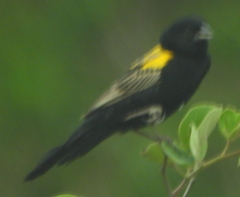

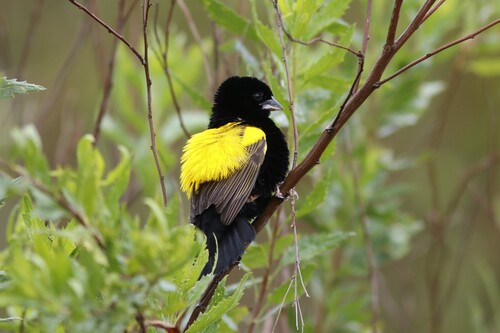
Yellow-shouldered Widowbird

Yellow-shouldered Widowbird

Euplectes macroura

Silhouette: Sheatherius · PhyloPic

LCLeast ConcernNTVUENCR
Daily sighting probability ~10% · With luck
at Bale Mountains National Park

In 3 days ~20% in a week ~40%

11 Verified sightings at Bale Mountains National Park From 2019 to 2026
651 In all 6 parks
December Best month
☀️ Diurnal When it's spotted

About the Yellow-shouldered Widowbird

The yellow-mantled widowbird (Euplectes macroura), also known as the yellow-backed widow, is a species of bird in the family Ploceidae. The yellow-mantled widowbird was formally described in 1789 by the German naturalist Johann Friedrich Gmelin in his revised and expanded edition of Carl Linnaeus's Systema Naturae. He placed it with the crossbills in the genus Loxia and coined the binomial name Loxia macroura. Gmelin specified the locality as "Whydah"; this is Ouidah on the coast of Benin in West Africa. The specific epithet is from Ancient Greek makros meaning "long" and -ouros meaning "tailed". The yellow-mantled widowbird is now one of 18 species placed in the genus Euplectes that was introduced in 1829 by the English naturalist William Swainson.

Males are larger than females and acquire longer tails and striking black and golden yellow plumages in the breeding... Wikipedia →

Sounds

Call0:11

Congo (Democratic Republic) · 2017

© Bram Piot · XC361674 · CC BY-NC-SA 4.0

Song0:47

Malawi · 2015

© Frank Lambert · XC309965 · CC BY-NC-ND 4.0

Call0:26

Zambia · 2020

© Dries Van de Loock · XC552097 · CC BY-NC-SA 4.0

Global Distribution

Parks Where Found

# Park Country Daily sighting probability
1 Odzala-Kokoua National Park 🇨🇬 Republic of the Congo
~30%
2 Masai Mara National Reserve 🇰🇪 Kenya
~10%
3 Kafue National Park 🇿🇲 Zambia
~10%
4 Bale Mountains National Park 🇪🇹 Ethiopia
~10%
5 Murchison Falls National Park 🇺🇬 Uganda
<5%
6 Serengeti National Park 🇹🇿 Tanzania
<5%

Cities Where Found

# City Country Daily sighting probability
1 Harare 🇿🇼 Zimbabwe
~10%

Before you go

What are the chances of seeing a Yellow-shouldered Widowbird in Bale Mountains National Park?

With luck

About 10% of wildlife watchers report a Yellow-shouldered Widowbird sighting in Bale Mountains National Park on a given day, based on 11 verified sightings from GBIF citizen-science data from 2019 to 2026. It is the 81st most-seen of the 117 birds we can rate there. Over three days the chance rises to about 20%, and over a week to about 40%, if each day is a fresh chance.

When is the best time to see a Yellow-shouldered Widowbird in Bale Mountains National Park?

December

In that month about 20% of wildlife watchers report a Yellow-shouldered Widowbird in Bale Mountains National Park on a given day, against under 5% in January, April–May and July, the lowest months. That is one of Bale Mountains National Park's driest months, with about 35 mm of rain against 230 mm in April. March and September have too few records to rate.

What time of day is best to see a Yellow-shouldered Widowbird?

Between 7 and 10 am

Across all the parks we cover, that three-hour window holds the most Yellow-shouldered Widowbird sightings with a recorded time, and about 9 in 10 of them come between 6 am and 6 pm: it is a daytime animal.

Is Bale Mountains National Park the best place to see a Yellow-shouldered Widowbird?

4th of 6

Of the 6 parks where we can rate Yellow-shouldered Widowbird sightings, Bale Mountains National Park ranks 4th at about 10%. The best odds are in Odzala-Kokoua National Park (Republic of the Congo, about 30%), Masai Mara National Reserve (Kenya, about 10%) and Kafue National Park (Zambia, about 10%).

Where does the Yellow-shouldered Widowbird sighting chance come from?

GBIF citizen-science records

It is estimated from how often the Yellow-shouldered Widowbird is recorded against all the birds logged in Bale Mountains National Park (11 verified sightings from 2019 to 2026), calibrated against known sighting rates. Figures are rounded to the nearest 10% because citizen-science data supports honest approximations, not decimals, and months with records from fewer than five people show "—". How it works.

← Back to Bale Mountains National Park