Malabar Pied Hornbill

Malabar Pied Hornbill

Anthracoceros coronatus

Silhouette: Rohit N · PhyloPic

LCNTNear ThreatenedVUENCR
Daily sighting probability ~20% · Possible
at Bandhavgarh National Park

In 3 days ~40% in a week ~70%

205 Verified sightings at Bandhavgarh National Park From 2019 to 2026
2,730 In all 9 parks
November Best month
🌅 Crepuscular When it's spotted

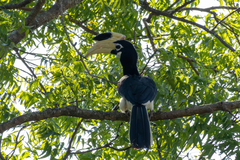
About the Malabar Pied Hornbill

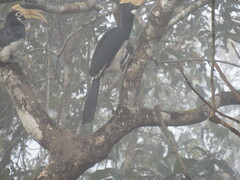
The Malabar pied hornbill (Anthracoceros coronatus), also known as the lesser pied hornbill, is a bird in the hornbill family, a family of tropical near-passerine birds found in the Old World. The Malabar pied hornbill was described by the French polymath Georges-Louis Leclerc, Comte de Buffon in 1780 in his Histoire Naturelle des Oiseaux. The bird was also illustrated in a hand-coloured plate engraved by François-Nicolas Martinet in the Planches Enluminées D'Histoire Naturelle, which was produced under the supervision of Edme-Louis Daubenton to accompany Buffon's text. Neither the plate caption nor Buffon's description included a scientific name but in 1783 the Dutch naturalist Pieter Boddaert coined the binomial name Buceros coronatus in his catalogue of the Planches Enluminées. The Malabar pied hornbill is now placed in the genus Anthracoceros that was introduced by the German naturalist Ludwig Reichenbach in 1849. The species is monotypic. The generic name combines the Ancient Greek anthrax, meaning "coal black" and kerōs, meaning "horn". The specific epithet coronatus is Latin for "crowned".

The Malabar pied hornbill is a large hornbill, at 65... Wikipedia →

Sounds

Call0:07

India · 2018

© Mandar Bhagat · XC417595 · CC BY-NC-ND 4.0

Song0:57

India · 2016

© Ganesh R mandavkar · XC301622 · CC BY-NC-SA 4.0

Call0:30

India · 2009

© Pankaj Lad · XC214133 · CC BY-NC-SA 4.0

Global Distribution

Parks Where Found

# Park Country Daily sighting probability
1 Wilpattu National Park 🇱🇰 Sri Lanka
~80%
2 Yala National Park 🇱🇰 Sri Lanka
~70%
3 Udawalawe National Park 🇱🇰 Sri Lanka
~40%
4 Minneriya National Park 🇱🇰 Sri Lanka
~30%
5 Bandhavgarh National Park 🇮🇳 India
~20%
6 Satpura National Park 🇮🇳 India
~10%
7 Nagarhole National Park 🇮🇳 India
~10%
8 Kanha National Park 🇮🇳 India
~10%
9 Bandipur National Park 🇮🇳 India
<5%

Zoos & Centres Where Found

# Zoo / Centre Country
1 清远长隆动物大越野 🇨🇳 China In captivity
2 Nehru Zoological Park 🇮🇳 India In captivity
3 Bronx Zoo 🇺🇸 United States In captivity
4 Jijamata Udyaan 🇮🇳 India In captivity
5 National Zoological Gardens of Sri Lanka 🇱🇰 Sri Lanka In captivity
6 Taraporewala Aquarium 🇮🇳 India In captivity

Before you go

What are the chances of seeing a Malabar Pied Hornbill in Bandhavgarh National Park?

Possible

About 20% of wildlife watchers report a Malabar Pied Hornbill sighting in Bandhavgarh National Park on a given day, based on 205 verified sightings from GBIF citizen-science data from 2019 to 2026. It is the 83rd most-seen of the 241 birds we can rate there. Over three days the chance rises to about 40%, and over a week to about 70%, if each day is a fresh chance.

When is the best time to see a Malabar Pied Hornbill in Bandhavgarh National Park?

November

In that month about 30% of wildlife watchers report a Malabar Pied Hornbill in Bandhavgarh National Park on a given day, against about 10% in January, March, May and July–October, the lowest months. That is one of Bandhavgarh National Park's driest months, with almost no rain against 400 mm in August.

What time of day is best to see a Malabar Pied Hornbill?

Between 3 and 6 am

Across all the parks we cover, that three-hour window holds the most Malabar Pied Hornbill sightings with a recorded time, and about half of them come between 6 am and 6 pm: it is most active around dawn and dusk.

Where does the Malabar Pied Hornbill sighting chance come from?

GBIF citizen-science records

It is estimated from how often the Malabar Pied Hornbill is recorded against all the birds logged in Bandhavgarh National Park (205 verified sightings from 2019 to 2026), calibrated against known sighting rates. Figures are rounded to the nearest 10% because citizen-science data supports honest approximations, not decimals, and months with records from fewer than five people show "—". How it works.

← Back to Bandhavgarh National Park