







European Earwig

European Earwig

Forficula auricularia

Daily sighting probability ~10% · With luck
at Bavarian Forest National Park

In 3 days ~20% in a week ~30%

9 Verified sightings at Bavarian Forest National Park From 2019 to 2026
60 In all 5 parks
November Best month
☀️🌙 Day & Night When it's spotted

About the European Earwig

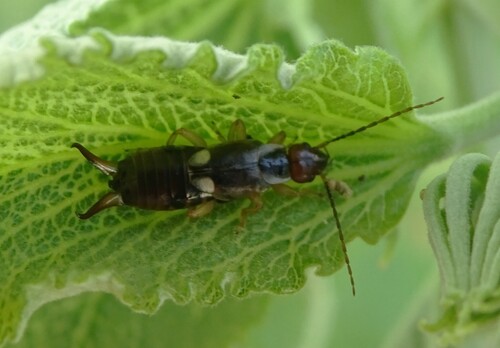
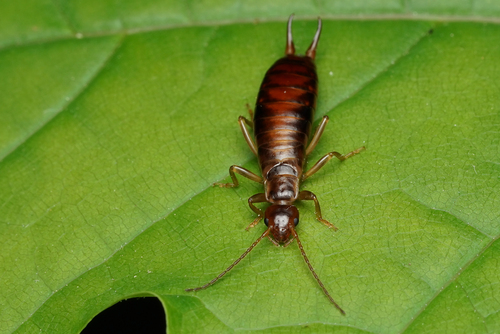
Forficula auricularia is a species complex comprising the common earwig. It is also known as the European earwig. It is an omnivorous insect belonging to the family Forficulidae. The name earwig comes from the appearance of the hindwings, which are unique in their resemblance to human ears when unfolded. The species name of the common earwig, auricularia, is a specific reference to this feature. The European earwig survives in a variety of environments. It is also a common household insect in North America. They are often considered a household pest because of their tendency to invade crevices in homes and consume pantry foods, though they may also act as beneficial species depending on the circumstances.

Forficula auricularia is reddish-brown in color with a flattened elongated body and slender beaded antennae. Earwigs possess pairs of pincers or forceps at the tip of the flexible abdomen. Both sexes have these pincers. In males, they are large and curved, whereas in females, they are straight. Nymphs are similar to adults in appearance, though their wings are either absent or small.

Forficula auricularia have elongated flattened brownish-colored bodies, with a shield... Wikipedia →

Global Distribution

Parks Where Found

# Park Country Daily sighting probability
1 Acadia National Park 🇺🇸 United States
~10%
2 Shenandoah National Park 🇺🇸 United States
~10%
3 Fertő-Hanság National Park 🇭🇺 Hungary
~10%
4 Bavarian Forest National Park 🇩🇪 Germany
~10%
5 Great Smoky Mountains National Park 🇺🇸 United States
<5%

Cities Where Found

# City Country Daily sighting probability
1 Turin 🇮🇹 Italy
~10%
2 Warsaw 🇵🇱 Poland
~10%
3 Sofia 🇧🇬 Bulgaria
~10%
4 Budapest 🇭🇺 Hungary
~10%
5 Boston 🇺🇸 United States
~10%
6 Chicago 🇺🇸 United States
~10%
7 Baltimore 🇺🇸 United States
~10%
8 Detroit 🇺🇸 United States
~10%
9 Kyiv 🇺🇦 Ukraine
~10%
10 Philadelphia 🇺🇸 United States
~10%

Before you go

What are the chances of seeing a European Earwig in Bavarian Forest National Park?

With luck

About 10% of wildlife watchers report a European Earwig sighting in Bavarian Forest National Park on a given day, based on 9 verified sightings from GBIF citizen-science data from 2019 to 2026. It is the 585th most-seen of the 1115 insects we can rate there. Over three days the chance rises to about 20%, and over a week to about 30%, if each day is a fresh chance.

When is the best time to see a European Earwig in Bavarian Forest National Park?

March, May–June, August and November

In those months about 10% of wildlife watchers report a European Earwig in Bavarian Forest National Park on a given day, against under 5% in April, July, September–October and December–February, the lowest months.

What time of day is best to see a European Earwig?

Between 8 and 11 pm

Across all the parks we cover, that three-hour window holds the most European Earwig sightings with a recorded time, and about 6 in 10 of them come between 6 pm and 6 am: it is seen both by day and at night.

Is Bavarian Forest National Park the best place to see a European Earwig?

Among the best

Of the 5 parks where we can rate European Earwig sightings, Bavarian Forest National Park ranks 4th at about 10%, level with the leaders once rounded. The best odds are in Acadia National Park (United States, about 10%), Shenandoah National Park (United States, about 10%) and Fertő-Hanság National Park (Hungary, about 10%).

Where does the European Earwig sighting chance come from?

GBIF citizen-science records

It is estimated from how often the European Earwig is recorded against all the insects logged in Bavarian Forest National Park (9 verified sightings from 2019 to 2026), calibrated against known sighting rates. Figures are rounded to the nearest 10% because citizen-science data supports honest approximations, not decimals, and months with records from fewer than five people show "—". How it works.

← Back to Bavarian Forest National Park