Smooth Newt

Smooth Newt

Lissotriton vulgaris

Silhouette: Kryp · PhyloPic

LCLeast ConcernNTVUENCR
Daily sighting probability ~10% · With luck
at Bavarian Forest National Park

In 3 days ~30% in a week ~60%

13 Verified sightings at Bavarian Forest National Park From 2019 to 2026
85 In all 5 parks
October Best month
🌅 Crepuscular When it's spotted

About the Smooth Newt

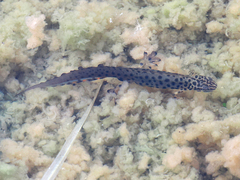
The smooth newt, European newt, northern smooth newt or common newt (Lissotriton vulgaris) is a species of newt. It is widespread in Europe and parts of Asia, and has also been introduced to Australia. Individuals are brown with a spotted underside that ranges in colour from orange to white. They reach an average length of 8–11 cm (3.1–4.3 in), with males being larger than females. The newts' skins are dry and velvety when they are living on land, but become smooth when they migrate into the water to breed. Males develop a more vivid colour pattern and a conspicuous skin seam (crest) on their back during the breeding season.

The smooth newt was originally described by Carl Linnaeus as a lizard, and was then given different genus names before being classified as a member of Lissotriton. There are currently three accepted subspecies of smooth newt. Formerly, there were also four subspecies—all with more restricted ranges that are now classified as separate species, because they have been found to be distinct genetically as well as in appearance: the Caucasian smooth newt, the Greek smooth newt, Kosswig's smooth newt and Schmidtler's smooth newt. Together with these four species and the Carpathian newt, the smooth newt forms what is known as a species complex: some of the species hybridise with each other.

For most of the year, smooth newts live on land, are mostly nocturnal, and hide during the day. They can adapt to a wide range of natural or semi-natural habitats, from forests at field edges to parks and gardens. Their diet consists mainly of invertebrates such as insects and earthworms and they are mainly preyed upon by fish, birds and snakes. Between spring and summer, they breed in ponds or similar bodies of water. Males court females with a ritualised underwater display. Females lay their eggs on water plants, and larvae hatch after 10 to 20 days. The larvae develop for around three months before metamorphosing into terrestrial juveniles, at which point they become known as efts. They reach maturity after two to three years, and the adults live for up to 14 years.

The smooth newt is abundant over much of its range and is classified as a species of least concern by the International Union for Conservation of Nature (IUCN). However, it has been negatively affected by habitat destruction and fragmentation, as well as the introduction of new species of fish. Like other European amphibians, the smooth newt has now been listed as a protected species by the Berne Convention. Wikipedia →

Sounds

Recording0:10

Sweden · 2021

© Elin Korall · iNaturalist · CC BY-NC 4.0

Global Distribution

Parks Where Found

# Park Country Daily sighting probability
1 Kiskunság National Park 🇭🇺 Hungary
~30%
2 Snowdonia National Park 🇬🇧 United Kingdom
~10%
3 Wadden Sea National Park 🇩🇪 Germany
~10%
4 Bavarian Forest National Park 🇩🇪 Germany
~10%
5 Fertő-Hanság National Park 🇭🇺 Hungary
~10%

Cities Where Found

# City Country Daily sighting probability
1 London 🇬🇧 United Kingdom
~30%
2 Liverpool 🇬🇧 United Kingdom
~30%
3 Birmingham 🇬🇧 United Kingdom
~30%
4 Copenhagen 🇩🇰 Denmark
~30%
5 Vienna 🇦🇹 Austria
~20%
6 Budapest 🇭🇺 Hungary
~20%
7 Manchester 🇬🇧 United Kingdom
~20%
8 Berlin 🇩🇪 Germany
~20%
9 Essen 🇩🇪 Germany
~20%
10 Prague 🇨🇿 Czechia
~10%

Zoos & Centres Where Found

# Zoo / Centre Country
1 Slimbridge Wetland Centre 🇬🇧 United Kingdom In captivity
2 Alpenzoo Innsbruck 🇦🇹 Austria In captivity

Before you go

What are the chances of seeing a Smooth Newt in Bavarian Forest National Park?

With luck

About 10% of wildlife watchers report a Smooth Newt sighting in Bavarian Forest National Park on a given day, based on 13 verified sightings from GBIF citizen-science data from 2019 to 2026. It is the 8th most-seen of the 8 amphibians we can rate there. Over three days the chance rises to about 30%, and over a week to about 60%, if each day is a fresh chance.

When is the best time to see a Smooth Newt in Bavarian Forest National Park?

April and October

In those months about 20% of wildlife watchers report a Smooth Newt in Bavarian Forest National Park on a given day, against under 5% in June–August and November–February, the lowest months.

What time of day is best to see a Smooth Newt?

Between 7 and 10 pm

Across all the parks we cover, that three-hour window holds the most Smooth Newt sightings with a recorded time, and about 6 in 10 of them come between 6 am and 6 pm: it is most active around dawn and dusk.

Is Bavarian Forest National Park the best place to see a Smooth Newt?

4th of 5

Of the 5 parks where we can rate Smooth Newt sightings, Bavarian Forest National Park ranks 4th at about 10%. The best odds are in Kiskunság National Park (Hungary, about 30%), Snowdonia National Park (United Kingdom, about 10%) and Wadden Sea National Park (Germany, about 10%).

Which relatives of the Smooth Newt live in Bavarian Forest National Park?

Same family: Salamandridae

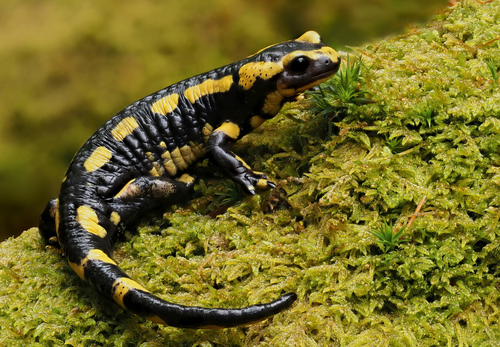
The closest relatives of the Smooth Newt that you can see in Bavarian Forest National Park (family Salamandridae, True Salamanders and Newts) are Fire Salamander (about 40%) and Alpine Newt (about 20%), with each one's daily chance of a sighting.

Where does the Smooth Newt sighting chance come from?

GBIF citizen-science records

It is estimated from how often the Smooth Newt is recorded against all the amphibians logged in Bavarian Forest National Park (13 verified sightings from 2019 to 2026), calibrated against known sighting rates. Figures are rounded to the nearest 10% because citizen-science data supports honest approximations, not decimals, and months with records from fewer than five people show "—". How it works.

← Back to Bavarian Forest National Park