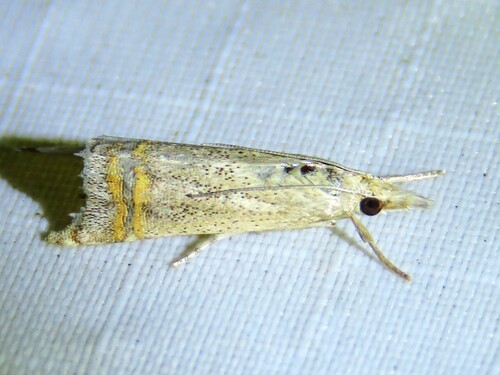
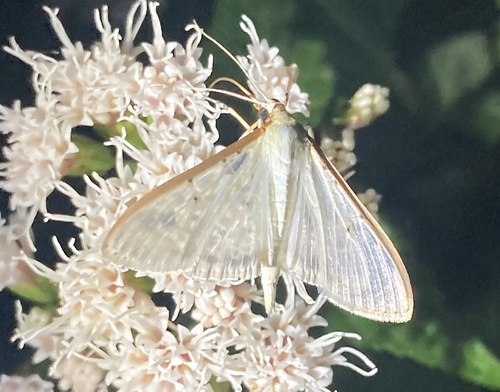
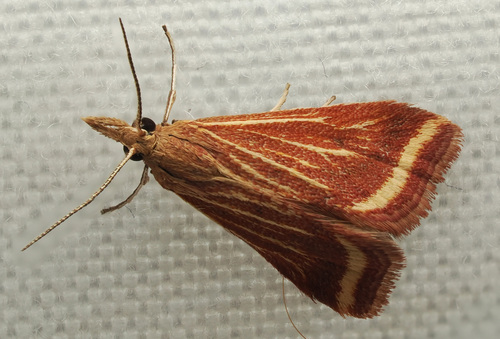
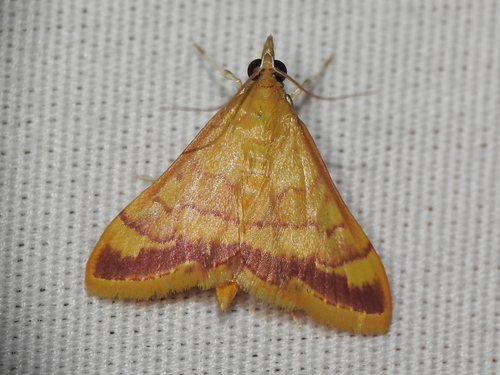
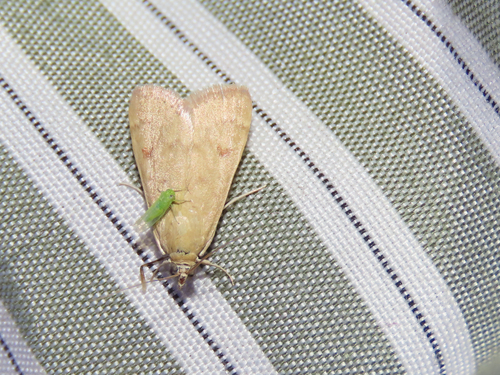
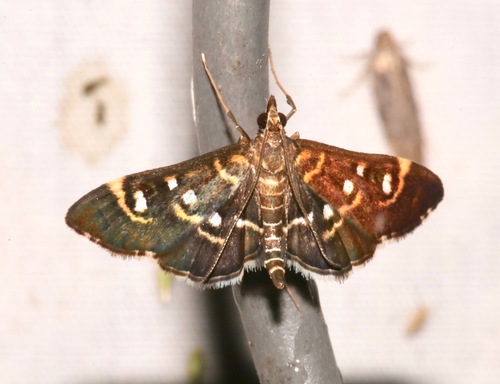
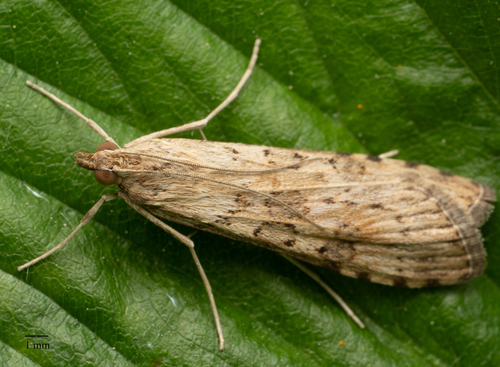
Belted Grass-Veneer

Belted Grass-Veneer

Euchromius ocellea

Daily sighting probability ~10% · With luck
at Big Bend National Park

In 3 days ~20% in a week ~40%

14 Verified sightings at Big Bend National Park From 2019 to 2026
14 In 1 park
September Best month
🌙 Nocturnal When it's spotted

About the Belted Grass-Veneer

Euchromius ocellea, the necklace veneer or belted grass-veneer, is a cosmopolitan migratory species of moth of the family Crambidae, first described by Adrian Hardy Haworth in 1811. It has Hodges number 5454. The species has a cosmopolitan distribution. It is widespread in tropical and subtropical regions, while it is a rare migrant in some other parts of its range, such as the UK and the Netherlands.

Larvae of Euchromius ocellea have a white body with amber pinacula and a pale amber head, and grow to a length of 18–20 mm. They feed on maize (Zea mays) and sorghum (Sorghum bicolor). Euchromius ocellea has a wingspan of 13–27 mm.

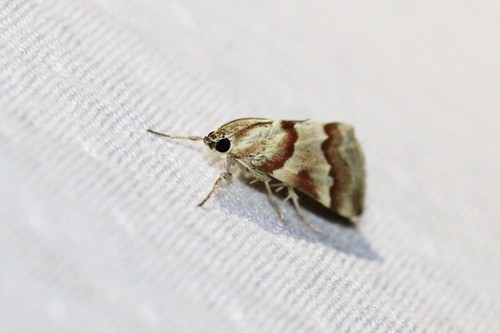
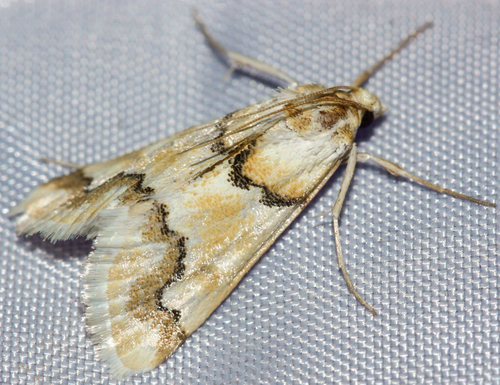
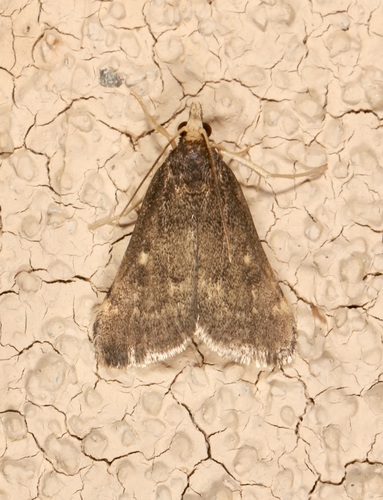
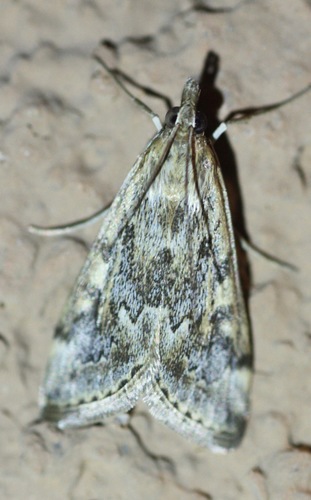
The ground colour of the forewings was given by Schouten as creamy white with a dense suffusion of ochreous to dark brown scales; while Goater described it as pale greyish ochreous. The forewings have a number of markings, including two medial bands, a subterminal line, a white patch near the terminal area, and a number of black dots in the terminal area. Goater additionally mentions fine silver streaking on the entire wing; golden metallic spots near the black terminal dots; and, in male... Wikipedia →

Global Distribution

Parks Where Found

# Park Country Daily sighting probability
1 Big Bend National Park 🇺🇸 United States
~10%

More parks will be added in future updates.

Cities Where Found

# City Country Daily sighting probability
1 Austin 🇺🇸 United States
~10%
2 Dallas 🇺🇸 United States
~10%
3 Kharkiv 🇺🇦 Ukraine
~10%
4 Houston 🇺🇸 United States
~10%
5 Bucharest 🇷🇴 Romania
~10%
6 Kyiv 🇺🇦 Ukraine
~10%
7 San Antonio 🇺🇸 United States
<5%
8 Portland 🇺🇸 United States
<5%
9 Monterrey 🇲🇽 México
<5%
10 San Diego 🇺🇸 United States
<5%

Before you go

What are the chances of seeing a Belted Grass-Veneer in Big Bend National Park?

With luck

About 10% of wildlife watchers report a Belted Grass-Veneer sighting in Big Bend National Park on a given day, based on 14 verified sightings from GBIF citizen-science data from 2019 to 2026. It is the 141st most-seen of the 329 insects we can rate there. Over three days the chance rises to about 20%, and over a week to about 40%, if each day is a fresh chance.

When is the best time to see a Belted Grass-Veneer in Big Bend National Park?

September

In that month about 20% of wildlife watchers report a Belted Grass-Veneer in Big Bend National Park on a given day, against under 5% in May–July and December–February, the lowest months. That is one of Big Bend National Park's wettest months, with about 50 mm of rain against 10 mm in April.

What time of day is best to see a Belted Grass-Veneer?

Between 8 and 11 pm

Across all the parks we cover, that three-hour window holds the most Belted Grass-Veneer sightings with a recorded time, and about 9 in 10 of them come between 6 pm and 6 am: it is mostly seen at night.

Where else can you see a Belted Grass-Veneer?

Only Big Bend National Park, in our data

Big Bend National Park is the only park on Wallace's Line with enough records to rate Belted Grass-Veneer sightings: about 10% of wildlife watchers there report one on a given day.

Where does the Belted Grass-Veneer sighting chance come from?

GBIF citizen-science records

It is estimated from how often the Belted Grass-Veneer is recorded against all the insects logged in Big Bend National Park (14 verified sightings from 2019 to 2026), calibrated against known sighting rates. Figures are rounded to the nearest 10% because citizen-science data supports honest approximations, not decimals, and months with records from fewer than five people show "—". How it works.

← Back to Big Bend National Park