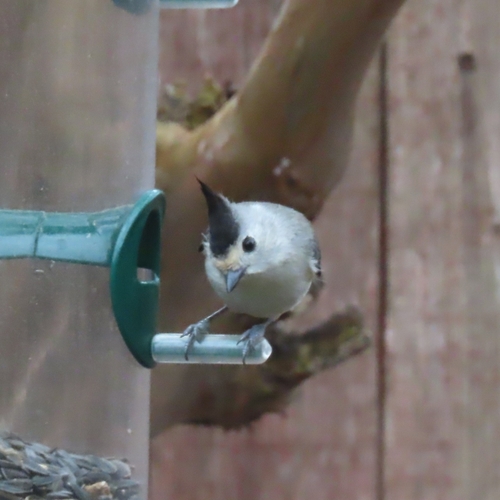
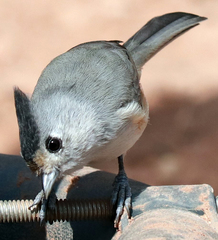
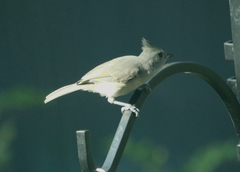


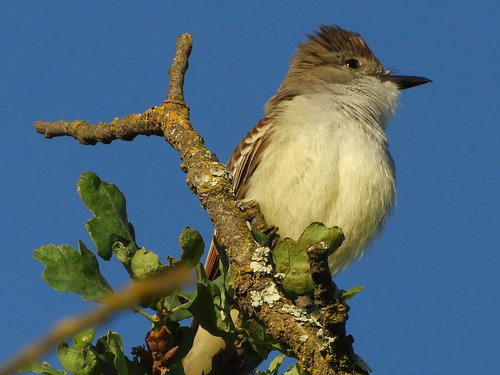
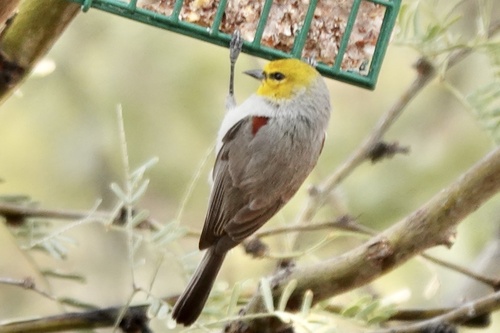
Black-crested Titmouse

Black-crested Titmouse

Baeolophus atricristatus

Silhouette: Sheatherius · PhyloPic

LCLeast ConcernNTVUENCR
Daily sighting probability ~30% · Possible
at Big Bend National Park

In 3 days ~70% in a week ~90%

2,053 Verified sightings at Big Bend National Park From 2019 to 2026
3,822 In all 2 parks
August Best month
☀️ Diurnal When it's spotted

About the Black-crested Titmouse

The black-crested titmouse or Mexican titmouse (Baeolophus atricristatus), is a passerine bird in the family Paridae, the tits and chickadees. It is found in Mexico and the U. S. states of Oklahoma and Texas and as a vagrant in at least one other state.

The black-crested titmouse was originally described in 1850 as Parus atricristatus. It was later reassigned to its present genus Baeolophus that was erected in 1851. Still later it was treated as conspecific with the tufted titmouse (B. bicolor). As early as 1988 it was treated by some taxonomists as a separate species and the American Ornithological Society did so in 2002. The black-crested and tufted titmice hybridize in a narrow zone in Oklahoma and Texas.

The black-crested titmouse has these three subspecies: It is a moderately large member of its family and has a distinct crest. The sexes have the almost the same plumage. Adult males of the nominate subspecies B. a. atricristatus have the eponymous... Wikipedia →

Sounds

Song0:18

United States · 2024

© David Tattersley · XC900110 · CC BY-NC-SA 4.0

Alarm call0:21

United States · 2022

© Gregory Askew · XC756330 · CC BY-NC-SA 4.0

Recording0:08

Mexico · 2022

© Ivann Romero · XC740221 · CC BY-NC-SA 4.0

Global Distribution

Parks Where Found

# Park Country Daily sighting probability
1 Cumbres de Monterrey National Park 🇲🇽 Mexico
~70%
2 Big Bend National Park 🇺🇸 United States
~30%

Cities Where Found

# City Country Daily sighting probability
1 San Antonio 🇺🇸 United States
~60%
2 Austin 🇺🇸 United States
~40%
3 Monterrey 🇲🇽 México
~20%

Before you go

What are the chances of seeing a Black-crested Titmouse in Big Bend National Park?

Possible

About 30% of wildlife watchers report a Black-crested Titmouse sighting in Big Bend National Park on a given day, based on 2,053 verified sightings from GBIF citizen-science data from 2019 to 2026. It is the 27th most-seen of the 270 birds we can rate there. Over three days the chance rises to about 70%, and over a week to about 90%, if each day is a fresh chance.

When is the best time to see a Black-crested Titmouse in Big Bend National Park?

May and August

In those months about 50% of wildlife watchers report a Black-crested Titmouse in Big Bend National Park on a given day, against about 20% in September to February, the lowest months. Those are among Big Bend National Park's wettest months, with about 35 mm of rain a month against 10 mm in April.

What time of day is best to see a Black-crested Titmouse?

Between 9 am and noon

Across all the parks we cover, that three-hour window holds the most Black-crested Titmouse sightings with a recorded time, and about 8 in 10 of them come between 6 am and 6 pm: it is a daytime animal.

Is Big Bend National Park the best place to see a Black-crested Titmouse?

2nd of 2

Of the 2 parks where we can rate Black-crested Titmouse sightings, Big Bend National Park ranks 2nd at about 30%. The best odds are in Cumbres de Monterrey National Park (Mexico, about 70%).

Which relatives of the Black-crested Titmouse live in Big Bend National Park?

Same order: Passeriformes

The closest relatives of the Black-crested Titmouse that you can see in Big Bend National Park (order Passeriformes, Perching Birds) are Common Raven (about 70%), Northern Mockingbird (about 60%) and Cactus Wren (about 50%), with each one's daily chance of a sighting.

Where does the Black-crested Titmouse sighting chance come from?

GBIF citizen-science records

It is estimated from how often the Black-crested Titmouse is recorded against all the birds logged in Big Bend National Park (2,053 verified sightings from 2019 to 2026), calibrated against known sighting rates. Figures are rounded to the nearest 10% because citizen-science data supports honest approximations, not decimals, and months with records from fewer than five people show "—". How it works.

← Back to Big Bend National Park