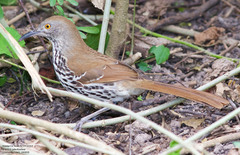
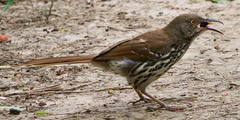
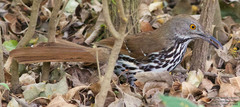
Long-billed Thrasher

Long-billed Thrasher

Toxostoma longirostre

Silhouette: Sheatherius · PhyloPic

LCLeast ConcernNTVUENCR
Daily sighting probability <5% · Rare
at Big Bend National Park

In 3 days <5%

8 Verified sightings at Big Bend National Park From 2019 to 2026
393 In all 2 parks
November Best month
☀️ Diurnal When it's spotted

About the Long-billed Thrasher

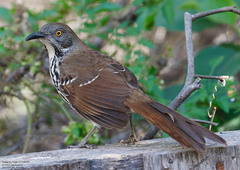
The long-billed thrasher (Toxostoma longirostre) is a medium-sized resident songbird of South Texas and eastern Mexico. It bears a strong resemblance to its close relative the brown thrasher in appearance, calls, and various other behaviors; however, the two species do not overlap in range except in the winter when the brown thrasher will temporarily reside in the northern range of the long-billed.

The bird is a large sized mimid that is not especially wary, but it will take precautionary measures to prevent itself from being potential prey. Like other thrashers, it is named after its sweeping methods when searching for food, not for thrashing predators, although they are aggressive defenders of their territories.

The specific name longirostre is derived from the Latin words longus long and rostrum bill. There are two subspecies of the long-billed thrasher. T. longirostre ssp. longirostre was first described in scientific literature by Frédéric de Lafresnaye in 1838 as Orpheus longirostris, while T. longirostre ssp. sennitti was described by Robert Ridgway a half-century later.

T. longirostre ssp. longirostre (Lafresnaye, 1838). Range is in eastern Mexico, within the... Wikipedia →

Sounds

Song0:09

Mexico · 2017

© Joren van Schie · XC1078781 · CC BY-NC-SA 4.0

Uncertain0:12

Mexico · 2024

© Leonardo Guzman Hernandez · XC914439 · CC BY-NC-SA 4.0

Call0:22

United States · 2020

© Scott Gravette · XC609827 · CC BY-NC-SA 4.0

Global Distribution

Parks Where Found

# Park Country Daily sighting probability
1 Cumbres de Monterrey National Park 🇲🇽 Mexico
~20%
2 Big Bend National Park 🇺🇸 United States
<5%

Cities Where Found

# City Country Daily sighting probability
1 San Antonio 🇺🇸 United States
~20%
2 Monterrey 🇲🇽 México
~10%
3 Houston 🇺🇸 United States
<5%

Before you go

What are the chances of seeing a Long-billed Thrasher in Big Bend National Park?

Rare

Under 5% of wildlife watchers report a Long-billed Thrasher sighting in Big Bend National Park on a given day, based on 8 verified sightings from GBIF citizen-science data from 2019 to 2026. It is the 263rd most-seen of the 270 birds we can rate there. Over three days the chance rises to under 5%, if each day is a fresh chance.

When is the best time to see a Long-billed Thrasher in Big Bend National Park?

Any time of year

In every month with enough records, under 5% of wildlife watchers report a Long-billed Thrasher in Big Bend National Park on a given day, so our monthly data shows no clear season.

What time of day is best to see a Long-billed Thrasher?

Between 8 and 11 am

Across all the parks we cover, that three-hour window holds the most Long-billed Thrasher sightings with a recorded time, and about 9 in 10 of them come between 6 am and 6 pm: it is a daytime animal.

Is Big Bend National Park the best place to see a Long-billed Thrasher?

2nd of 2

Of the 2 parks where we can rate Long-billed Thrasher sightings, Big Bend National Park ranks 2nd at under 5%. The best odds are in Cumbres de Monterrey National Park (Mexico, about 20%).

Which relatives of the Long-billed Thrasher live in Big Bend National Park?

Same genus: Toxostoma

The closest relatives of the Long-billed Thrasher that you can see in Big Bend National Park (genus Toxostoma, Typical Thrashers) are Curve-billed Thrasher (about 20%) and Crissal Thrasher (about 20%), with each one's daily chance of a sighting.

Where does the Long-billed Thrasher sighting chance come from?

GBIF citizen-science records

It is estimated from how often the Long-billed Thrasher is recorded against all the birds logged in Big Bend National Park (8 verified sightings from 2019 to 2026), calibrated against known sighting rates. Figures are rounded to the nearest 10% because citizen-science data supports honest approximations, not decimals, and months with records from fewer than five people show "—". How it works.

← Back to Big Bend National Park