Marbled Whiptail

Marbled Whiptail

Aspidoscelis marmoratus

Silhouette: Jose Carlos Arenas-Monroy · PhyloPic

Daily sighting probability ~30% · Possible
at Big Bend National Park

In 3 days ~70% in a week ~90%

182 Verified sightings at Big Bend National Park From 2019 to 2026
182 In 1 park
September Best month
☀️ Diurnal When it's spotted

About the Marbled Whiptail

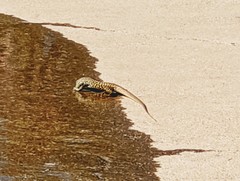
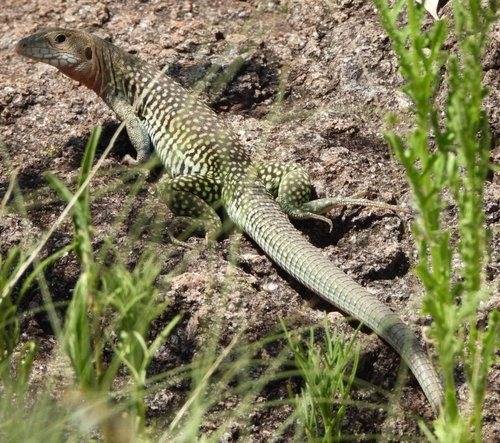
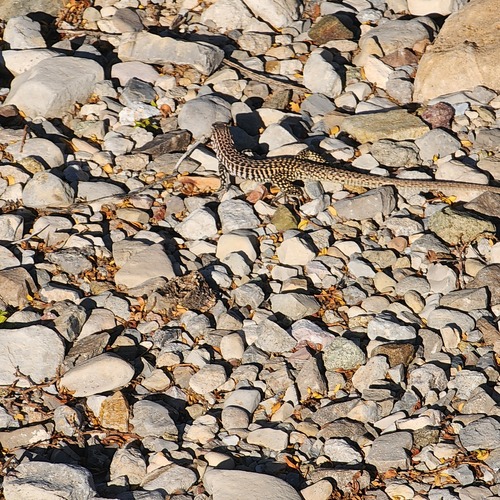
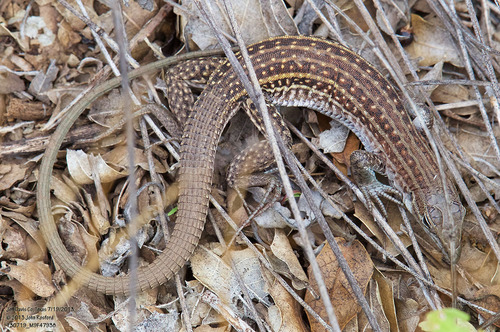
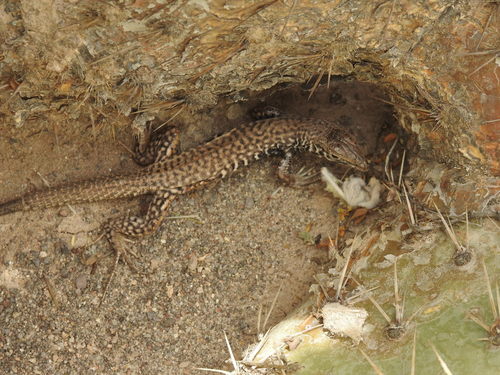
The marbled whiptail (Aspidoscelis marmoratus) is a species of lizard found in the United States, in southern New Mexico and Texas, and in northern Mexico, in Coahuila, Chihuahua and Durango. The marbled whiptail grows from 8 to 12 inches in length. It is grey or black overall in color with 4 to 8 yellow or white stripes, often with dark mottling, giving it a marbled appearance. Their underside is white or pale yellow, with a peach coloration on the throat. They are slender bodied, with long tails.

Like most other species of whiptail lizards, the marbled whiptail is diurnal and insectivorous. It is wary, energetic, and fast moving, darting for cover if approached. Its preferred habitat is semiarid, sandy areas with sparse vegetation, or the open edges of wooded areas. Breeding takes place in the spring, with up to four eggs laid sometime between the months of May and August, hatch happening usually in August during the wet season. The eggs hatch in six to eight weeks. A second clutch of eggs is occasionally laid in mid summer. Hatchlings look much like the adults, except they have bright blue colored tails.

Facultative... Wikipedia →
Global Distribution

Parks Where Found

# Park Country Daily sighting probability
1 Big Bend National Park 🇺🇸 United States
~30%

More parks will be added in future updates.

Before you go

What are the chances of seeing a Marbled Whiptail in Big Bend National Park?

Possible

About 30% of wildlife watchers report a Marbled Whiptail sighting in Big Bend National Park on a given day, based on 182 verified sightings from GBIF citizen-science data from 2019 to 2026. It is the 4th most-seen of the 48 reptiles we can rate there. Over three days the chance rises to about 70%, and over a week to about 90%, if each day is a fresh chance.

When is the best time to see a Marbled Whiptail in Big Bend National Park?

September

In that month about 60% of wildlife watchers report a Marbled Whiptail in Big Bend National Park on a given day, against under 5% in December to February, the lowest months. That is one of Big Bend National Park's wettest months, with about 50 mm of rain against 10 mm in April.

What time of day is best to see a Marbled Whiptail?

Between 9 am and noon

Across all the parks we cover, that three-hour window holds the most Marbled Whiptail sightings with a recorded time, and about 9 in 10 of them come between 6 am and 6 pm: it is a daytime animal.

Where else can you see a Marbled Whiptail?

Only Big Bend National Park, in our data

Big Bend National Park is the only park on Wallace's Line with enough records to rate Marbled Whiptail sightings: about 30% of wildlife watchers there report one on a given day.

Where does the Marbled Whiptail sighting chance come from?

GBIF citizen-science records

It is estimated from how often the Marbled Whiptail is recorded against all the reptiles logged in Big Bend National Park (182 verified sightings from 2019 to 2026), calibrated against known sighting rates. Figures are rounded to the nearest 10% because citizen-science data supports honest approximations, not decimals, and months with records from fewer than five people show "—". How it works.

← Back to Big Bend National Park