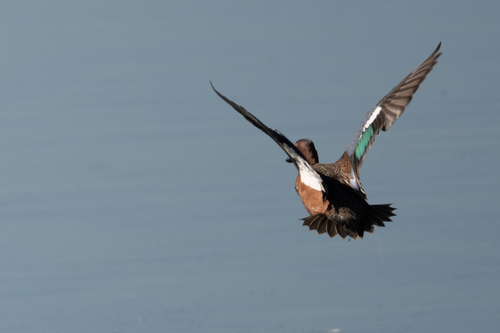
Mexican Duck

Mexican Duck

Anas diazi

Silhouette: Sheatherius · PhyloPic

Daily sighting probability ~10% · With luck
at Big Bend National Park

In 3 days ~30% in a week ~50%

486 Verified sightings at Big Bend National Park From 2019 to 2026
537 In all 2 parks
March Best month
☀️ Diurnal When it's spotted

About the Mexican Duck

The Mexican duck (Anas diazi) is a species of dabbling duck that breeds in Mexico and the southwestern United States. Most of the population is resident, but some northern birds migrate south to Mexico in winter. The species also occurs widely, but in limited numbers, in Colorado in all seasons and there are photographs of birds referable to this taxon from Utah, Wyoming, Nebraska, and Montana.

Mexican Ducks reside in almost all aquatic habitats. The bird has a length of 45–55 cm (17.7–21.6 in) and a weight of 849–1,243 g (1.872–2.740 lb) The Mexican duck is mainly brown, with a blue speculum edged with white, obvious in flight or at rest. The male has a brighter yellow bill than the female.

The Mexican duck was considered a subspecies of the mallard, as Anas platyrhynchos diazi until 2020, when the American Ornithological Society determined the Mexican Duck to be its own species. Analysis of mtDNA control region sequence data—taking into account hybridization events—indicates it is the southwestern relative of the American black duck and shares a fairly recent common ancestry with this species (McCracken et al. 2001).... Wikipedia →

Sounds

Call0:34

United States · 2024

© Richard E. Webster · XC941124 · CC BY-NC-SA 4.0

Flight call0:08

Mexico · 2022

© Manuel Grosselet · XC737174 · CC BY-NC-SA 4.0

Alarm call0:32

Mexico · 2020

© Isain Contreras Rodríguez · XC531189 · CC BY-NC-SA 4.0

Global Distribution

Parks Where Found

# Park Country Daily sighting probability
1 Big Bend National Park 🇺🇸 United States
~10%
2 Saguaro National Park 🇺🇸 United States
<5%

Cities Where Found

# City Country Daily sighting probability
1 Ciudad Juárez 🇲🇽 México
~80%
2 Puebla 🇲🇽 México
~40%
3 Mexico City 🇲🇽 México
~40%
4 León 🇲🇽 México
~30%
5 Toluca 🇲🇽 México
~20%
6 San Luis Potosí 🇲🇽 México
~20%
7 Torreón 🇲🇽 México
~10%
8 Guadalajara 🇲🇽 México
<5%
9 Mesa 🇺🇸 United States
<5%
10 Las Vegas 🇺🇸 United States
<5%

Zoos & Centres Where Found

# Zoo / Centre Country
1 Parque Zoológico de León - Zooleón 🇲🇽 Mexico In captivity
2 Chapultepec Zoo 🇲🇽 Mexico In captivity
3 Fish Spa Acuario Fantasia 🇲🇽 Mexico In captivity

Before you go

What are the chances of seeing a Mexican Duck in Big Bend National Park?

With luck

About 10% of wildlife watchers report a Mexican Duck sighting in Big Bend National Park on a given day, based on 486 verified sightings from GBIF citizen-science data from 2019 to 2026. It is the 86th most-seen of the 270 birds we can rate there. Over three days the chance rises to about 30%, and over a week to about 50%, if each day is a fresh chance.

When is the best time to see a Mexican Duck in Big Bend National Park?

September to May

In those months about 10% of wildlife watchers report a Mexican Duck in Big Bend National Park on a given day, against under 5% in June to August, the lowest months.

What time of day is best to see a Mexican Duck?

Between 9 am and noon

Across all the parks we cover, that three-hour window holds the most Mexican Duck sightings with a recorded time, and about 8 in 10 of them come between 6 am and 6 pm: it is a daytime animal.

Is Big Bend National Park the best place to see a Mexican Duck?

Yes

Of the 2 parks where we can rate Mexican Duck sightings, Big Bend National Park has the highest daily chance: about 10%. Next come Saguaro National Park (United States, under 5%).

Where does the Mexican Duck sighting chance come from?

GBIF citizen-science records

It is estimated from how often the Mexican Duck is recorded against all the birds logged in Big Bend National Park (486 verified sightings from 2019 to 2026), calibrated against known sighting rates. Figures are rounded to the nearest 10% because citizen-science data supports honest approximations, not decimals, and months with records from fewer than five people show "—". How it works.

← Back to Big Bend National Park