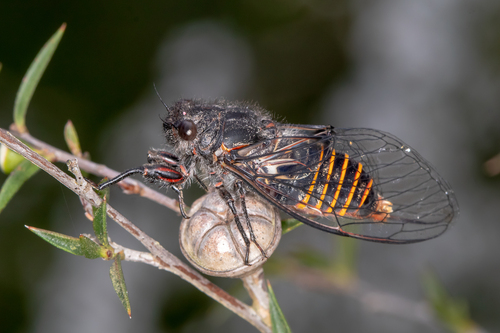
About the Bronze Orange Bug
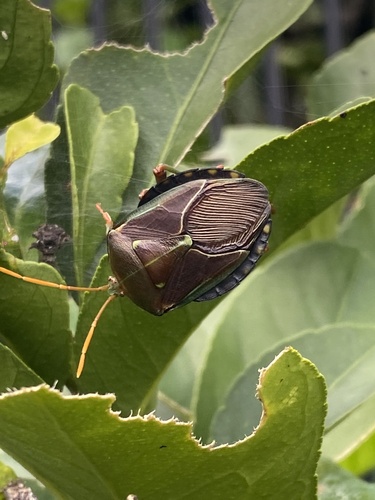
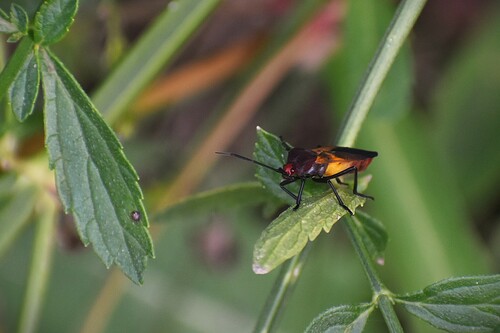
Musgraveia sulciventris is a Tessaratomid bug found in Australia, sometimes known as the bronze orange bug. It is considered a pest, particularly to plants in the citrus group. Bronze orange bugs suck the sap from trees, which causes the flowers and fruit to fall.
In 1863, Swedish entomologist Carl Stål described the species as Oncoscelis sulciventris from a collection near Moreton Bay in Queensland. In 1957, English entomologists Dennis Leston and G.G.E. Scudder reclassified the bronze orange bug as Musgraveia sulciventris, due to reorganization of Oncoscelis and related genera. It is the type species of the genus Musgraveia and in the Tessaratomidae family.
Bronze orange bugs are first found on trees in late winter. Mating takes place between late November through early March. Each mating pair takes 3 to 5 days to produce 10 to 14 eggs. The female lays up to four clutches of eggs and deposits them on the undersurface of a leaf. The bright green spherical eggs are around 2.5 mm (0.1 in) in diameter. The incubation period varies based on current weather conditions. Hatching averages around 7.4 days at 25 °C and 6 percent humidity. As a... Wikipedia →